FNGU: Who Runs This Leveraged ETN and Why the Relationships Matter
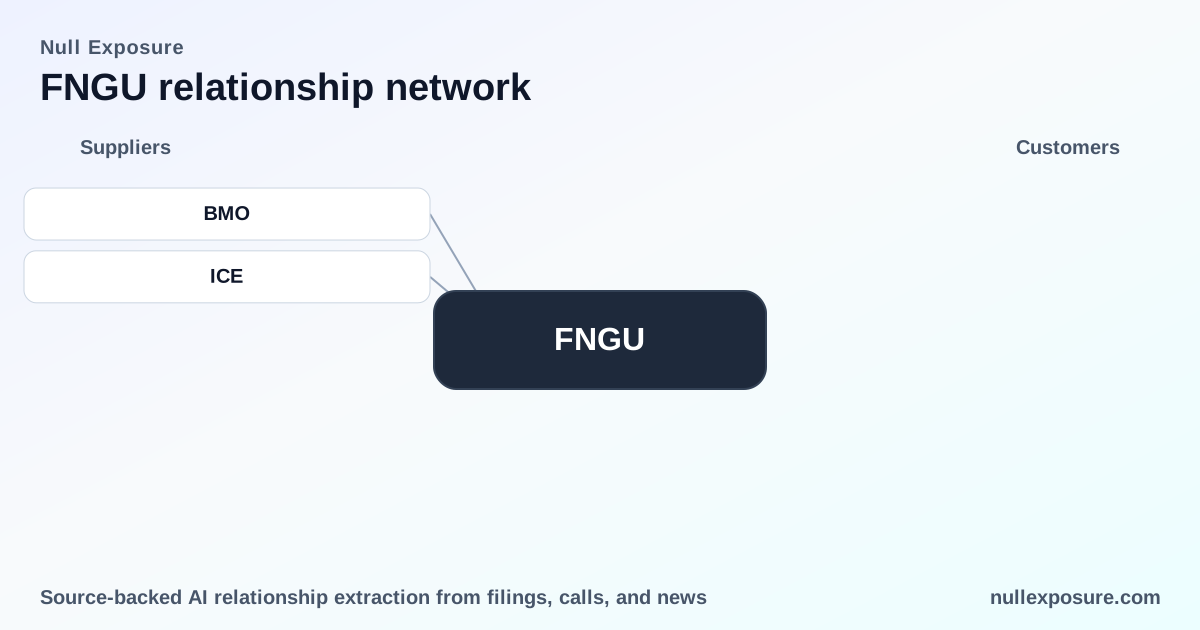
FNGU is a 3x leveraged exchange-traded note that generates value through structured issuance and market distribution rather than traditional asset management. Bank of Montreal issues and structures the note, earns fees through ETN issuance and distribution mechanics, and relies on licensed index data and exchange listing to deliver the product to investors. For investors and counterparties evaluating supplier exposure, the economics and risks of FNGU track directly to the issuer, the index licensor, and the exchange where it trades. For a quick dive into supplier risk and operational posture, visit https://nullexposure.com/.
How FNGU operates and where the fees come from
FNGU is an ETN: a debt instrument whose return is linked to a leveraged multiple of an index rather than a pooled fund of securities. The issuer—Bank of Montreal—structures the note, underwrites primary issuance and manages redemption mechanics, while the product depends on a licensed index for reference pricing and an exchange for distribution and liquidity. Revenues for BMO flow from issuance and the embedded issuer spread, while distribution and secondary market activity determine liquidity and investor access. Operationally, the product functions as a concentrated supplier network: issuer, index provider, and exchange carry outsized importance for continuity and performance.
Key relationships that drive economics and operational risk
Bank of Montreal — the issuer and operational hub
Bank of Montreal is the issuer of FNGU and handles registration, prospectus filings, and the mechanics of issuance and redemption. According to BMO’s newsroom release announcing redemption and ticker changes and new ETN launches, the bank filed the registration and related prospectus materials with the SEC for each series of ETNs (newsroom release, Feb 19, 2025: https://newsroom.bmo.com/2025-02-19-BMO-Announces-Upcoming-Redemption-and-Ticker-Symbol-Change-for-MicroSectorsTM-FANG-TM-Index-3x-Leveraged-ETNs-Ticker-FNGU-as-well-as-the-Launch-of-a-New-MicroSectorsTM-Exchange-Traded-Note-ETN-,-the-MicroSectorsTM-FANG-TM-3x-Leveraged-ETNs-Tick). Trading commentary and product pages also identify Bank of Montreal as the issuer under the REX MicroSectors brand (TradingView product overview, FY2018–FY2024: https://www.tradingview.com/symbols/AMEX-FNGU/ and https://www.tradingview.com/symbols/AMEX-FNGU/analysis/). Issuer credit, disclosure quality, and the structure of registration documents are the dominant commercial levers for suppliers and investors.
ICE Data Indices, LLC — index licensor and pricing backbone
The underlying benchmark for FNGU is the NYSE FANG+ Index, a product of ICE Data Indices which FNGU uses under license. BMO’s announcement explicitly states that the NYSE FANG+® Index is a product of ICE Data Indices and is used with permission (BMO newsroom release, Feb 19, 2025: https://newsroom.bmo.com/2025-02-19-BMO-Announces-Upcoming-Redemption-and-Ticker-Symbol-Change-for-MicroSectorsTM-FANG-TM-Index-3x-Leveraged-ETNs-Ticker-FNGU-as-well-as-the-Launch-of-a-New-MicroSectorsTM-Exchange-Traded-Note-ETN-,-the-MicroSectorsTM-FANG-TM-3x-Leveraged-ETNs-Tick). Index licensing is structurally critical: pricing permissions, index methodology changes, or licensing disputes have direct product and disclosure consequences.
NYSE — listing venue and liquidity conduit
FNGU trades on an exchange venue and BMO’s communications reference NYSE listing activity for related ETN series, including trading under similar tickers in product conversion or relaunch events (BMO newsroom release, Feb 19, 2025; NYSE trading notices cited in the same release: https://newsroom.bmo.com/2025-02-19-BMO-Announces-Upcoming-Redemption-and-Ticker-Symbol-Change-for-MicroSectorsTM-FANG-TM-Index-3x-Leveraged-ETNs-Ticker-FNGU-as-well-as-the-Launch-of-a-New-MicroSectorsTM-Exchange-Traded-Note-ETN-,-the-MicroSectorsTM-FANG-TM-3x-Leveraged-ETNs-Tick). Trading venue rules, quoting obligations, and ticker-level liquidity determine secondary-market execution quality and downstream margin and collateral dynamics for market-makers. Exchange listing and trading rules materially affect investor access and execution risk.
Company-level operating signals and constraints
Even in the absence of explicit constraint excerpts, the structure of FNGU implies several persistent supplier and operating characteristics investors should treat as company-level signals:
- Issuer-centric contracting posture. The issuer crafts prospectus terms, redemption mechanics, and product governance; supplier negotiations (index licensor, listing venue) are framed around issuer-led contracts.
- High counterparty concentration. A small group of counterparties (issuer, index licensor, exchange) control the product’s continuity and are therefore single points of failure for distribution and benchmark licensing.
- Operational criticality and maturity. ETN legal and operational frameworks are mature financial market primitives, so standard governance, disclosure and listing procedures govern continuity; that maturity reduces novelty risk but concentrates implementation risk in issuer and licensor performance.
- Commercial stickiness around licensing and listing. Index licensing and exchange access are strategic and contractual; changes to either require formal notices and filings and can produce rapid shifts in investor access or terms.
What these relationships mean for investors and suppliers
For counterparties—market-makers, custodians, index licensors, and service providers—exposure to FNGU is primarily exposure to issuer credit and to the continuity of licensing and listing arrangements. Suppliers should price in concentrated counterparty credit and operational reviews that prioritize issuer disclosures and ICE Data licensing agreements. For operators and investors, monitor BMO’s SEC filings and notices for redemption or ticker changes as they directly affect liquidity and tail-event mechanics (BMO registration filings and newsroom statements, FY2025: https://newsroom.bmo.com/2025-02-19-BMO-Announces-Upcoming-Redemption-and-Ticker-Symbol-Change-for-MicroSectorsTM-FANG-TM-Index-3x-Leveraged-ETNs-Ticker-FNGU-as-well-as-the-Launch-of-a-New-MicroSectorsTM-Exchange-Traded-Note-ETN-,-the-MicroSectorsTM-FANG-TM-3x-Leveraged-ETNs-Tick). Risk management should center on issuer credit, license continuity, and exchange trading mechanics.
If you focus on counterparty screening, documentation, or operational readiness linked to ETNs, get more supplier risk context at https://nullexposure.com/.
Practical next steps for counterparties and investors
- Review BMO’s prospectus and registration supplements for the series in question to confirm redemption features and fee mechanics (see BMO newsroom filing notice referenced above).
- Confirm index licensing terms with ICE Data for continuity, change-notice provisions, and index governance to understand pathway risk if methodology changes occur.
- Validate trading and quoting obligations with the exchange and market-makers to anticipate liquidity shifts during corporate actions or product transitions.
Bottom line
FNGU’s economic and operational profile is anchored in a concentrated supplier model: Bank of Montreal as issuer, ICE Data Indices as index licensor, and an exchange venue for distribution. For investors and operators, the clearest levers of product economics and risk are issuer credit and contractual relationships around index licensing and listing. For deeper supplier-risk intelligence and tailored counterparty analysis, visit https://nullexposure.com/.