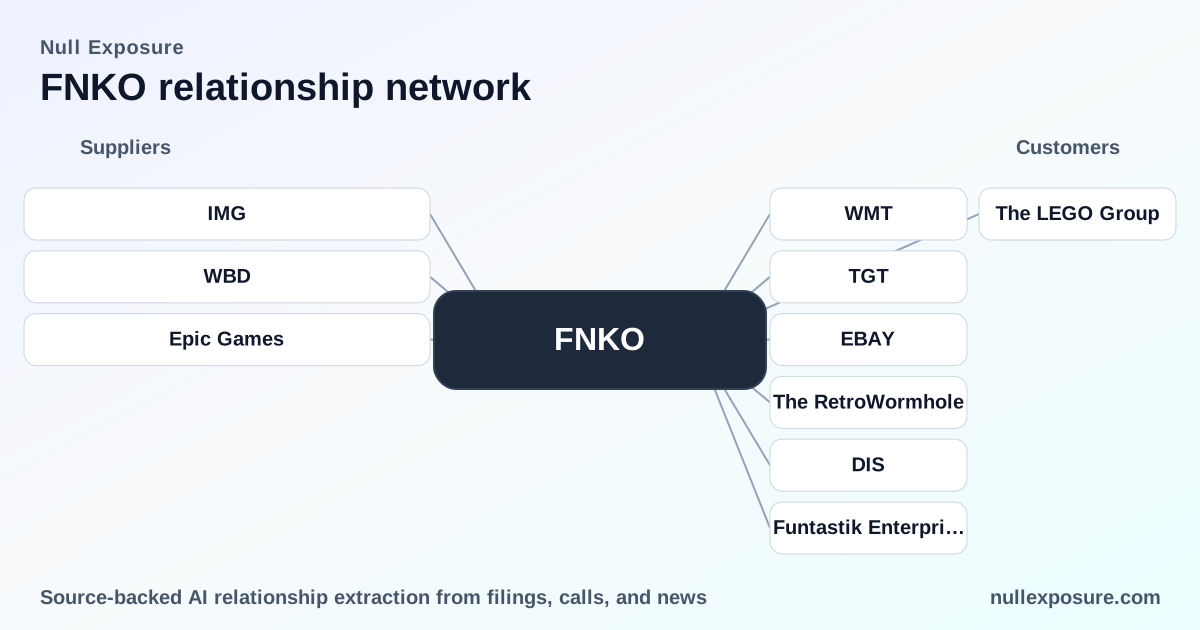
Funko’s supplier map and what it means for investors
Funko designs, licenses and distributes pop‑culture merchandise worldwide, monetizing through retail sales of proprietary and licensed products and through structured licensing payments to third‑party IP owners. The company outsources most manufacturing to third parties in Asia and Mexico, sells finished goods into retail channels and recognizes royalties and licensing costs against revenue — a model that drives high gross margins but exposes cash flow and margins to short‑term license renewals, concentrated manufacturing risk and sizable guaranteed royalty obligations.
Explore a compact supplier and partner dossier and the operational constraints that matter for valuation. For a broader supplier intelligence view visit https://nullexposure.com/.
How Funko’s commercial model works in practice
Funko’s economics are straightforward: it licenses intellectual property, pays royalties, contracts external manufacturers, and sells finished collectibles through global retail. Revenue (TTM $908M) and gross profit ($351M) reflect a licensing‑heavy assortment, but profitability is pressured (diluted EPS -$1.20, operating margin ~2.2% on reported data). The company reports meaningful committed royalty outflows — $68.6 million in minimum guaranteed royalties, heavily back‑loaded into 2025 — which creates a fixed cash obligation that compresses free cash flow if topline weakens.
Key financial signals: Price/Revenue ~0.26, EV/Revenue ~0.55, and negative trailing EPS, which together imply a recovery narrative priced into equity but constrained by working capital and licensing cadence.
Who Funko is working with (compact relationship summaries)
Below are plain‑English summaries for each partner and counterparty referenced in public sources.
IMG
Funko announced a partnership brokered by IMG to bring Fortnite‑themed toys and collectibles to market, with IMG acting as deal intermediary for the Epic Games collaboration (press release, 2018: https://www.globenewswire.com/news-release/2018/07/18/1538899/0/en/Funko-and-Epic-Games-Partner-to-Launch-Fortnite-Toys-and-Collectibles.html). This underscores Funko’s use of intermediaries to secure gaming IP deals.
Epic Games
Epic Games is a brand partner for a licensed Fortnite product line launched with Funko; the arrangement was publicized in a 2018 press release that highlights Funko’s strategy of turning major gaming franchises into retail product lines (GlobeNewswire, 2018: https://www.globenewswire.com/news-release/2018/07/18/1538899/0/en/Funko-and-Epic-Games-Partner-to-Launch-Fortnite-Toys-and-Collectibles.html).
Warner Bros. Discovery Global Consumer Products (WBD)
Funko and Warner Bros. Discovery Global Consumer Products announced a collaboration on the “Pop! Yourself” Harry Potter collection, illustrating Funko’s reliance on studio partnerships to access high‑value entertainment IP (Funko investor press release, 2024: https://investor.funko.com/news-and-events/press-releases/Press-Releases/2024/Funko-and-Warner-Bros.-Discovery-Unveil-Magical-Pop-Yourself-Collaboration-to-Captivate-All-Harry-Potter-Fans/default.aspx).
LGE Design Build
Funko signed a lease for an 860,000‑square‑foot industrial facility in Buckeye developed by LGE Design Build, showing expansion of U.S. warehousing/logistics capacity to support distribution (Phoenix Business Journal, Oct 2021: https://www.bizjournals.com/phoenix/news/2021/10/13/toymaker-lease-buckeye.html).
A.B. Data, Ltd. / A.B. Data Ltd.
A.B. Data is serving as settlement administrator in Funko securities and stockholder settlements, which indicates ongoing legal and claims administration activity requiring third‑party administrative support (claims portal references, FY2025–FY2026: https://www.claimdepot.com/settlements/funko-securities-settlement and https://www.claimdepot.com/settlements/funko-stockholder-settlement).
Dolphin Entertainment (DLPN) and related activations
Dolphin Entertainment and its subsidiaries amplified national media coverage for Funko’s limited‑edition Seattle Seahawks Pop! release during Super Bowl LX and led other activations such as 42West x Funko, demonstrating third‑party PR and marketing partnerships that drive episodic demand spikes (Globe and Mail and company releases, 2025–2026: https://www.theglobeandmail.com/investing/markets/stocks/DLPN/pressreleases/953913/dolphin-entertainment-reports-record-fourth-quarter-and-full-year-2025-results/ and https://www.newswire.com/news/dolphins-powerhouse-subsidiaries-lead-major-brand-activations-during-super-bowl).
GAINN
GAINN disclosed the sale of its remaining Funko shares in May 2024, recording a small realized gain and an exit of its investment in Funko, a sign of institutional turnover among holders (GAINN 10‑K filing excerpt, FY2025: gainn-2025-03-31).
(If you want a consolidated view of these partner relationships and what they imply for supplier exposure, see https://nullexposure.com/.)
Operational constraints that shape supplier and valuation risk
The supplier constraints disclosed by Funko have immediate investment relevance:
- Short‑term contracting posture: Funko does not maintain long‑term manufacturing contracts and its license agreements are typically two to three years and not automatically renewable, which creates recurring renewal risk and revenue volatility. This is a company‑level signal drawn from public disclosure about contract terms.
- Licensing‑heavy economics: Funko operates as a licensee for most of its IP and pays royalties calculated as a percentage of revenue; guaranteed minimum royalties are a material recurring cash commitment (company disclosures note royalty structures and minimum guarantees).
- Geographic manufacturing concentration: Production is focused in Vietnam, China and Mexico, with logistics hubs in the U.S., U.K. and Netherlands — a concentration that increases exposure to APAC supply‑chain disruptions and shipping constraints.
- Critical supplier dependence: The company explicitly states that loss or unavailability of a manufacturer or factory could have a materially negative impact, signaling high operational criticality for key third‑party manufacturers.
- Spend magnitude: Minimum guaranteed royalty obligations total $68.6 million, with $64.2 million due in 2025, indicating material fixed cash outflows that compress liquidity if sales soften.
- Relationship roles and maturity: Public disclosures categorize counterparties across roles — licensee, licensor, manufacturer — and confirm active, ongoing agreements rather than speculative or one‑off deals.
These constraints are structural and should be treated as recurring features of Funko’s operating model rather than transient anomalies.
Investment implications — what investors should watch
- Topline renewal cadence: Because license terms are short, quarterly and annual revenue will correlate with renewal timing for marquee IP; watch renewal announcements and timing for WBD, gaming partners and key studio relationships.
- Cash flow sensitivity to guaranteed royalties: The $68.6M minimum guarantees are a near‑term cash drag; monitor working capital and covenant headroom closely.
- Supply concentration risk: Any disruption in Vietnam/China/Mexico supply or port congestion will have disproportionate impact given outsourced manufacturing and limited long‑term manufacturer contracts.
- Event‑driven demand: Partnerships and PR activations (e.g., Super Bowl releases) produce episodic spikes; the company’s ability to convert marketing into sustainable sell‑through affects margin recovery.
Bottom line: Funko’s model scales gross profit through licensing reach and product premiumization, but investors are buying a business with concentrated manufacturing, short license tenors and material guaranteed royalty obligations that together create asymmetric operational risk.
For a deeper supplier risk assessment and ongoing monitoring of Funko counterparties, visit https://nullexposure.com/.