Finward Bancorp (FNWD): Funding counterparties and supplier posture that shape dividend and liquidity risk
Finward Bancorp is the holding company for Peoples Bank; it monetizes a regional banking franchise through net interest income on loans and securities, fee income from retail and wealth services, and periodic dividends from the bank subsidiary that flow to holding‑company shareholders. The company operates a balance‑sheet‑driven model: deposits and customer flows fund lending, while wholesale facilities and repurchase agreements provide the backstop liquidity that supports growth and dividend capacity. For users evaluating supplier and counterparty relationships, the critical axes are funding concentration, contract tenor, and core processing outsourcing. Learn how these relationships affect credit and operational exposure at the company level: https://nullexposure.com/
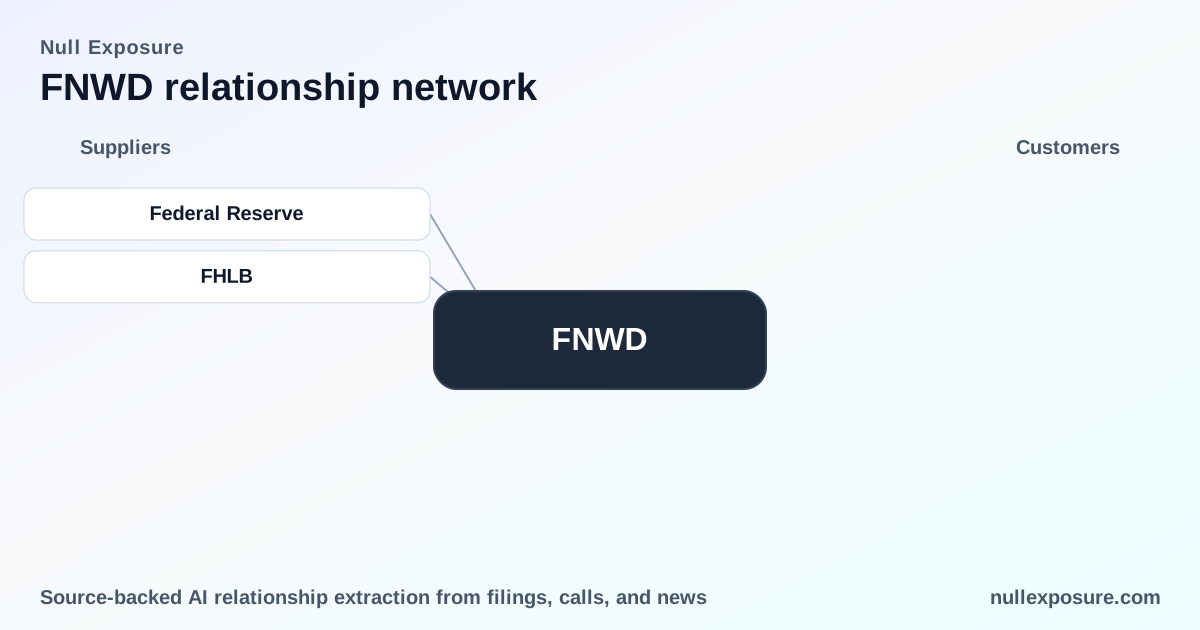
Funding counterparties: the Federal Reserve and FHLB as liquidity backstops
-
Federal Reserve
The company reported available liquidity of $687 million as of December 31, 2024, which explicitly includes borrowing capacity from Federal Reserve facilities as part of its contingency funding. According to the company's FY2025 earnings release reported via Reuters on TradingView (January 28, 2025), the Federal Reserve is a named source of borrowing capacity in the bank's liquidity stack. -
Federal Home Loan Bank (FHLB)
FHLB advances are an active, material funding source for Finward; the company discloses fixed‑rate advances and repurchase agreements as part of its funding mix. The same FY2025 earnings release notes that the liquidity figure includes borrowing capacity from the FHLB, and company filings disclose $65.0 million in FHLB fixed‑rate advances as of December 31, 2024 (with maturities typically one to five years).
Both counterparties function as wholesale funding partners rather than everyday service vendors, and the company explicitly treats capacity from these facilities as part of its liquidity cushion (FY2025 earnings disclosure via Reuters/TradingView).
How each relationship shows up in the record
Federal Reserve — The bank counts Federal Reserve facilities among its available liquidity sources and reports that capacity in public earnings disclosures for FY2025, which investors should read as part of the firm’s contingency funding plan (company FY2025 earnings release, Reuters via TradingView, Jan 28, 2025).
FHLB — The company actively uses advances from the Federal Home Loan Bank to fund securities and loans with matched maturities; filings show $65.0 million in FHLB fixed‑rate advances at year‑end and disclose that advance maturities typically range from one to five years (company FY2025 earnings release and related filings, Reuters via TradingView, Jan 28, 2025).
What the disclosed constraints reveal about the operating model and supplier risk
Company filings and excerpted evidence expose a small set of consistent structural characteristics that investors should treat as operating constraints rather than isolated footnotes.
-
Contracting posture: long‑dated commitments and medium‑term credit
The firm has long‑term lease commitments with initial 15‑year terms, indicating fixed occupancy and capital structure obligations that lock in costs and reduce short‑term flexibility. Separately, FHLB advances have maturities concentrated in the one‑to‑five‑year window, which signals a mix of medium‑term wholesale funding rather than purely short‑dated reliance. -
Concentration and spend scale
FHLB advances and repurchase agreements are material to the balance sheet: filings record $65.0 million of FHLB fixed‑rate advances and $40.1 million of repurchase agreements at December 31, 2024, placing wholesale funding in the $10M–$100M spend band and making FHLB an important single counterparty for funding needs. -
Criticality: dividend capacity linked to bank earnings
The company explicitly states that the holding company’s ability to pay dividends is heavily dependent on the bank’s ability to pay dividends to the holding company, which makes funding and earnings stability at the subsidiary level critical to shareholder returns. -
Operational dependency on an outsourced core
The bank outsources core processing to Fidelity National Information Services (FIS) for loans, deposits, cards, digital banking, and wealth functions. That outsourcing elevates vendor concentration and operational vendor risk even as it reduces in‑house IT capital needs. -
Relationship maturity and activity
Lease agreements and the stated FHLB advance schedules are active and ongoing commitments; investors should treat those relationships as operationally embedded rather than transient.
Together, these constraints describe a balance‑sheet‑centric bank with medium‑term wholesale funding, long‑dated real‑estate commitments, and a single large vendor for core banking operations—a clear profile for evaluating counterparty and supplier resilience.
Investor implications: liquidity, dividends, and operational resilience
-
Liquidity profile: The combined liquidity buffer of $687 million that includes Federal Reserve and FHLB capacity is a meaningful cushion relative to the bank’s scale, but reliance on wholesale lines introduces refinancing and counterparty concentration risk if market conditions tighten. The disclosed FHLB positions and repo balances are material and should be tracked against deposit volatility.
-
Dividend sensitivity: Because holding‑company dividends depend on the bank’s internal distributions, earnings volatility or regulatory capital actions at the bank level will directly affect shareholder returns. The company’s trailing EPS, P/B near 0.94, and modest dividend yield require monitoring of bank earnings trends.
-
Operational risk: Outsourcing core processing to FIS reduces internal costs but creates a single‑vendor dependency that can amplify outage or contractual transition costs, particularly given the bank’s retail and card processing needs.
If you are modeling downside scenarios for FNWD, stress the wholesale funding lines and the dividend‑throughput from the bank to the holding company as primary levers that affect shareholder cash flows.
For a deeper supplier and counterparty map that puts these relationships into a portfolio context, visit https://nullexposure.com/
Next steps for due diligence
- Review the company’s FY2025 earnings release and the referenced filings for the full liquidity table and lease schedules to quantify rollover exposure and amortization of lease liabilities (Reuters coverage via TradingView, Jan 28, 2025).
- Confirm counterparty limits and collateral terms for FHLB advances and repo agreements, and assess the contractual remedies that would trigger in stressed markets.
- Evaluate vendor contracts with FIS for termination windows, service credits, and transition risk to understand operational continuity exposure.
Access comprehensive supplier risk profiles and cross‑counterparty analytics at https://nullexposure.com/ — the single place to centralize exposure, contracts, and maturity schedules for investors and operators.
Bottom line
Finward Bancorp runs a typical regional banking holding‑company model: interest spread generation plus fee income, supported by a mix of deposits and wholesale funding from FHLB and Federal Reserve facilities, with significant long‑term lease commitments and outsourced core processing. For investors, the key decision points are how concentrated wholesale funding is, the maturity ladder on those advances, and the operational dependence on an external core vendor—all of which determine dividend sustainability and resiliency under stress. For ongoing monitoring and supplier mapping tools, go to https://nullexposure.com/