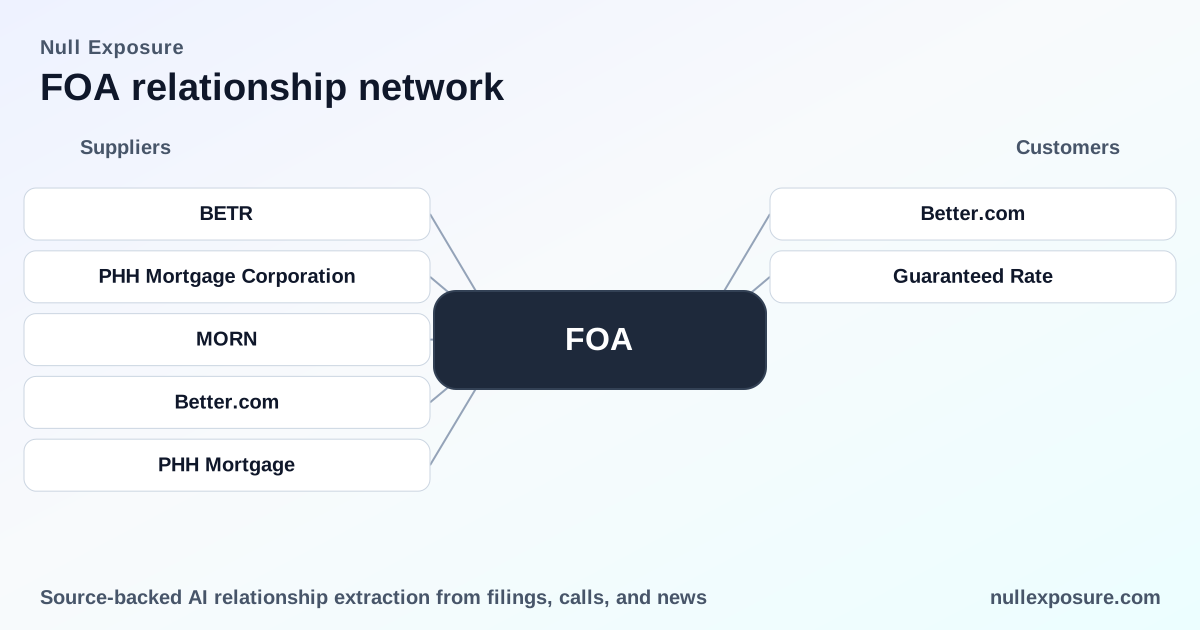
Finance of America (FOA): Supplier relationships that reshape reverse-mortgage scale and distribution
Finance of America operates a U.S. consumer-loan platform focused on reverse mortgages and home-equity products. The company monetizes through originations, servicing income, securities issuance (including HMBS), and balance-sheet lending supported by warehouse and securitization facilities; supplier and partner relationships extend its origination footprint, sourcing and servicing capacity, and advisor education channels. Investor thesis: FOA is consolidating reverse-mortgage scale by partnering with originators, acquiring servicing assets, and embedding advisory distribution — a strategy that increases loan flow and securitization optionality while concentrating operational counterparty exposure. Learn more about supplier signals on the FOA profile at NullExposure: https://nullexposure.com/
Business relationships in the public record
The following are the supplier and partner links surfaced in recent reporting and filings. Each description is concise and sourced to the underlying coverage.
Better.com — origination and technology partner
Finance of America announced a strategic origination partnership with Better.com to power FOA’s reverse-mortgage product rollout, including traditional HECM and the HomeSafe™ suite, expanding FOA’s sourcing and tech stack for forward-looking originations. (Source: Investing.com coverage of the Better.com partnership, March 9, 2026 — https://ca.investing.com/news/company-news/bettercom-to-power-finance-of-americas-new-home-equity-products-93CH-4244400)
PHH Mortgage Corporation / Onity Group Inc — HECM servicing portfolio acquisition
FOA’s reverse mortgage unit entered an agreement to acquire the HECM servicing portfolio and other reverse mortgage assets from PHH Mortgage (a subsidiary of Onity Group), a direct expansion of FOA’s servicing scale and an asset-based pathway to grow HMBS servicing and cash flows. (Source: National Mortgage Professional reporting on FOA’s acquisition of PHH reverse mortgage assets, March 2026 — https://nationalmortgageprofessional.com/news/finance-america-acquire-phhs-reverse-mortgage-assets)
Morningstar Inc. — advisor distribution and education partnership
Finance of America Reverse became Morningstar’s first reverse-mortgage education provider, making FAR’s educational tools available to roughly 150,000 financial advisors through Morningstar Advisor Workstation, a distribution channel that feeds advisor referrals and improves product awareness. (Source: National Mortgage Professional coverage referencing the Morningstar agreement, cited in FOA commentary, FY2022 — https://nationalmortgageprofessional.com/news/finance-america-posts-4th-straight-quarterly-loss)
How these relationships fit FOA’s operating model
FOA’s supplier posture is pragmatic and execution-focused. The firm contracts out origination and servicing responsibilities where it accelerates scale, while retaining named-servicer status and balance-sheet ownership where required. Filings and disclosures show FOA uses multiple third-party subservicers and warehouse facilities to maintain capacity and continuity; FOA then packages or holds assets into HMBS and other structures to realize funding and fee income.
- Contracting posture: FOA operates under framework and subservicing arrangements that allocate routine servicing tasks to third parties while reserving ultimate servicer responsibility to FOA as the named servicer. Company disclosures require FOA to perform or replace a failing subservicer to protect securitizations and investor obligations (company filings around Dec 31, 2024).
- Concentration and capacity: FOA reported $1.6 billion of committed or uncommitted loan funding capacity across 14 lending facilities with 11 counterparties as of Dec 31, 2024, a sign of meaningful counterparty reach but also concentration risk tied to a finite set of funding and subservicing partners.
- Criticality: Servicers and originator partners are operationally critical: they handle borrower contact, advances, payments processing and loss-mitigation — functions that, if interrupted, require FOA to step in as servicer or source a replacement subservicer to avoid disruption to HMBS and balance-sheet loans.
- Maturity and spend: FOA’s recent purchases and facility redemptions show large-dollar capacity and financial flows: the company paid $1.9 billion of principal when redeeming securitized notes in the reported period and disclosed a $100M-plus spend band across lending and securitization activities, indicating mature, high-dollar operational relationships.
What investors should watch — strategic upside and operational risk
FOA’s partner mix drives both growth and exposure. The Better.com arrangement delivers incremental originations and a technology backbone that accelerates customer acquisition and product distribution; acquisition of PHH’s servicing portfolio immediately lifts servicing scale and recurring fee streams; the Morningstar tie offers entrenched advisor distribution, improving product awareness among financial planners.
- Upside: Partnerships expand originations without FOA building a full retail origination network, accelerating HMBS issuance and servicing fee income. PHH portfolio acquisition converts third-party flow into owned servicing economics and securitization optionality.
- Operational risk: The business model relies on a small set of funding and servicing counterparties; FOA is contractually on-the-hook to replace failing subservicers and to perform servicing if required, creating a backstop obligation that can be capital- and operationally intensive during stress (company disclosures through FY2024 reference this remediation duty).
- Execution sensitivity: Successful integration of acquired servicing assets and coordination with technology partners like Better.com determine whether originations translate to profitable securitizations rather than simply higher servicing overhead.
Actionable takeaways for investors and operators
- Partnerships materially accelerate scale: Better.com and Morningstar broaden originations and referral pipelines; PHH acquisition materially increases servicing assets. These moves change FOA’s top-line mix toward higher recurring and securitization-related flows.
- Counterparty concentration is a live risk: $1.6B of capacity and 14 facilities across 11 counterparties produce meaningful exposure; operational disruptions at a subservicer or funder force FOA to reassign servicing or perform it directly.
- Operational execution will determine valuation upside: Integration of servicing assets and stability of funding lines will dictate whether FOA captures expanded economics or absorbs disproportionate remediation costs.
If you evaluate supplier risk or want a concise supplier risk profile for FOA, start with the FOA supplier overview at NullExposure: https://nullexposure.com/. For corporate counterparties and a deeper mapping of funding and servicing relationships, review FOA’s supplier intelligence on NullExposure: https://nullexposure.com/.
Conclusion — a risk-weighted growth play
FOA is executing a clear strategy to scale reverse-mortgage origination and servicing through a mix of partnerships and acquisitions. The company converts incremental originations into balance-sheet optionality and securitization volume, but the model requires disciplined counterparty management and operational integration. Investors should weigh the revenue and securitization upside from Better.com, PHH, and Morningstar against the counterparty concentration and substitute-servicer obligations that sit on FOA’s balance sheet. For the full supplier dossier and ongoing monitoring, visit NullExposure: https://nullexposure.com/.