Hang Feng Technology Innovation (FOFO): what its supplier and advisor network reveals to investors
Hang Feng Technology Innovation Co., Ltd. operates as a small, recently public technology company focused on artificial intelligence, cloud and IoT solutions and is monetizing through a combination of professional services, proprietary technology licensing and a nascent tokenization channel for real-world assets. The company completed a U.S. listing and financing in 2025 to fund growth, and it is using a mix of boutique capital markets and blockchain partners to turn intellectual property and asset-management relationships into recurring fee streams. For investors, the critical frame is: this is a founder-controlled, high-margin small-cap that is leaning on strategic advisors and a blockchain partner to scale distribution of tokenized assets.
Learn more about supplier mapping and counterparty risk at https://nullexposure.com/.
Why these counterparty ties matter now
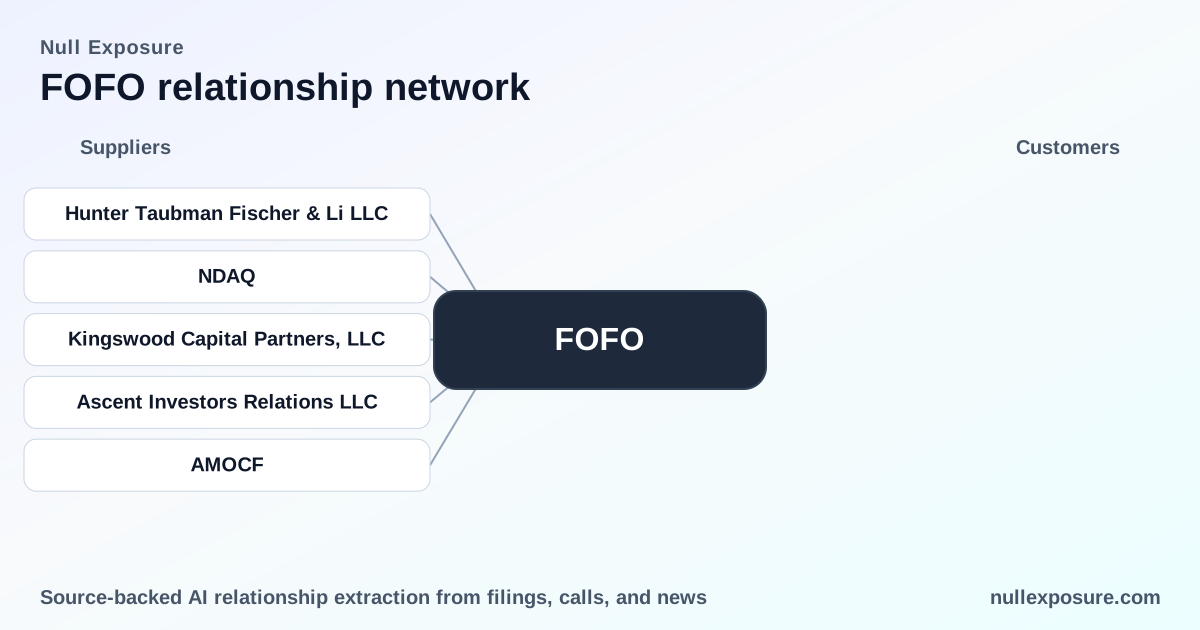
Hang Feng’s network of advisors and partners reads like a playbook for an IPO-stage tech company pivoting into tokenized real-world assets (RWAs). Kingswood Capital Partners acted as the underwriter, Hunter Taubman Fischer & Li provided U.S. legal counsel, Nasdaq supplied the listing venue, Ascent handled investor relations, and Animoca Brands signed a memorandum of understanding to distribute tokenized RWAs on its NUVA marketplace. Those relationships collectively indicate a two-track commercialization strategy: traditional capital markets to secure balance-sheet liquidity and a blockchain distribution partnership to create new revenue channels.
Operationally this implies several company-level characteristics worth noting to operators and investors:
- Contracting posture: engagements appear transactional and targeted — boutique underwriter and specialist counsel rather than large bulge-bracket teams — signaling cost-conscious, execution-focused contracting suited to a smaller IPO and follow-on commercialization agreements.
- Concentration and control: with insiders owning ~58% and institutions ~0.21%, governance and strategic choices will be shaped by founders and insiders rather than large institutional shareholders.
- Criticality and maturity: the company reports strong gross margins and positive net profitability at present, but scale remains limited (market cap roughly $37 million and a recent IPO), so many supplier relationships are critical for credibility and distribution rather than for large operational scale.
- Liquidity and market risk: listing on Nasdaq opens access to U.S. capital and visibility but the narrow free float (shares float ~2.21 million of ~6.87 million outstanding) creates volatility and concentrated trading dynamics.
The relationship map — who does what, in plain English
- Kingswood Capital Partners, LLC — underwriter for the IPO and manager of the overallotment. Kingswood led the offering on a firm commitment basis and handled the over-allotment exercise that increased gross proceeds to $6.3 million, providing the primary capital markets execution for Hang Feng’s U.S. listing (reported in GlobeNewswire and QuiverQuant releases, September 2025).
- Hunter Taubman Fischer & Li LLC — U.S. legal counsel to Hang Feng on the offering. The firm provided U.S. counsel services during the IPO process, supporting regulatory and transactional legal work in the United States (reported in GlobeNewswire and QuiverQuant press material, September 2025).
- Nasdaq Capital Market — listing venue where FOFO began trading. Hang Feng’s ordinary shares began trading on the Nasdaq Capital Market on September 12, 2025 under ticker FOFO, securing a U.S. exchange listing and attendant visibility to retail and institutional market participants (announced via GlobeNewswire, September 15, 2025).
- Ascent Investors Relations LLC — investor relations contact and communications provider. Ascent is listed as the company’s investor relations service and public contact for investor inquiries, indicating Hang Feng’s reliance on outsourced IR to manage market communications and retail investor engagement (contact details published in the company press release and QuiverQuant distribution, September 2025).
- Animoca Brands — strategic memorandum of understanding for tokenized RWA distribution. Hang Feng and Animoca executed an MOU to leverage Hang Feng’s asset-management expertise and Animoca’s on-chain vault marketplace, NUVA, to distribute tokenized real-world assets, creating a potential new revenue stream and distribution channel for Hang Feng’s tokenized securities (reported in a November 2025 press item via The Manila Times).
What operators and investors should read between the lines
The legal, underwriting and IR roster is coherent for a small-cap IPO: boutique capital markets execution plus specialist U.S. counsel and outsourced IR minimizes upfront cost and accelerates time-to-market, but it also signals limited institutional traction to date. The Animoca MOU opens a non-traditional monetization route that is strategically bold: tokenized RWAs provide fee and distribution upside but introduce regulatory, custody and secondary-market liquidity questions that are material to valuation.
Key risk/reward vectors:
- Reward: high reported profit margin and targeted partnerships could generate asymmetric upside if the tokenization channel scales and institutional buyers accept NUVA-based distribution.
- Risk: high insider ownership and a thin institutional base concentrate governance and liquidity risk; limited free float amplifies price moves and can complicate follow-on financing or M&A negotiation dynamics.
- Execution: boutique underwriter and counsel are fully capable for a $6.3 million IPO, but lack the distribution breadth of larger banks when scaling to larger capital raises.
If you are evaluating FOFO as a supplier or counterparty, validate the legal construct of any tokenized asset offering, the governance arrangements tied to founder control, and the post-listing liquidity profile before committing material contract terms.
Explore tailored supplier risk assessments and counterparty dashboards at https://nullexposure.com/.
A short due-diligence checklist for relationship managers and buyers
- Confirm the scope of the Animoca MOU: pilot transactions, rights to proceeds, and regulatory compliance obligations for tokenized RWAs.
- Review IPO lock-up schedules and any director/officer transfer restrictions tied to the underwriting (impacts insider sell-down risk).
- Validate legal opinions and U.S. securities counsel deliverables provided by Hunter Taubman Fischer & Li for cross-border compliance.
- Test IR responsiveness and disclosure cadence through Ascent to understand market messaging and institutional targeting capability.
- Model liquidity scenarios given the small free float and high insider ownership to set realistic exit and pricing assumptions.
Bottom line — positioning and next steps for investors
Hang Feng is a high-margin, small-cap technology firm that used a targeted IPO playbook to secure capital and is now pursuing an innovative but execution-sensitive tokenization strategy via Animoca’s NUVA marketplace. For investors and operators, the story is attractive if you value early exposure to tokenized RWAs and are comfortable with concentrated ownership and limited liquidity. For counterparties, supplier agreements and commercial terms should be structured to account for founder control, regulatory complexity around tokenization, and potential volatility in the public share price.
For a deeper supplier and counterparty risk evaluation tailored to your portfolio, visit https://nullexposure.com/.