Amicus Therapeutics (FOLD) — supplier and advisor relationships that move the valuation needle
Amicus Therapeutics operates as a commercial-stage biotechnology company selling rare-disease therapies (Galafold and Pombiliti) while pursuing licensed programs and milestone-bearing deals; the firm monetizes through product sales, licensing income and option/milestone structures and is currently the subject of a strategic sale process. Value depends on steady manufacturing and distribution of approved products, successful commercialization of licensed assets, and the execution of strategic transactions. For a concise supplier-risk view tailored to investors and operators, see Null Exposure: https://nullexposure.com/.
How Amicus runs the machine and where the risks sit
Amicus outsources virtually all manufacturing, packaging and distribution, and complements internal capabilities with third-party licensing deals for pipeline programs. That operating posture produces three structural characteristics relevant to investors: high supplier concentration, meaningful contracted spend, and geopolitical supply exposure. The company carries binding minimum purchase and manufacturing commitments totaling $179.7 million as of December 31, 2024, which locks future cost and capacity exposure into its P&L and balance sheet planning (with $102.7 million expected in 2025 and $77.0 million in 2026). These commitments transform supplier relationships from tactical vendors into strategic counterparties whose performance and continuity are value-critical.
- Concentration: Amicus relies on single-source third-party manufacturers for a majority of its commercial and development products.
- Contracting posture: Long-term and binding manufacturing and purchase agreements create near-term spend certainty and long-term operational dependency.
- Criticality: Disruption at a single manufacturer would directly affect commercial supply and patient access, creating immediate revenue and regulatory risk.
- Geopolitical exposure: Manufacturing located in the PRC elevates tariff and export-control risk for U.S. commercialization.
Learn more about how supplier concentration translates to financial risk at Null Exposure: https://nullexposure.com/.
Supplier and advisor relationships you need to track now
Below are the counterparties surfaced in public filings and sector reporting. Each relationship note includes the relevant source and a concise plain-English summary.
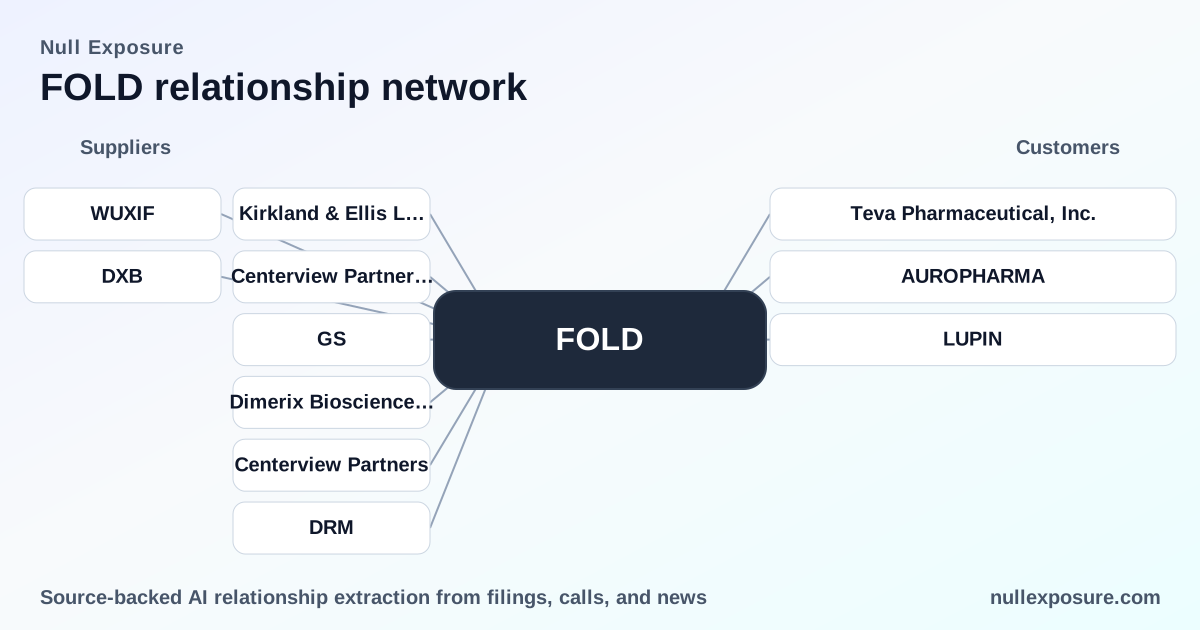
WuXi Biologics — the sole manufacturer of Pombiliti
Amicus currently relies on WuXi as the sole contract manufacturer for its biologic product Pombiliti, and the company explicitly warns that U.S.–PRC tensions and potential trade or export measures could materially impair supply and distribution of Pombiliti and related products. (Amicus 2024 Form 10‑K; fiscal year 2024 filing.)
Dimerix / Dimerix Bioscience Pty Limited — US commercialization license for DMX‑200
Amicus secured an exclusive U.S. license for DMX‑200 from Dimerix, paying an upfront $30 million with potential downstream milestones, consolidating U.S. commercialization rights for FSGS and related indications. (TradingView coverage summarizing Amicus filings, March 2026; TheHealthcareTechnologyReport and Pharmaceutical‑Technology reporting on DMX‑200 purchase and deal structure, 2025–2026.)
Centerview Partners LLC — financial advisor to Amicus in a strategic process
Centerview Partners is acting as a financial advisor to Amicus in connection with the company’s strategic review and acquisition discussions. (CityBiz coverage of the BioMarin bid and Amicus advisers, March 9, 2026.)
Goldman Sachs & Co. LLC — sell‑side / corporate advisory to Amicus
Goldman Sachs is serving as a financial advisor to Amicus in the strategic transaction process that culminated in reported acquisition interest; press coverage lists Goldman alongside Centerview as Amicus advisors. (CityBiz and AKM news reports covering the transaction activity and advisory roster, March 9, 2026.)
Kirkland & Ellis LLP — legal counsel to Amicus
Kirkland & Ellis is legal counsel to Amicus for the transaction and related corporate matters, supporting deal documentation and regulatory filings. (CityBiz reporting on the transaction and advisor list, March 9, 2026.)
What these relationships mean for investors and operators
- WuXi’s role is value‑critical. The company-level disclosure that Pombiliti is manufactured by a sole PRC supplier converts a commercial supplier into a strategic single point of failure and introduces trade‑policy risk directly into revenue forecasts (Amicus 2024 10‑K). This is the clearest geostrategic exposure in the capital structure.
- Contractual lock‑in increases short-term certainty and medium-term risk. The $179.7 million of binding manufacturing and purchase obligations creates predictable spend but also locks Amicus into supplier relationships that are costly to unwind or replace without margin and timing consequences (company filings).
- Advisors signal a sale or strategic alternative process. The engagement of Centerview, Goldman and Kirkland — reported in March 2026 coverage of the BioMarin approach — indicates active strategic options work that directly affects valuation dynamics and counterparty diligence on supplier continuity. (CityBiz; AKM news, March 2026.)
- Licensing is an active monetization lever. The Dimerix DMX‑200 license (upfront and milestone economics) demonstrates Amicus’s approach to augment revenue and pipeline breadth via targeted licensing and opens potential upside if clinical and regulatory milestones are achieved. (TradingView and industry press, 2025–2026.)
Operational constraints and strategic signals from filings
Amicus’s filings and press disclosures produce clear operating-model constraints that investors must integrate into credit and valuation work:
- Long‑term contracting posture: filings describe single‑source manufacturers and binding minimum purchase obligations, signaling limited near-term supplier flexibility.
- Spend magnitude: the disclosed $179.7 million in purchase/manufacturing obligations places Amicus in the >$100m supplier spend band, which materially affects working-capital and contractual risk profiles.
- Manufacturing and distribution outsourcing: Amicus outsources all manufacturing and packaging and relies on third parties for distribution and clinical services, elevating vendor management as a functional priority.
- Geography concentration: the filing explicitly names WuXi in the PRC as the manufacturer of Pombiliti, creating APAC‑linked geopolitical risk to U.S. supply. (Amicus 2024 Form 10‑K.)
Where an excerpt named a counterparty directly (WuXi), the constraint is attached to that supplier; otherwise these are company-level signals to be reflected in counterparty diligence and scenario modeling.
If you need a supplier‑specific exposure map tied to contract maturities and spend schedules, Null Exposure provides a practical way to operationalize that analysis: https://nullexposure.com/.
What to do next — investor actions and operator priorities
- For investors: stress‑test revenue forecasts for Pombiliti and Galafold under a WuXi disruption scenario, and incorporate the $179.7 million contracted obligations into short‑term cash flow modeling. Treat the strategic sale process as a binary event that compresses or expands downside depending on buyer diligence on supply continuity.
- For operators: prioritize alternate manufacturing qualification plans and renegotiation of minimum‑purchase terms; document and accelerate secondary sourcing options to reduce single‑supplier exposure.
- For both: monitor regulatory and trade developments between the U.S. and PRC, and track the sale process and its buyer due diligence on supply contracts.
For transaction-ready supplier diligence and exposure reporting, start with Null Exposure’s supplier intelligence and scenario analysis tools: https://nullexposure.com/.
Bold relationships and contractual facts will determine the path to value for Amicus — treat supplier continuity and advisor-led transaction execution as primary drivers in your investment thesis.