Forestar Group Inc. (FOR) — supplier relationships that matter for execution and local approvals
Forestar Group Inc. develops and delivers residential lots across the United States and monetizes by selling finished lots and land development services to homebuilders and end-home buyers; supplier relationships — from infrastructure vendors to local public authorities — are operational levers that accelerate closings and protect margins. For investors, the combination of recurring shared‑service arrangements with a large homebuilder counterparty and discrete local obligations defines both cost structure and execution risk. Visit https://nullexposure.com/ for deeper supplier mapping and risk scoring.
How Forestar runs the business and why vendors are strategic
Forestar operates as a residential lot developer: it acquires raw land, funds entitlements and infrastructure work, installs utilities and improvements, and sells finished lots to national and regional homebuilders or sells completed lots to retail buyers. Revenues flow from lot sales and related services; margins depend on execution speed, permitting timelines, and predictable vendor costs. Supplier contracts therefore translate directly to working capital needs and the timing of lot deliveries.
Forestar’s public filings and market metrics show a highly cyclical but profitable model — FY2025 revenue of roughly $1.685 billion and an EBITDA around $212 million — so supplier predictability is a financial priority. For a concise supplier risk view tailored to active investors, see https://nullexposure.com/.
Shared services with D.R. Horton: a material, visible dependence
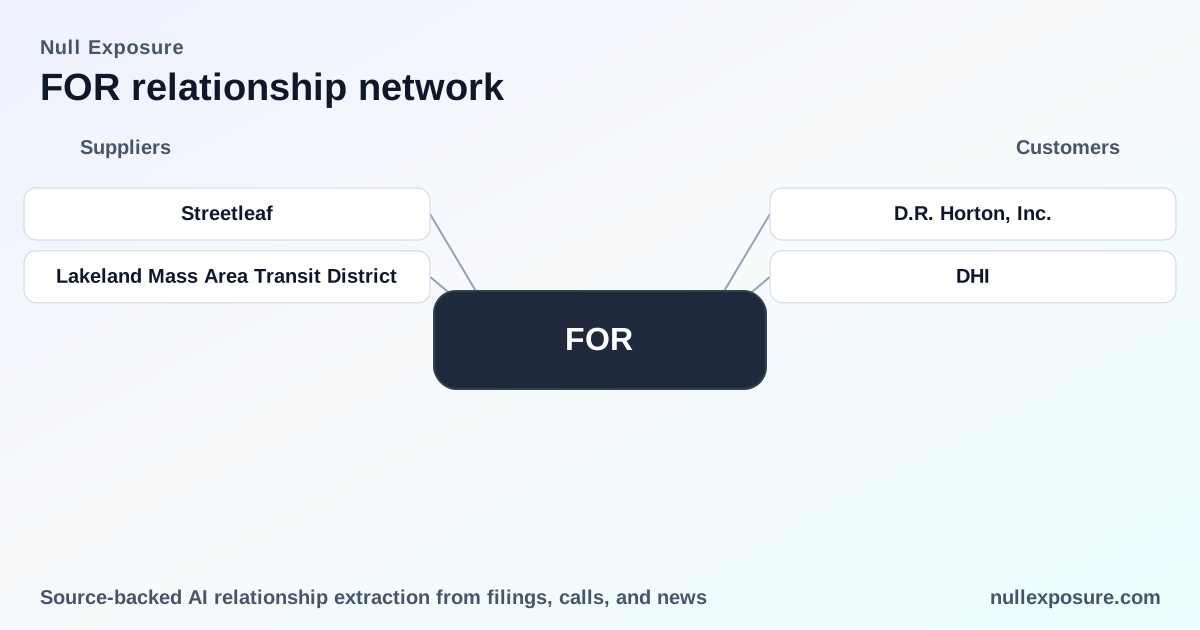
Forestar maintains a Shared Services Agreement with D.R. Horton under which D.R. Horton provides administrative, compliance, operational and procurement services. Forestar’s consolidated statements of operations included payments and reimbursements to D.R. Horton totaling tens of millions: $7.3M in shared services and $14.4M in health-insurance reimbursements in fiscal 2025, with comparable, smaller amounts in 2024 and 2023. This arrangement is disclosed in Forestar’s FY2025 filing and is a clear example of a related-party operational dependency.
- Why this matters: the contracting posture is outsourced/insourced hybrid with a single large provider; this concentrates operational risk but also delivers scale and procurement leverage. According to Forestar’s FY2025 filings, the arrangement reduces standalone corporate cost infrastructure but creates vendor concentration risk and potential governance considerations.
The active supplier relationships in the public record
Streetleaf — national vendor agreement for solar streetlights
Forestar signed a national vendor agreement with Streetleaf to offer solar-powered streetlight services as an option to communities nationwide, positioning sustainable lighting as a build‑out alternative for new developments. This was announced via GlobeNewswire in February 2025 and frames an operational shift toward optional, low‑infrastructure lighting solutions for communities served by Forestar. (GlobeNewswire, Feb 25, 2025)
Lakeland Mass Area Transit District — local public-works payment obligation
In a 2022 local planning context, Forestar agreed to pay the Lakeland Mass Area Transit District $166,666 per year for three years (final payment by Dec. 31, 2025) to support the purchase of a bus; the obligation was part of traffic and community plan approvals for a residential project. This illustrates the type of localized, contract-like obligations developers absorb as part of entitlement and permitting. (The Ledger, Feb 23, 2022)
What these supplier entries reveal about Forestar’s operating constraints
Taken together, the relationships and disclosures reveal a predictable set of operating-model characteristics that investors should underwrite into forecasts:
- Contracting posture: Forestar blends outsourced corporate functions and third‑party supplier selection with related‑party support from a large homebuilder (D.R. Horton). The shared‑services arrangement is a deliberate cost-allocation and operational integration choice rather than a purely arms‑length procurement model.
- Concentration: The D.R. Horton relationship represents concentrated operational exposure at the corporate-support level; even routine SG&A flows are routed through the counterparty, creating dependency on one major provider for administrative continuity.
- Criticality: Supplier services here are operationally critical — administrative, compliance and procurement functions directly affect development cadence, permitting timelines and the timing of lot closings. Local obligations (e.g., Lakeland transit payment) are legally embedded conditions of approvals and therefore critical to project delivery.
- Maturity and scale: Relationships differ by maturity: the D.R. Horton shared services are multi‑year, recurring and material (multi‑million dollar amounts disclosed across fiscal years), while vendor agreements like Streetleaf are commercial supply relationships designed to scale across communities as an option rather than a required standard.
These constraints and exposures are explicit in Forestar’s own disclosures — the FY2025 filing lists the shared services amounts and reimbursements for 2023–2025 — and should be modeled as recurring operating cashflows rather than one‑off vendor interactions.
What investors should watch next
- Contract governance and transition risk. The D.R. Horton support model is efficient but concentrated; any change in that arrangement or pricing could meaningfully alter SG&A dynamics. Monitor subsequent proxy statements and the next annual filing for amendments or termination clauses.
- Local obligations pipeline. Small recurring payments tied to municipal approvals (like the Lakeland transit payments) are not large on a corporate basis, but they are representative of a class of conditional obligations that can delay closings if not managed proactively.
- Operational scalability of optional solutions. The Streetleaf national vendor agreement introduces a sustainability angle that can reduce municipal infrastructure cost and accelerate lot acceptance in jurisdictions prioritizing green solutions; track adoption rates in major active markets.
For a structured supplier risk scorecard and to benchmark Forestar’s vendor exposure against peers, explore more at https://nullexposure.com/.
Final takeaways
- Forestar monetizes land development through lot sales, and supplier arrangements are direct levers on timing and margin. The company’s shared services agreement with D.R. Horton is a material, multi‑year operational dependence disclosed in FY2025 filings, while vendor agreements like Streetleaf and localized obligations such as the Lakeland transit payment illustrate the mix of scalable vendor relationships and discrete municipal commitments that shape execution risk.
- Investors should treat related‑party shared services as an ongoing cost center and municipal obligations as project‑level gating items.
For investors and operators requiring an actionable supplier map and ongoing monitoring of these relationships, visit https://nullexposure.com/ for detailed intelligence and updates.