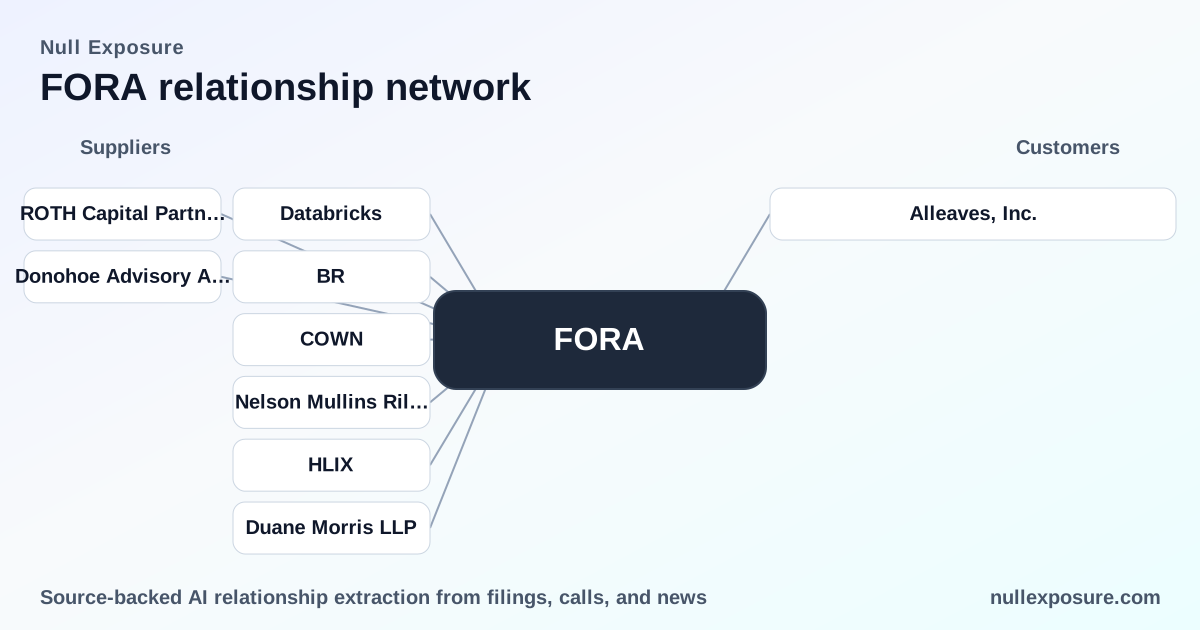
Forian Inc. (FORA): Supplier map, contractual posture, and what it means for investors
Forian (FORA) sells software, predictive analytics and licensed information to healthcare and cannabis clients, monetizing through recurring software licenses, managed analytics services, and data products that feed decision workflows for providers, payers and life-science investors. Revenue depends on a mix of licensed third‑party content and proprietary analytics delivered via cloud infrastructure, making supplier relationships both an input to product value and a potential concentration risk.
Explore supplier intelligence at Null Exposure
How Forian makes money and why suppliers matter
Forian packages licensed content, proprietary models and SaaS delivery to produce recurring revenue from clients seeking clinical and commercial analytics. The company’s commercial model relies on two linked inputs: rights to external information assets (licensed content) and cloud-based processing/storage. If either input proves constrained, product delivery and gross margins can be affected quickly because the business sells integrated analytics rather than stand‑alone infrastructure.
Key operating characteristics for investors:
- Contracting posture is license‑heavy. Forian states it licenses certain information assets from third parties as a key input to its software and information products, so supplier contracts carry explicit content and use‑rights limits.
- Materiality and concentration are real. Forian warns that disruptions to suppliers could have a material short‑term impact while alternates are secured; that elevates supplier risk relative to software firms that rely primarily on open or self‑generated content.
- Cloud dependence is embedded. The company uses third‑party cloud services for storage and processing, which is typical but creates a dual dependency on both content licensors and infrastructure providers.
- Contract maturity and transition risk are present. The company disclosed a vendor exit from the data‑licensing market, triggering contract evaluation and potential accelerated amortization—a signal that some licensed relationships are in flux rather than long‑term evergreen agreements.
Supplier relationships in plain English
Below are the supplier and adviser relationships surfaced in public releases and press coverage, with concise takeaways and source references.
Databricks
Forian partnered with Databricks to distribute its Chartis™ physician and organization affiliation product through the Databricks Marketplace, broadening data distribution and making Chartis easier to access for enterprise analytics consumers. Source: Reuters coverage reported via TradingView (Dec 2024) describing the Databricks Marketplace partnership in FY2024.
Broadridge Corporate Issuer Solutions, Inc.
Broadridge serves as the transfer agent for Forian and was involved in the corporate transaction that launched the public company; this is an administrative, regulatory‑support relationship rather than a product supplier. Source: Forian launch press release on PR Newswire (FY2021).
TD Cowen
Forian acquired Kyber Data Science LLC from TD Cowen, an acquisition intended to strengthen advanced healthcare analytics and machine learning capabilities marketed to financial services and healthcare clients. Source: Forian acquisition announcement on GlobeNewswire (Nov 2024).
Nelson Mullins Riley & Scarborough LLP
Nelson Mullins acted as legal counsel to one of the legacy parties in the combination that formed Forian; its role was advisory during the corporate combination and listing process. Source: Forian launch press release on PR Newswire (FY2021).
Helix Technologies, Inc.
Data from Helix’s technology offerings was specifically identified as a feed that will power analytics for cannabinoid products—highlighting an early vertical data partnership that supports Forian’s cannabis analytics vertical. Source: Forian launch press release on PR Newswire (FY2021).
Duane Morris LLP
Duane Morris served as legal advisor to Forian (and MOR Analytics) during the transaction that created the company, providing the corporate and securities counsel necessary for the combination and Nasdaq listing. Source: Forian launch press release on PR Newswire (FY2021).
ROTH Capital Partners, LLC
ROTH Capital Partners provided advisory support around the Nasdaq listing and related capital markets matters for Forian during its corporate combination and market entry. Source: Forian launch press release on PR Newswire (FY2021).
Donohoe Advisory Associates LLC
Donohoe Advisory Associates also advised on Nasdaq‑related matters alongside ROTH, serving as a capital markets and transactional adviser in the company’s launch sequence. Source: Forian launch press release on PR Newswire (FY2021).
What the supplier map tells investors about operational risk
The relationship list is a mix of content/licensing partners, acquisition sellers, and transaction advisers rather than a long roster of large-scale infrastructure vendors. That composition creates three practical implications:
- Cataloged supplier dependency is supplier‑specific and material. Forian explicitly licenses third‑party content as a key product input and warns that supplier disruptions can produce material short‑term impacts; investors should treat licensed content as a semi‑fixed cost and a potential point of failure.
- Contracts skew toward licensing, not open access. The company’s disclosures identify licensing as the contract type, implying fixed fees, term limits and use‑restrictions that constrain flexibility and can force restructuring costs if vendors exit the market.
- Cloud reliance increases operational leverage. Forian’s processing and storage run on third‑party cloud infrastructure, which is operationally efficient but concentrates runtime and data security exposure off‑balance‑sheet.
- Some supplier relationships are transactional and advisory. Legal and capital markets advisers (Duane Morris, Nelson Mullins, ROTH, Donohoe, Broadridge) are important for growth and governance but do not drive product economics; conversely, partners like Helix and the Kyber acquisition directly augment product capability and revenue potential.
Explore supplier intelligence at Null Exposure
Investment implications and risk/reward
- Upside drivers: Acquisition of Kyber and the Chartis distribution via Databricks expand addressable market and product stickiness; proprietary models combined with third‑party content can deliver premium margins if licenses are secured on favorable terms.
- Key risks: License concentration and a vendor exit from the data‑licensing market create transition and amortization risk; any failure to replace critical content on comparable terms would pressure margins and client deliverables. This is a material operational risk that investors must underwrite before valuing long‑term revenue streams.
- What to watch next: contract renewals and counterparty disclosures for major content licensors, timing and cost of any accelerated amortization, metrics on gross margin stability post‑Kyber integration, and commercial traction of Chartis through Databricks.
Bottom line and next steps for diligencing
Forian is executing a data‑and‑analytics play that leverages licensed content plus proprietary models; that structure delivers differentiated product value but creates concentration and contract maturity risk that is both material and actionable. Investors should prioritize contract diligence around major content sources and monitor amortization disclosures and cloud vendor arrangements in upcoming filings.
If you need a supplier‑level risk brief or a mapped supplier dashboard for Forian, start here: https://nullexposure.com/.