FormFactor (FORM): Supplier Relationships and Operational Constraints — What Investors Should Know
FormFactor designs and manufactures probe cards, analytical probes, probe stations and supporting metrology and thermal systems, selling these capital and consumable products to semiconductor manufacturers and research institutions; the company monetizes through high-margin equipment sales, recurring probe-card and service revenue, and incremental product extensions such as integrated technologies. Supply-chain posture and selective technology integrations—rather than broad distribution—drive near-term margin and growth sensitivity. For a focused supply-risk read and supplier mapping, visit NullExposure: https://nullexposure.com/.
How FormFactor operates and where supplier relationships matter
FormFactor is a specialist semiconductor equipment vendor whose product value is tightly coupled to component quality, specialized subassemblies, and IP-driven integrations. The business model converts engineering-led product development into equipment sales and recurring probe-card/service cycles; revenue TTM stood at $784.99 million and gross profit at $307.59 million as of the latest reported quarter (2025-12-31), underlining a capital-intensive, supplier-dependent operating model.
Procurement is not passive. FormFactor discloses reliance on purchase orders rather than long-term supplier contracts, which creates direct exposure to price volatility, capacity constraints and component shortages. This contracting posture increases operational flexibility but elevates execution risk when demand surges or when inputs are scarce. Investors should treat procurement configuration as a structural feature of the business model, not a transitory detail — it shapes margin variability, supplier leverage and inventory strategy.
Company-level constraints and what they mean for investors
- Contracting posture — spot/PO-driven: FormFactor’s public disclosures state that the company generally uses purchase orders instead of long-term supply agreements, exposing revenues and margins to supplier pricing and capacity cycles. This disclosure is a primary company-level signal about procurement strategy.
- Concentration and criticality — limited public disclosure: The company does not provide detailed, repeatable supplier concentration metrics in the public summary provided here; absence of granular supplier concentration data increases the importance of qualitative monitoring (earnings calls, regulatory filings) for signs of single-vendor dependency.
- Maturity and integration risk: FormFactor’s strategy includes integrating acquired or partnered technologies into its product lineup; these integrations accelerate capability but also impose execution risk in ramping manufacturing and qualification.
These company-level signals should be incorporated into valuation and scenario work. In practical terms, modelers should build in higher short-term supply-cost volatility and a slower-than-linear margin response to revenue inflections given the PO-based procurement posture.
The supplier relationships public record — what’s on the table
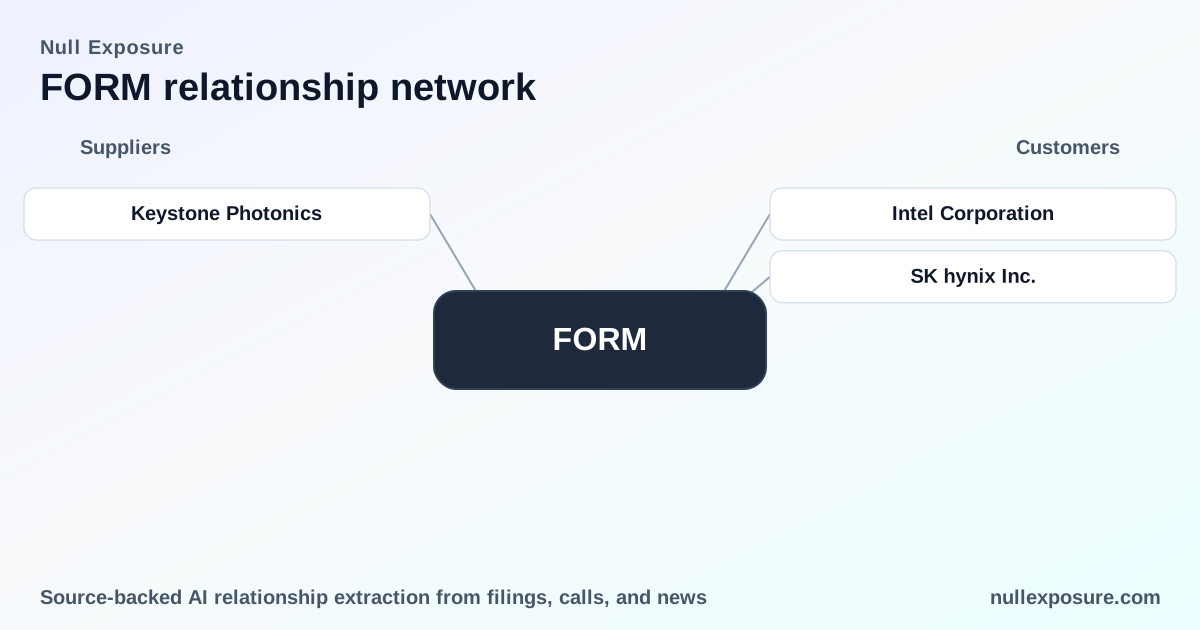
The public relationship evidence for FormFactor in the supplied results includes one named supplier/technology partner.
Keystone Photonics
FormFactor has signaled plans to integrate Keystone Photonics technology into its product lineup, with additional focus on market-share gains across its three HBM (high-bandwidth memory) customers mentioned in the Q4 call coverage. This positions Keystone as a strategic technology input for targeted HBM test solutions and suggests product roadmaps that leverage Keystone’s capability set. (Finviz news coverage of FormFactor’s Q4 earnings call, March 9, 2026.)
This single-instance mention shows a tactical, product-focused supplier/technology relationship rather than evidence of a broad supply agreement; the narrative is about capability integration and customer targeting rather than long-term contractual protections. Investors should read it as technology augmentation with potential revenue leverage for HBM-related probe cards, contingent on successful product integration and customer qualification.
Investment implications: risk, upside and modeling guidance
FormFactor’s operating model and the disclosed supplier posture translate into a distinct risk/reward profile for investors and customers:
- Risk — supplier-price and capacity sensitivity: Because procurement relies largely on purchase orders, cost pass-through and capacity shortages can compress margins rapidly during supply tightness. This is not theoretical — the company explicitly notes price increases and component shortages as risks in its procurement disclosure.
- Upside — targeted technology integration: Integrating Keystone Photonics technology is a direct operational lever to capture more value in the HBM test segment, an area where customers pay for differentiated capability. Successful integration can expand addressable spend per wafer/probe test sequence and support pricing power.
- Execution hinge — qualification cycles and customer wins: The commercial impact of any supplier integration is gated by qualification timelines at foundries and memory vendors; investor returns hinge on converting engineering wins into production bookings.
Actionable items for investors and operators:
- Stress-test margin sensitivity to supplier cost inflation and model a scenario with an extended procurement premium for 2–4 quarters after demand surges.
- Track FormFactor’s public communications for supplier concentration disclosures and qualification milestones tied to Keystone integration.
- Consider the potential for discrete upside in HBM-focused probe-card sales if integration accelerates customer qualification cycles.
For additional supplier analytics and relationship mapping, see NullExposure: https://nullexposure.com/.
How to use this in financial models and diligence
- Base-case models should incorporate FormFactor’s current profitability (profit margin ~6.93% TTM) and assume incremental margin compression risk under short-term supply disruption scenarios due to spot purchasing.
- Upside scenarios should explicitly model incremental revenue tied to Keystone-enabled HBM solutions and delayed profitability improvements until qualification and volume ramp.
- Monitor the company’s quarterly commentary for procurement language changes; movement from purchase-order reliance toward multi-year supply agreements would be a material reduction in supplier risk and should be re-priced.
Final takeaways and investor actions
FormFactor is an engineering-driven company whose near-term performance is tightly coupled to supplier execution and selective tech integrations. The company’s spot-oriented procurement posture is a material operational constraint that increases margin volatility, but targeted integrations such as Keystone Photonics offer clear product-led upside into the HBM market. Investors should combine quantitative scenario work with active monitoring of qualification milestones and procurement disclosures.
If you are building exposure or conducting supplier diligence on FORM, start with focused monitoring of qualification updates and procurement-language changes on earnings calls and filings. For a concise supplier risk profile and tracking tools, visit NullExposure: https://nullexposure.com/.