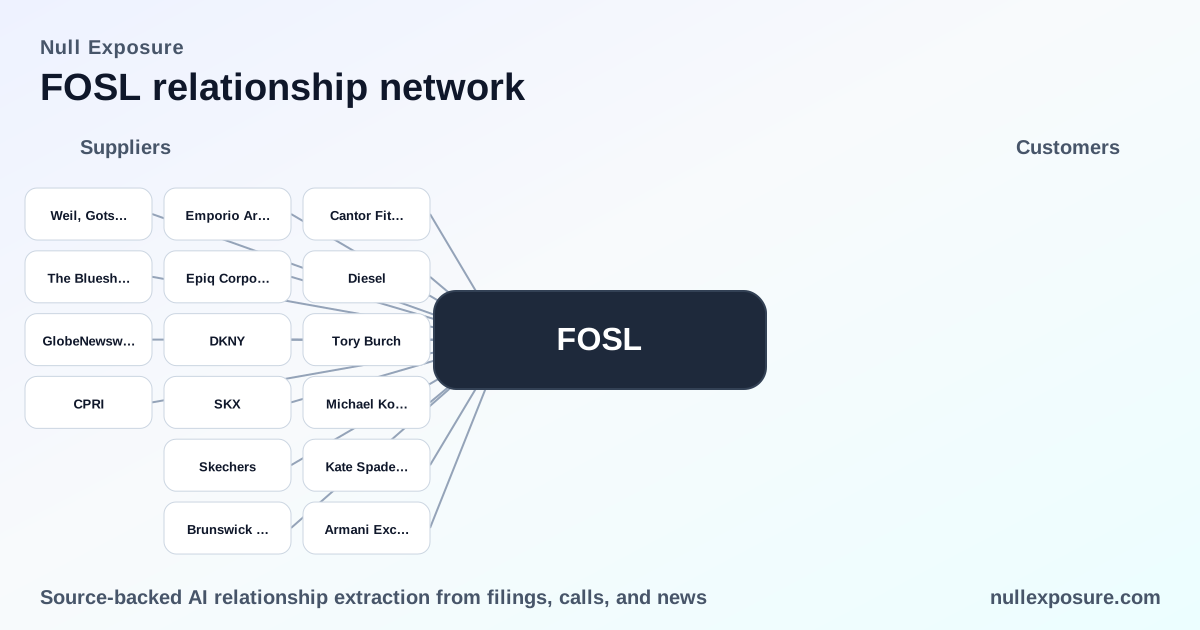
Fossil Group (FOSL): supplier-network and advisory map for investors
Fossil Group designs, sources and sells fashion watches and accessories through a mix of owned labels and licensed brand partnerships, monetizing via wholesale, retail and licensing fees while relying on international manufacturers for production. The current public narrative and filings center on a debt-exchange process and operational exposures tied to global sourcing and short-term manufacturing arrangements — factors that directly affect supplier continuity and restructuring outcomes. For deeper supplier-risk mapping and counterparty intelligence, visit https://nullexposure.com/.
How Fossil runs the machine and where value flows
Fossil’s revenue is generated through three interlocking vectors: owned-brand retail and wholesale, licensed-brand royalties and agreements, and cost-sensitive international manufacturing. The company outsources most production internationally — primarily in China and across APAC — and operates with a mix of long-standing supplier relationships but without formal long-term contracts with unrelated manufacturers, making sourcing flexible yet sensitive to geopolitical and operational shocks. Fossil recently executed a restructuring and exchange-offer process for its senior notes, which has concentrated activity with financial and legal advisors and information agents supporting the capital structure work.
- Monetization: product sales (owned and licensed brands) and licensing/royalty arrangements with fashion houses.
- Cost base and risk: production sourced globally, concentration in APAC manufacturing, and short-term contracting posture that reduces binding guarantees but increases supplier volatility.
- Capital posture: active debt-exchange and restructuring processes with dealer managers, information agents and legal counsel in play.
If you evaluate supplier counterparty risk or vendor concentration as an investor or operator, consider mapping these relationships into procurement and scenario models—learn how at https://nullexposure.com/.
Operating constraints that matter to investors
The public record provides direct signals about the nature and maturity of Fossil’s supplier and service relationships:
- Short-term contracting posture: Fossil states it does not have long-term contracts with unrelated watch and accessory manufacturers, although it maintains long relationships with several manufacturers; this is a company-level signal that procurement flexibility comes at the cost of enforceable supply guarantees (confidence: 0.60).
- Global sourcing with APAC concentration: The company sources the vast majority of products internationally and explicitly names China as a primary manufacturing source, making Fossil exposed to foreign regulation, shipping disruption and country-specific operational risk (confidence: 0.80 for both global sourcing and APAC emphasis).
- Manufacturing role is central: Multiple excerpts label counterparties as manufacturers, indicating that third-party production is a critical operational dependency rather than a peripheral service (confidence: 0.80).
- Third‑party service providers for security and operations: Fossil uses external service providers to manage cybersecurity alongside an internal CISO and team, implying outsourced operational services are part of the enterprise control environment (confidence: 0.80).
These constraints indicate a company operating with high supplier flexibility, high geopolitical and logistics sensitivity, and active reliance on external professional advisors during a complex restructuring.
Who Fossil is dealing with right now — counterparties and advisors
Below I list every counterparty and advisory name surfaced in the recent results with a concise description and source reference.
- Cantor Fitzgerald & Co. — Acts as dealer manager for Fossil’s exchange offer and is the direct point of contact for investors seeking transaction details, including named representatives Tom Pernetti and Ian Brostowski. See the company announcement and related press coverage in October 2025 and March 2026 (GlobeNewswire / Futunn, Oct–Nov 2025; Mar 2026).
- Epiq Corporate Restructuring, LLC — Served as the Information, Exchange and Subscription Agent for Fossil’s exchange offer and consent solicitation, reporting tender results and processing documentation for the restructuring. Refer to Fossil’s exchange-offer notices (Futunn / GlobeNewswire, Oct 2025).
- Brunswick Group LLP — Functions as Fossil’s media contact for the restructuring plan and helped manage external communications during the plan and sanction-order announcements. See the restructuring notices and media contact statements (MarketScreener / GlobeNewswire, Oct–Nov 2025).
- Weil, Gotshal & Manges LLP — Identified as Fossil’s legal advisor on the Restructuring Plan, handling legal guidance tied to the Notes Restructuring and plan meetings. This is documented in the company’s notice of plan meeting (MarketScreener, Oct 2025).
- The Blueshirt Group — Listed as Fossil’s investor relations contact (Christine Greany), responsible for investor communications and earnings release coordination in Q3 and Q4 filings/announcements (GlobeNewswire / QuiverQuant, Nov 2025; Feb–Mar 2026).
- Diesel — Cited as one of Fossil’s licensed brands; Diesel is part of Fossil’s licensing portfolio, demonstrating Fossil’s revenue mix includes externally branded licensing relationships (MarketScreener / GlobeNewswire, Oct–Nov 2025).
- Tory Burch — Shown among the suite of licensed brands Fossil produces, indicating ongoing license agreements that contribute to product assortment and revenue (MarketScreener / GlobeNewswire, Oct–Nov 2025).
- Michael Kors (including references as MICHAEL KORS / Capri) — Listed as a licensed brand in Fossil’s brand portfolio; licensing with major fashion houses like Michael Kors supports Fossil’s retail footprint (MarketScreener / GlobeNewswire / QuiverQuant, Nov 2025; Feb–Mar 2026).
- Kate Spade New York — Appears in Fossil’s roster of licensed brands for watches and accessories, reinforcing diversified licensing income streams (GlobeNewswire, Nov 2025).
- Armani Exchange — Identified as a licensed brand in Fossil’s communications and earnings materials (MarketScreener / GlobeNewswire / BNNBloomberg, Oct–Nov 2025).
- Emporio Armani — Named in the same licensing group, reflecting Fossil’s multi-brand licensing strategy (MarketScreener / GlobeNewswire, Oct–Nov 2025).
- DKNY — Included among Fossil’s licensed brand partners noted in financial releases and press coverage (MarketScreener / GlobeNewswire, Oct–Nov 2025).
- Skechers (SKX) — Listed as a licensed brand partner in Fossil announcements, confirming broader brand-licensing relationships beyond traditional fashion houses (QuiverQuant / GlobeNewswire, Feb–Mar 2026).
- Epiq / repeated entries — Multiple filings reiterate Epiq’s role as the information agent for the restructuring, underscoring a continuing operational role in the debt-exchange timeline (GlobeNewswire / Futunn, Oct–Nov 2025).
- GlobeNewswire (as a distribution channel) — Used by Fossil to publish financial results, restructuring notices and press releases; serves as the primary distribution point for official company announcements (GlobeNewswire releases, Oct–Nov 2025; Feb 2026).
- BNNBloomberg (coverage) — Reported on Fossil’s extension of the exchange offer and disclosed net-debt figures referenced in market commentary (BNNBloomberg, Oct 2025).
Each of the above entries is drawn from Fossil’s published press releases and consequential market coverage between October 2025 and March 2026; these sources show the company’s dual exposure to brand-license counterparties and to a concentrated set of restructuring advisors and agents.
Investment implications and tactical takeaways
- Supplier exposure is operationally critical. Fossil’s reliance on APAC manufacturing with no long-term contracts for unrelated manufacturers translates into procurement flexibility but elevates execution risk under supply-chain stress or trade-policy change.
- Restructuring drives counterparty concentration. Dealer managers, information agents and legal counsel are central to near-term outcomes; monitoring Epiq, Cantor Fitzgerald and Weil will provide early signals on creditor coordination and settlement mechanics.
- Licensing diversification reduces single-brand dependence but not structural margin pressure. The broad licensed portfolio (Armani Exchange, Diesel, Michael Kors, Kate Spade, Skechers, Tory Burch, DKNY, Emporio Armani and others) supports revenue resilience, yet product-margin recovery depends on sourcing stability and successful capital restructuring.
For operational teams and investors who want a supplier-focused intelligence feed or to model counterparty exposures by supplier role and geography, start with a tailored review at https://nullexposure.com/.
Conclusion: what to watch next
Track three vectors to gauge risk-to-reward over the next 12 months: (1) progress of the exchange offer and any creditor agreements coordinated by Cantor Fitzgerald and Epiq; (2) signs of supplier disruptions in APAC or changes to manufacturing partners; and (3) revenue trends across licensed brands reported in quarterly releases distributed via GlobeNewswire. Fossil’s business is highly dependent on external manufacturers and a small set of restructuring advisors, so investor returns will correlate tightly with successful capital restructuring and stabilization of global sourcing channels.
If you are modeling counterparty risk or preparing procurement contingency plans, detailed mapping of Fossil’s suppliers and advisors is available—learn more at https://nullexposure.com/.