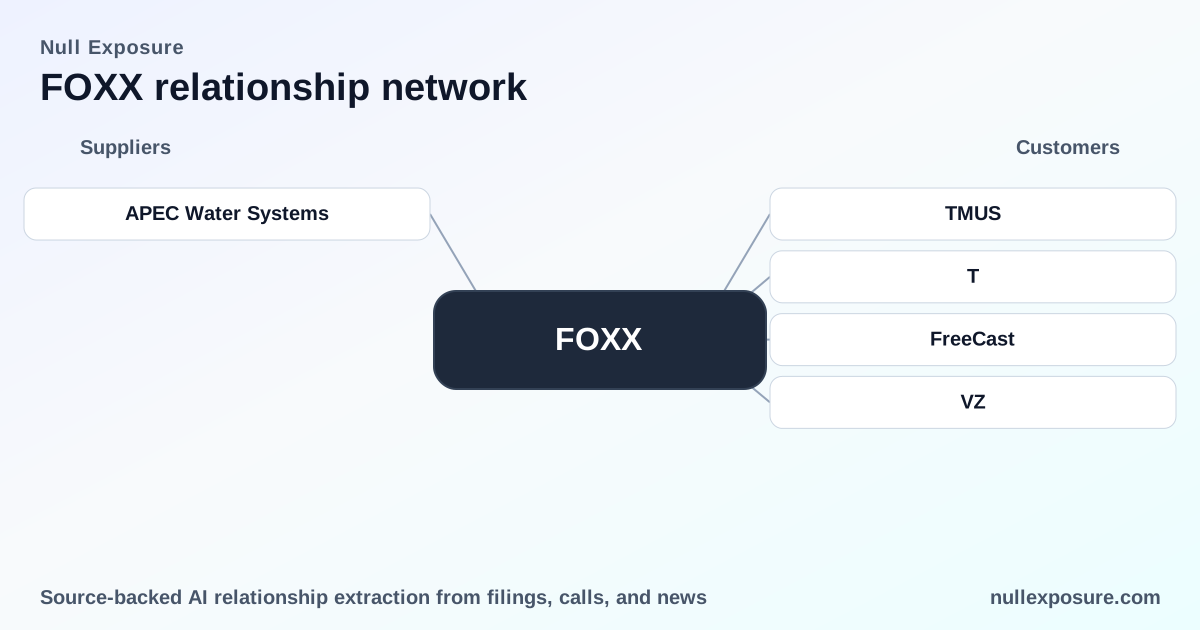
FOXX Supplier Footprint: What investors and operators need to know
Foxx Development Holdings (FOXX) operates as a development and product integrator that generates revenue from real estate projects and from strategic technology partnerships that commercialize hardware-enabled services. The company combines property development with partner-supplied devices and certifications to create bundled offerings; it monetizes through project sales/leasing and through the sale and deployment of partner-branded hardware and associated services. For investors, the financial profile is small-cap and loss-making today, with meaningful supplier-driven operational risk that requires active monitoring.
Learn more about supplier-risk monitoring at https://nullexposure.com/.
Why supplier relationships matter to FOXX’s business model
Foxx’s operating model is not a pure developer play. Company disclosures and reported activity show an operational posture that depends on external manufacturers, certification bodies, and channel partners to turn product concepts into shippable, compliant units. That reliance produces three investor-relevant characteristics:
- High supplier concentration: Foxx discloses a single, unnamed supplier that accounted for a very large share of purchases for the fiscal year ended June 30, 2025 — a structural vulnerability for procurement, pricing and continuity.
- Regulatory and certification dependency: The company documents its role as a certified supplier to FCC programs and its use of third-party agencies for FCC equipment authorizations and Global Mobile Suppliers Association certifications, which makes its go-to-market contingent on successful certification and compliance.
- Geographic supplier exposure: Foxx reports cultivated supplier relationships in Indonesia and Southeast Asia, indicating that production and supply-chain risk are concentrated in APAC jurisdictions.
Together these signals indicate a contracting posture that is reliant on a narrow set of external partners, high materiality of chosen suppliers, and an operational model where certification and cross-border sourcing are critical to revenue delivery. For active investors and operators, those are not speculative warnings — they are actionable levers for governance and contract negotiation.
The constraint signals investors must treat as company-level realities
Company disclosures provide the raw constraints that shape FOXX’s supplier risk profile:
- Foxx states: "As a certified supplier for the FCC's Lifeline and Affordable Connectivity Program (ACP), we played a vital role in efforts to ensure essential communication services are economically accessible." That is a direct signal that regulatory standing and program eligibility are part of FOXX’s commercial base.
- The company reports: "For the year ended June 30, 2025, one supplier, supplier A, which is a third party of the Company, accounted for 93% of the Company’s total purchases." That is a defining materiality constraint for procurement and working-capital risk.
- Foxx also notes supplier relationships in Indonesia and Southeast Asian countries, which establishes APAC concentration in sourcing.
- The firm explains that it engages third-party agencies for testing and certifications, including Equipment Authorizations from the FCC and certifications from the Global Mobile Suppliers Association, indicating an operational dependency on external testing and approvals.
- Filings further reference procurement constructs such as supplier concentration reporting and “PurchasesMember” disclosures, reinforcing the formal recognition of supplier risk in financial statements.
These are company-level signals about concentration, criticality, regulatory dependence, and cross-border sourcing — not properties tied to any single named partner unless the company explicitly states so.
APEC Water Systems — the supplier relationship identified
APEC Water Systems is cited in public reporting as a strategic technology partner for a product launch. The announcement states that Foxx launched the APEC Smart Water Leak Detector through the partnership, illustrating a channel where Foxx leverages third-party manufacturing and co-branding to bring devices to market. Source: a news item on intellectia.ai dated March 9, 2026.
What the APEC relationship implies for investors and operators
The APEC tie demonstrates Foxx’s commercial approach: partner with established manufacturers to accelerate product rollouts rather than internalize full manufacturing. For investors that implies:
- Revenue leverage with limited capital outlay: Partner launches let Foxx access product revenue without building a factory, preserving capex.
- Operational and reputational dependency: Product quality, delivery and compliance are co-dependent on APEC’s capabilities, and product failures or certification gaps will flow back to Foxx’s brand.
- Limited diversification of supplier risk: Given the company-level disclosure that one supplier represents the overwhelming share of purchases, any single-device partnership increases the effective concentration unless counterbalanced by additional supplier relationships.
Source for the APEC tie: press coverage of the March 2026 product launch on intellectia.ai.
Explore supplier concentration analytics and portfolio-level stress scenarios at https://nullexposure.com/.
Practical recommendations for investors and operators
Investor and operational priorities are straightforward and actionable:
- Treat supplier concentration as an active risk factor: Require management to disclose supplier identity or credible mitigation plans if one supplier accounts for a dominant share of purchases. Insist on visibility into contract length, exclusivity, minimum purchase commitments, and termination rights.
- Monitor certifications and program eligibility: Because FOXX relies on FCC Equipment Authorizations and program certifications (Lifeline/ACP), investors should track renewal cycles, regulatory audits, and any changes in program rules that could interrupt revenues.
- Stress-test APAC supply continuity: Given supplier relationships in Indonesia and Southeast Asia, model logistics disruption scenarios (ports, tariffs, supplier insolvency) and inventory buffers required to sustain operations for 3–6 months.
- Demand commercial redundancy: From an operational governance perspective, require a supplier diversification roadmap that reduces any single supplier’s share of purchases below materiality thresholds within a defined period.
These actions convert observed disclosure constraints into governance responses that protect valuation.
Final assessment and next steps
Foxx’s public disclosures and reported partnership activity show a business model that strategically outsources manufacturing and relies on certifications to unlock programs and channels. That model conserves capital but concentrates execution risk in a few external relationships. Investor focus should be on supplier concentration, certification continuity, and APAC supply-chain resilience.
For a structured supplier-risk review and ongoing monitoring tailored to FOXX’s profile, visit https://nullexposure.com/ and set up targeted alerts and contractual review templates. Investors and operators that convert these disclosure signals into governance actions will materially reduce downside from supplier disruptions.