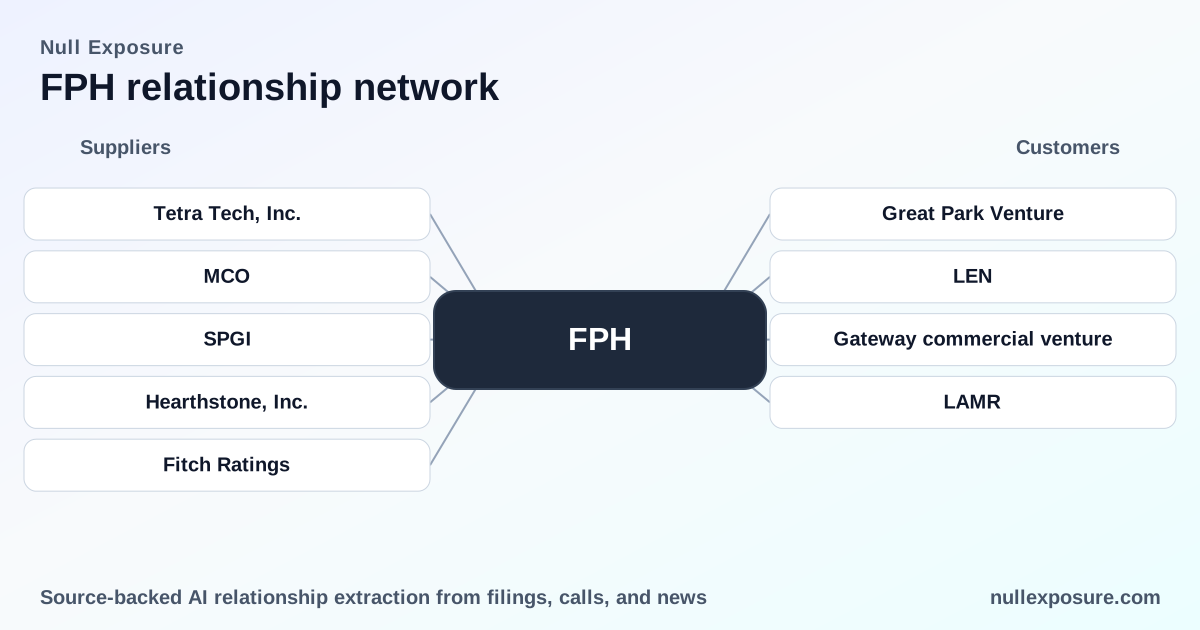
Five Point Holdings (FPH) — supplier relationships and what they mean for investors
Five Point Holdings develops and operates master-planned communities and monetizes through the sale and development of residential and commercial real estate, supplemented by long-term service arrangements and asset dispositions. Key monetization drivers include property development cash flows, long-dated contractual obligations tied to site infrastructure (notably water delivery agreements), and occasional asset-level transactions with counterparties. This review focuses on FPH’s supplier and counterparty relationships surfaced in public filings and news reporting, and on the implications for operating risk and capital markets exposure. For a comprehensive view of counterparties across property and project lifecycles, visit https://nullexposure.com/.
Why supplier relationships matter for Five Point investors
Supplier and counterparty contracts drive the timetable and cost of development for master-planned communities. Long-term infrastructure contracts, government negotiations over land transfer, and active credit rating interactions directly influence the company’s ability to execute projects, its cost of capital, and near-term cash obligations. Long-tenor commitments and government-controlled parcels create execution risk that is operationally critical and financially material.
- Contracting posture: FPH has at least one long-term buyer-style obligation with a 35-year initial term for water delivery, tying future cash outflows to development economics.
- Concentration and criticality: The water contract shows concentrated, essential inputs for project buildout; remaining minimum payments place the arrangement squarely in the tens-of-millions band, which is material for development economics.
- Maturity and optionality: The water agreement’s initial term runs into 2039 and includes an option for a second 35-year term, establishing a multi-decade commitment that affects capital planning and scenario analysis.
- Government interaction: Portions of key sites are controlled by the U.S. Navy and contingent on formal suitability and transfer processes, creating regulatory gating that delays or conditions revenue realization.
If you want a consolidated supplier risk profile with these dynamics mapped across projects and counterparties, see more at https://nullexposure.com/.
The relationships surfaced (plain-English summaries)
Tetra Tech, Inc.
Tetra Tech is referenced in FPH’s FY2024 filing in relation to contaminated-site sampling at the San Francisco Shipyard: allegations that Tetra Tech contractors misrepresented sampling results have prompted governmental investigations, litigation, and additional sampling by the Navy and regulators. According to Five Point’s FY2024 10‑K, this has produced re-evaluation and additional regulatory work at the site. (Source: FPH FY2024 10‑K filing.)
Moody’s Ratings
Moody’s executed a credit action in September 2025 that upgraded FPH’s senior notes and corporate ratings to B2 (senior notes) and B2 (corporate), reflecting changes in leverage and liquidity posture reported by the company that quarter. The rating action was reported in public news coverage of the company’s 2025 credit updates. (Source: Advfn reporting on September 2025 rating actions.)
S&P Global Ratings
S&P Global reaffirmed FPH’s ratings at B+/B in September 2025, confirming the agency’s view of the issuer’s credit profile even while other agencies adjusted their stances. This reaffirmation was recorded in the same market coverage of 2025 rating activity. (Source: Advfn reporting on September 2025 rating actions.)
Fitch Ratings
Fitch provided initial ratings of BB-/B for FPH in the same September 2025 window, establishing a third independent rating view and expanding the company’s public credit footprint. Market reports captured this initial assignment at the time. (Source: Advfn reporting on September 2025 rating actions.)
Hearthstone, Inc.
Hearthstone is referenced in market reports concerning a corporate transaction in which Five Point acquired Hearthstone Residential Holdings, LLC from Hearthstone, Inc. and an affiliated trust for $57.6 million; this transaction is a discrete, asset-level counterparty interaction that reduced a third-party holdings position and shifted assets under Five Point’s control. (Source: MarketScreener reporting on the transaction.)
What these relationships imply for operations and financials
Environmental and regulatory counterparty risk is a leading operational constraint. The Tetra Tech-related issues at the San Francisco Shipyard increase the probability of slower land transfer, added remediation costs, and protracted regulatory schedules tied to the Navy’s FOST process. The company-level disclosure explicitly notes that approximately 408 acres remain under U.S. Navy ownership and will not be conveyed until the FOST is satisfactorily completed, which is a gating item for revenue recognition on that parcel (FPH FY2024 10‑K).
Capital markets relationships are stabilizing the cost of capital. The September 2025 rating actions — Moody’s upgrade, S&P reaffirmation, and Fitch initial assignment — have immediate implications for borrowing costs and access to liquidity. Multiple rating views create optionality for debt placement and refinancing, and the mixed outcomes (upgrade vs. reaffirmation vs. initial rating) should be priced into scenario analyses for future issuance.
Long-term supplier contracts create scheduled cash outflows that are material. Five Point discloses an aggregate of $28.3 million in remaining annual minimum payments under the initial term of the water purchase agreement, which sits squarely in the $10m–$100m spend band and establishes a predictable near-term cash liability. The contract’s structure (35‑year initial term with a 35‑year option) pushes many obligations far into the future and therefore requires active modeling of interest rates, development timelines, and counterparty performance.
Collectively, these signals show a company managing multi-decade infrastructure commitments, government-controlled land transfers, and evolving credit-market validation, a mix that benefits from close monitoring of remediation outcomes, contract performance, and rating agency feedback.
Explore more supplier and counterparty intelligence for FPH and peers at https://nullexposure.com/ — actionable profiles speed diligence and capital planning.
Investment takeaways and next steps
- Risk to development timelines is elevated where government-held parcels and environmental investigations overlap; quantify the economic impact of delayed conveyance at the San Francisco Shipyard in base and downside cases.
- Credit profile is improving but heterogeneous across agencies; use the September 2025 rating actions to update cost-of-debt assumptions and refinancing windows.
- Known contractual cash commitments are material and long-dated; incorporate the $28.3 million remaining minimum payments and the 35‑year water contract term into multi-year liquidity forecasts.
For investors and operators conducting supplier diligence, the priorities are remediation progress reporting, contract enforceability language on long-term utility purchases, and the trajectory of credit ratings. For a tailored supplier exposure report or to map these relationships across project timelines, visit https://nullexposure.com/ and request a custom analysis.
Bolded summary: FPH operates with material long-term supplier commitments and active government and rating‑agency interactions that are central to execution risk and cost of capital.