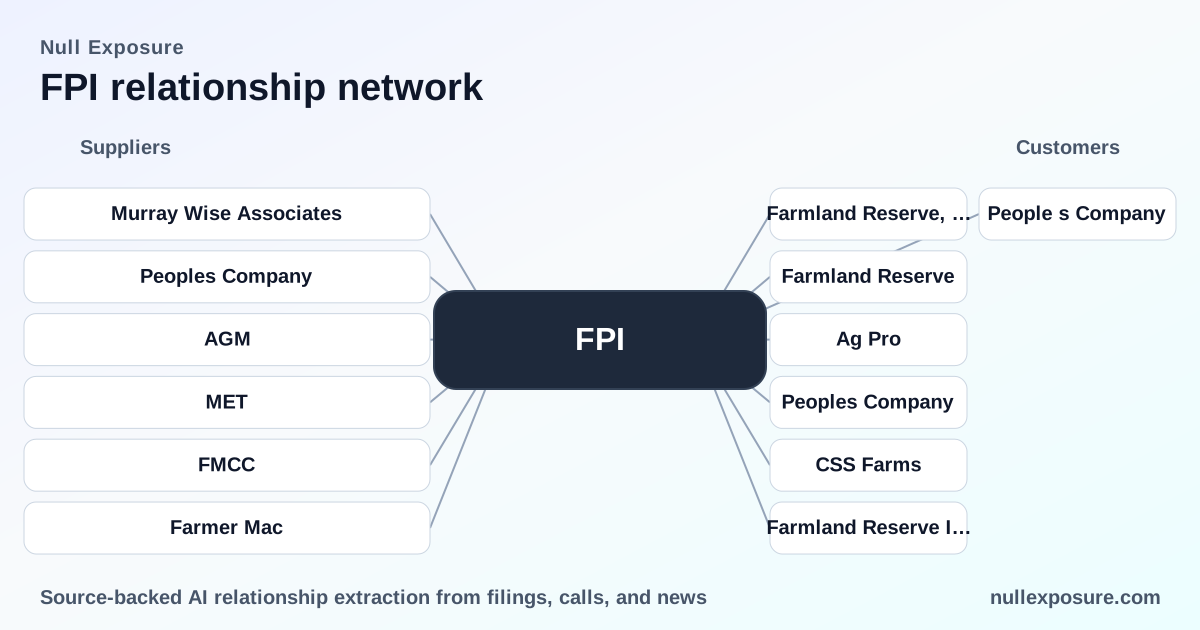
Farmland Partners (FPI): supplier and financing counterparties that shape near-term optionality
Farmland Partners operates as a publicly traded farmland owner and manager that monetizes through land appreciation, rental and crop-share income, and selective asset sales and third‑party management contracts. The company augments balance sheet capacity with secured facilities and bilateral loans while outsourcing specialized farm management functions to third parties, creating a hybrid asset-operator profile that balances capital intensity with operating leverage. For a concise supplier and counterparty risk briefing, see the homepage: https://nullexposure.com/.
How FPI’s business model translates into supplier exposure
Farmland Partners acquires and holds agricultural real estate as a core asset class and extracts cash returns through leasing, management contracts, and occasional dispositions. Revenue drivers are land rents, management fees on non-controlled assets, and proceeds from selective sales, while capital structure relies on asset-backed facilities and third‑party loan relationships. The company regularly adjusts its operating footprint by divesting non-core assets and contracting external managers to preserve scale without commensurate fixed overhead.
This operating posture creates three structural characteristics for suppliers and counterparts:
- Contracting posture: FPI contracts out specialized farm management and relies on third‑party capital providers, which reduces internal staffing but raises vendor criticality.
- Concentration and criticality: Key financing counterparties and a small set of management vendors assume outsized importance relative to FPI’s lean operating team.
- Maturity and optionality: Asset sale and management transitions are used actively to reallocate capital and shorten the return horizon on non-core holdings.
If you want a broader supplier risk view, start here: https://nullexposure.com/.
The relationships that matter — what investors need to know
Murray Wise Associates
Farmland Partners sold Murray Wise Associates (MWA) as part of a strategic repositioning, and the company acknowledged MWA’s role in growing FPI’s management portfolio over the prior four years. This divestiture represents both a monetization of manager capability and a reduction in in‑house management capacity. According to a PR Newswire release (published March 9, 2026), Farmland Partners’ CEO Luca Fabbri specifically credited MWA’s team for expanding FPI’s management portfolio prior to the sale.
Peoples Company
The transaction with Peoples Company, effective November 15, 2025, included an engagement for Peoples Company to continue managing select non‑core farmland assets on behalf of FPI. Peoples Company will serve as an outsourced manager for residual assets, preserving cashflow continuity while transferring operational responsibilities off FPI’s balance sheet. That arrangement was described in the same PR Newswire announcement that covered the MWA sale.
Farmer Mac (multiple facility references)
FPI increased the size of its Farmer Mac facility from $75.0 million to $89.6 million following an amendment in December. Expansion of this facility enhances secured liquidity capacity that supports ongoing land financing and lowers short‑term refinancing stress. The increase was disclosed in FPI’s Q4/FY2025 earnings commentary reported in earnings transcripts summarized by The Globe and Mail and other outlets in March 2026.
MetLife (loan counterparties)
FPI identified four MetLife loans with resets due in 2026 totaling approximately $26.0 million. These upcoming resets create identifiable refinancing risk in the short term and should be monitored against interest rate movement and covenant terms. The loan reset detail was reported in the company’s earnings call transcript coverage by The Globe and Mail (March 2026) and echoed in related earnings coverage.
What the constraint data says about supplier posture and cyber risk
A company‑level constraint flagged in FPI’s profile identifies a reliance on reputable third‑party vendors to mitigate key cybersecurity risks given the company’s relatively small size and personnel. That is a clear signal that FPI’s operating model is vendor‑dependent for critical functions, including cybersecurity and specialized farm operations. For investors, that translates into:
- Higher vendor criticality: A small set of suppliers can create outsized operational risk if contracts fail or service degrades.
- Greater contracting importance: Vendor agreements, SLAs, liability allocation and termination rights materially affect operational continuity.
- Maturity signal: Outsourcing indicates limited internal IT and operational scale; governance and vendor management are therefore central to resiliency.
Treat this as a company-level signal rather than an attribute of any single named relationship.
Investment implications — where value and risks concentrate
Farmland Partners’ use of external managers and expanded asset-backed facilities creates both upside and concentrated risk. Positive implications include immediate liquidity cushion from the Farmer Mac facility amendment and near‑term cash preservation through outsourced management of non‑core assets. Principal risks include the $26.0 million of MetLife loans coming up for reset in 2026 and potential vendor dependence that increases operational leverage to counterparties.
Operationally, transferring management of certain assets to Peoples Company reduces fixed operating expense and preserves yield on core holdings, but it also reduces direct control over farm-level execution and could compress margins if management fees increase. The sale of Murray Wise Associates crystallizes value from a management asset, which strengthens near-term liquidity but removes a growth engine for third‑party management revenue.
Diligence checklist for buyers and counterparties
- Review the Farmer Mac facility amendment terms and covenants to quantify liquidity flexibility.
- Inspect the MetLife loan schedules and reset mechanics for 2026 to assess refinancing sensitivity.
- Evaluate the Peoples Company engagement terms and SLAs to understand retained operational control and fee structure.
- Examine transition arrangements and customer handoffs resulting from the Murray Wise Associates sale to assess revenue continuity.
- Validate vendor cybersecurity controls and contingency plans given FPI’s dependency on third‑party providers.
Need a deeper supplier risk brief? Learn more at https://nullexposure.com/.
Bottom line and next steps
Farmland Partners runs a capital‑intensive, asset-backed business that deliberately outsources management and relies on secured financing. The company shows constructive balance sheet management through facility expansion and selective asset dispositions, but vendor dependence and short‑term loan resets are tangible risk points for investors. For active diligence, prioritize creditor schedules and vendor contracts, and stress-test refinancing scenarios around the 2026 MetLife resets.
For a full supplier-risk profile and ongoing monitoring of FPI counterparties, visit the homepage and begin a tailored review: https://nullexposure.com/.