Forgent Power Solutions (FPS): What the underwriter lineup reveals about financing, risk and supplier posture
Forgent Power Solutions manufactures electrical distribution equipment and monetizes through product sales to utilities, construction and industrial customers while pursuing scale via capital markets; the company has engaged major investment banks to lead an IPO that will directly fund growth and provide a public valuation. The selection of lead underwriters and timing of the filing are the primary financing signals investors should interpret when assessing FPS's supplier and capital relationships. For more detailed coverage and ongoing monitoring, visit https://nullexposure.com/.
Why the underwriter roster matters for investors
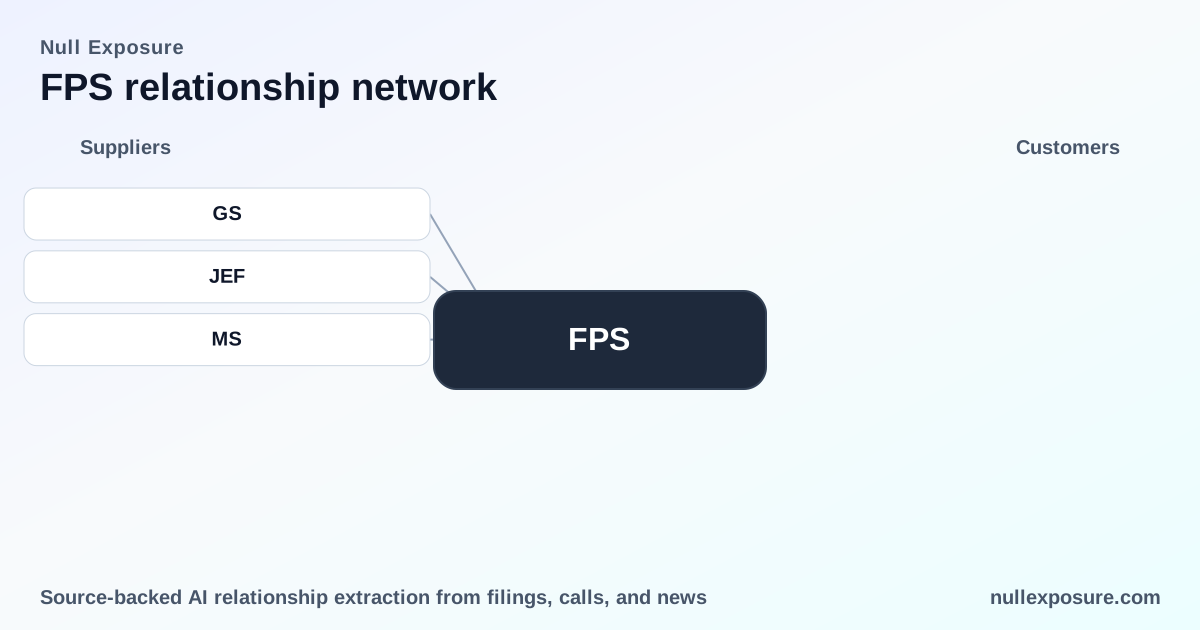
Underwriters are not merely intermediaries for equity issuance — they signal access to distribution channels, pricing discipline and investor appetite. Goldman Sachs, Jefferies and Morgan Stanley as lead bookrunners indicate institutional placement capability, underwriting scale and visible sell-side support for the transaction. Their involvement reduces execution risk for the IPO compared with a less-established syndicate and creates direct channels to institutional investors that will set the company’s initial trading dynamics.
Who FPS has engaged (direct relationship coverage)
- Goldman Sachs & Co. LLC — Goldman Sachs is listed as a lead underwriter for FPS’s IPO, which positions the bank to drive bookbuilding, pricing and institutional allocation. A TradingView news report on March 9, 2026 lists Goldman Sachs among the lead underwriters for the filing (TradingView, 2026-03-09).
- Jefferies — Jefferies is named alongside the other bookrunners, giving FPS distribution into middle-market and specialized industrial investor bases where Jefferies has coverage strength. The same TradingView article from March 9, 2026 documents Jefferies as a lead underwriter (TradingView, 2026-03-09).
- Morgan Stanley — Morgan Stanley is listed as the third lead underwriter, providing additional top-tier institutional reach and stabilizing power for the syndicate during roadshow and aftermarket phases. TradingView reported Morgan Stanley as a lead underwriter in the March 9, 2026 filing coverage (TradingView, 2026-03-09).
Operating-model constraints and company-level signals
The available information contains no explicit contractual constraints or supplier-level obligations disclosed in the sample. Treat that absence as a company-level signal: the public filing stage focuses on capital markets relationships rather than supplier contracts, and current external signals center on financing partners rather than operational suppliers.
Key operational signals investors should factor into diligence:
- Contracting posture: transactional and capital-market oriented at present — the priority is securing IPO capital rather than renegotiating vendor contracts. That produces a short-term contracting posture that favors speed and certainty of proceeds.
- Concentration: concentration of capital-market relationships is low in the sense of underwriter diversity (three lead banks), which is standard for major IPOs; this concentration increases the effectiveness of bookbuilding but creates single-point dependency on syndicate execution quality.
- Criticality: underwriting relationships are critical to liquidity and valuation; they materially affect IPO pricing, aftermarket support and institutional access.
- Maturity: FPS is at a transitional maturity stage — moving from private operating model to public-company obligations, which introduces new reporting requirements and governance scrutiny that suppliers and customers will watch.
What the underwriter choices imply for commercial counterparties and operators
Underwriter selection shapes expectations across several fronts: roadshow emphasis, investor mix, and interim balance-sheet flexibility. A top-tier syndicate increases the likelihood of a well-distributed book and stronger aftermarket support, which directly affects FPS’s bargaining power with suppliers and potential for strategic M&A funding. For operators, that translates to an improved ability to negotiate payment terms once the IPO proceeds are realized; for suppliers, the IPO outcome will determine counterparty credit risk and growth expectations.
Risks to monitor:
- Pricing pressure if the market re-prices industrial or capital goods sectors between filing and pricing.
- Execution risk concentrated in a small group of lead banks; underwriter reputation reduces but does not eliminate the volatility of aftermarket trading.
For ongoing monitoring and to track how these relationships evolve through pricing and aftermarket stabilization, visit https://nullexposure.com/.
Due diligence checklist tied to these relationships
Investors and operators should prioritize the following checks before drawing firm conclusions:
- Review the final prospectus for any operational covenants, large customer dependencies or supplier commitments disclosed in the S-1.
- Track lock-up schedules and underwriter stabilization activities post-IPO to anticipate share supply and short-term price pressure.
- Assess investor targeting from the roadshow to understand the likely shareholder base (long-only institutions vs. short-term allocators).
- Verify whether proceeds are earmarked for debt reduction, capex or working capital — each use case alters supplier negotiation dynamics.
These actions convert a financing signal into an operational thesis that underpins supplier and partner decisions.
Closing takeaways and next steps
Lead underwriters Goldman Sachs, Jefferies and Morgan Stanley provide FPS with a high-quality path to public markets, enhancing execution credibility and institutional reach. The current public information centers on capital-market relationships rather than supplier constraints, so investors must combine the underwriting signal with prospectus disclosures to form a complete operational risk view. For hands-on tracking of FPS’s filing progress and relationship changes, return to https://nullexposure.com/.
Final recommendation: prioritize the S-1 and subsequent pricing materials for direct evidence of how IPO proceeds are allocated, then reassess supplier negotiations and counterparty credit profiles once proceeds are deployed.