Franklin Financial (FRAF) — supplier relationships and what they mean for investors
Franklin Financial operates as a regional banking group that monetizes through net interest income and fee-driven lending activities, supplemented by short-term and term borrowing relationships that support balance-sheet liquidity and funding of loan growth. The company's supplier posture is oriented toward institutional liquidity providers rather than third-party service vendors; the capital structure includes committed wholesale borrowings that function as strategic, rate-sensitive supply lines. For investors, the key lens is how those borrowings affect refinancing windows, interest expense, and funding concentration.
Explore more supplier intelligence at https://nullexposure.com/
One clean relationship drives the funding story
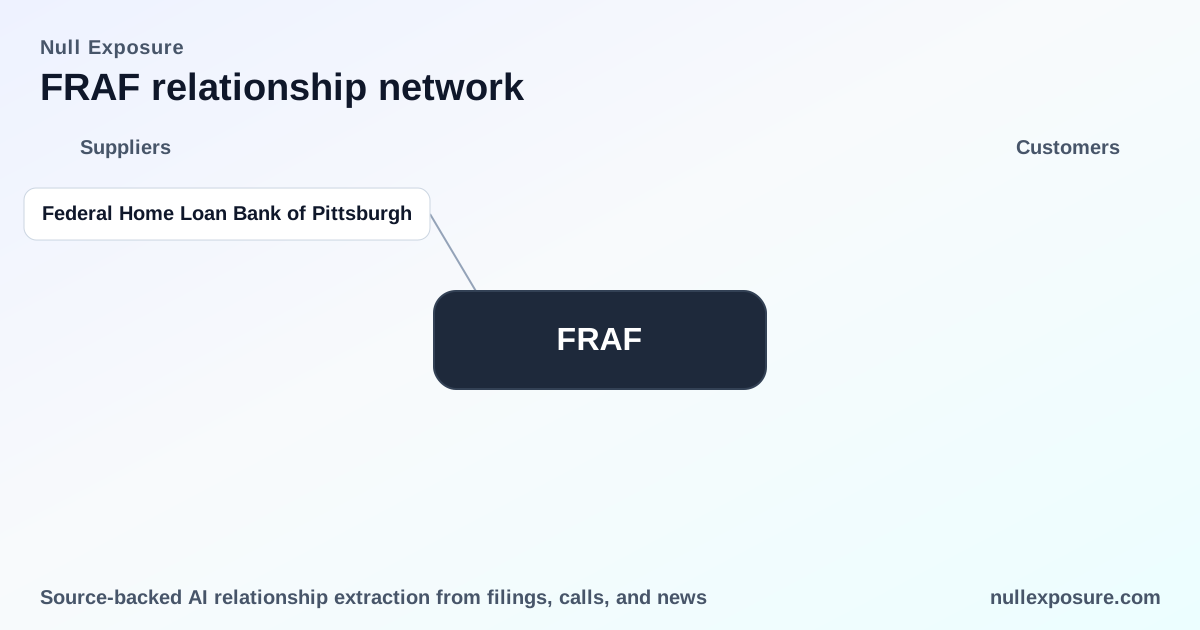
Franklin’s disclosed supplier relationships are narrow and finance-centric. As of the most recent public disclosures, the Federal Home Loan Bank of Pittsburgh (FHLB) is a material funding counterparty through a term borrowing that provides committed liquidity and shapes funding cost. According to a PR Newswire release summarizing Franklin Financial’s FY2025 results (published March 2026), the company had borrowings of $200.0 million from the Federal Home Loan Bank of Pittsburgh as of December 31, 2025. This is the primary supplier relationship investors must evaluate when sizing balance-sheet risk and refinance exposure. (Source: PR Newswire, Franklin Financial FY2025 results, March 2026.)
What the FHLB borrowing concretely signals about the operating model
- Long-term, rate-sensitive funding: Company disclosures indicate a $200.0 million term loan from the FHLB that matured in January 2027 at a stated rate of 4.32% (disclosed as of December 31, 2024). This characterizes the borrowing as a committed, medium-term facility rather than short overnight wholesale funding, which improves predictability of interest expense through the term. (Source: company disclosure as of Dec 31, 2024.)
- Concentration of supplier exposures: With FHLB as an identified counterparty at material size, supplier concentration is elevated on the funding side; the balance sheet depends on a small number of institutional lenders for wholesale liquidity rather than a broad, diversified set of capital providers.
- Criticality to liquidity management: The FHLB borrowing is a functional part of the bank’s liquidity toolkit—used to fund assets and manage regulatory liquidity ratios—so the relationship is operationally critical rather than purely ancillary.
- Maturity profile and refinancing timeline: The January 2027 maturity creates a known refinancing event in the medium term that investors must price into valuations and stress tests, especially if interest rates diverge from the 4.32% coupon in place during the loan period.
Relationship-level disclosure (every supplier in the record)
Federal Home Loan Bank of Pittsburgh — Franklin had borrowings of $200.0 million from the FHLB as of December 31, 2025, providing medium-term wholesale funding that supports asset funding and regulatory liquidity needs. (Source: PR Newswire, Franklin Financial reports 2025 Q4 and year-to-date results, published March 2026.)
Why that single relationship matters to valuation and credit work
The presence of a sizable FHLB facility defines several investor actions:
- Funding-cost sensitivity: The fixed-rate nature of the term loan through January 2027 at 4.32% reduces near-term interest-rate pass-through variability, but the refinance will occur in a materially different rate environment, which must be modeled into forward-looking net interest income scenarios.
- Liquidity concentration risk: With a concentrated borrowing counterparty, counterparty access and terms become a governance and credit-risk item; a stressed regional funding market or a change to FHLB collateral eligibility would directly affect Franklin’s cost of funds and available liquidity.
- Maturity cliffs as event risk: The January 2027 maturity is a discrete event that can be hedged, amortized, or refinanced; investors should check for available liquidity sources now rather than assuming seamless roll-forward.
If you want a deeper supplier map for valuation or due-diligence, see additional coverage at https://nullexposure.com/
Operational and contractual posture — what the constraints tell us
The documented contract-type constraint classifies Franklin’s borrowing as long-term, supported by the specific disclosure of a term loan maturing in January 2027 at a fixed coupon (4.32%). That classification implies:
- Stable contractual terms through the loan life rather than demand-style borrowings that can be recalled overnight.
- Predictable amortization/refinance timelines, enabling the bank to plan asset-liability management around a known repayment date.
- Greater lender negotiating leverage at rollover, since a concentrated facility increases the economic importance of the lender-borrower relationship at maturity.
These are company-level operational signals drawn directly from Franklin’s own disclosures and affect how investors assess both the credit profile and strategic runway.
Practical investor checklist
- Confirm whether the $200.0 million FHLB borrowing remains outstanding and whether any amendments or prepayments have occurred since the latest report. The maturity date (January 2027) is the near-term event to monitor.
- Stress-test net interest income under scenarios where the facility is refinanced at materially higher rates or where FHLB advances become more restrictive.
- Evaluate the bank’s access to alternative wholesale funding to mitigate concentration risk and quantify contingency funding plans in adverse scenarios.
For subscription-grade supplier analysis and ongoing monitoring tools, visit https://nullexposure.com/
Bottom line: concentrated lender exposure, manageable if monitored
Franklin Financial’s supplier footprint is concentrated and finance-centric: one material FHLB term loan represents the primary supplier relationship and defines liquidity and refinancing risk over the next 12–18 months. The facility’s term structure (fixed rate through January 2027) gives the company predictable near-term interest expense, but creates a discrete refinancing event that investors must model explicitly. Track the FHLB borrowing status, verify alternative funding sources, and price the rollover into near-term forecasts to maintain an accurate risk-adjusted view of FRAF.