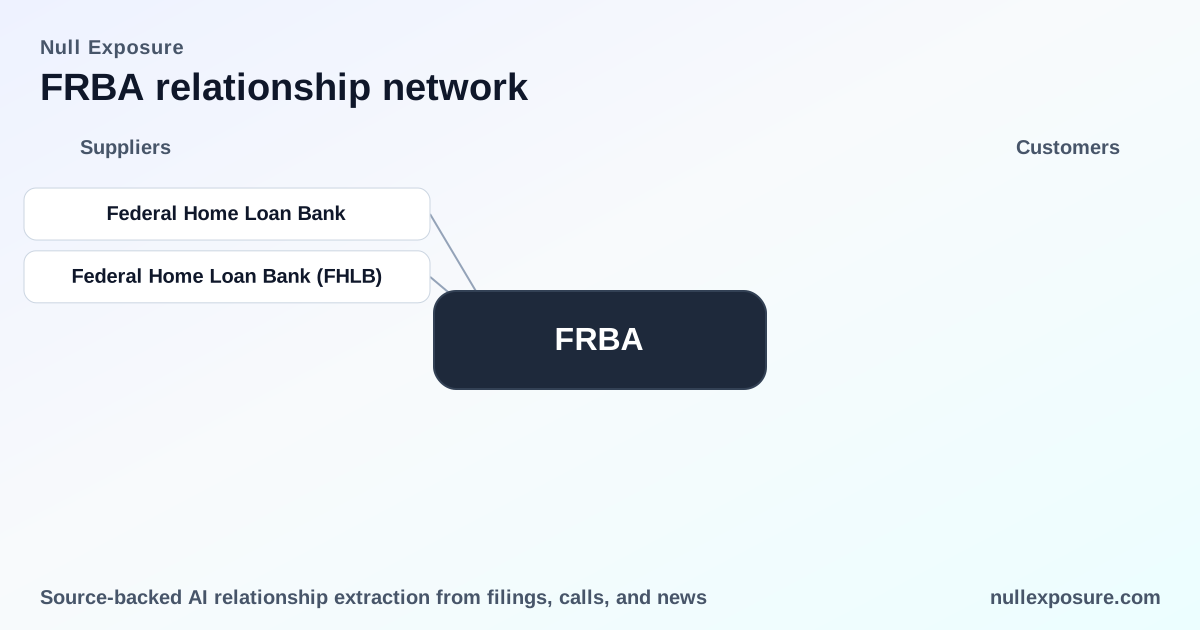
First Bank (FRBA) — FHLB dependence and what it means for liquidity and risk
First Bank operates as a regional commercial bank headquartered in Hamilton, NJ, earning interest and fee income from deposit and lending activity and monetizing scale through net interest margin and noninterest services. Revenue is concentrated in traditional banking spreads — net interest income — supported by a conservative balance sheet and access to wholesale liquidity lines, with FY figures showing $135.3M in trailing revenue, a 32.3% profit margin and a 10.2% return on equity. For investors and operators, the bank’s relationship with liquidity counterparties is a key operational lever and a near-term driver of funding flexibility.
Explore deeper supplier-risk intelligence at https://nullexposure.com/
Quick snapshot for the investor who needs to act
First Bank (NASDAQ: FRBA) presents as a value-tilted regional bank with a trailing P/E of 9.16, price-to-book under one at 0.87, and a market capitalization near $377M. The bank reported steady quarterly revenue growth with modest EPS improvement (diluted EPS of $1.66) and a low beta (0.67) that signals limited market volatility relative to peers. Dividend yield is small but consistent (1.59%), supporting an income-sensitive investor profile. These broad financials contextualize the supplier relationships examined below: they are operationally material because liquidity partners influence margin and balance sheet composition.
What the public record shows about FHLB and borrowings
The relationships in the record are exclusively linked to the Federal Home Loan Bank (FHLB) system. Each entry below reproduces the public mention in the source and summarizes the operational fact investors need.
-
Federal Home Loan Bank — Yahoo Finance coverage (March 9, 2026): First Bank disclosed that borrowings decreased by $65.1 million compared to September 30, 2025, driven by reduced FHLB advances, which increased available borrowing capacity at the FHLB. This was reported in a news summary tied to the bank’s quarterly release on March 9, 2026. Source: Yahoo Finance article dated March 9, 2026 — https://finance.yahoo.com/news/first-bank-announces-fourth-quarter-214500053.html
-
Federal Home Loan Bank (FHLB) — GlobeNewswire press release (Jan 26, 2026): The bank’s formal press release stated the same $65.1 million reduction in borrowings vs. 9/30/2025 and higher available capacity at the FHLB, documenting a shift in wholesale funding utilization for the quarter. Source: First Bank press release, January 26, 2026 — https://www.globenewswire.com/news-release/2026/01/26/3226012/0/en/first-bank-announces-fourth-quarter-2025-net-income-of-12-3-million-and-full-year-net-income-of-43-7-million.html
-
Federal Home Loan Bank (FHLB) — Secondary GlobeNewswire posting (Jan 26, 2026): An additional GlobeNewswire listing restates the quarter-end borrowing decrease and availability statement, reinforcing the bank’s disclosure on borrowings and FHLB capacity. This duplicate press distribution confirms the messaging across investor channels. Source: GlobeNewswire reposting, January 26, 2026 — https://www.globenewswire.com/news-release/2026/01/26/3226012/0/en/First-Bank-Announces-Fourth-Quarter-2025-Net-Income-of-12-3-Million-and-Full-Year-Net-Income-of-43-7-Million.html
Why this FHLB signal matters for operators and investors
The public disclosures show an active relationship with the FHLB system and a meaningful reduction in advance utilization, which is a direct lever on funding cost and liquidity cushion. From an operational and investment perspective:
-
Contracting posture: First Bank treats the FHLB as a flexible backstop. The drop in advances indicates either stronger core deposit funding or deliberate de-leveraging; either outcome reduces immediate wholesale funding dependence and improves short-term liquidity ratios.
-
Concentration and criticality: Access to an FHLB advance facility is a critical supplier relationship for regional banks. Even though First Bank reduced borrowings this quarter, the maintained availability at the FHLB signals a continued reliance on that counterparty for contingency funding and balance sheet management.
-
Maturity and stability: The disclosures are routine and operational — not one-off emergency borrowings — which positions the FHLB relationship as mature and ongoing, not ad hoc. This is a company-level signal about funding strategy rather than a transient stress event.
These factors collectively translate into lower short-term funding risk but an ongoing counterparty dependence that warrants monitoring. If deposit outflows accelerate or loan growth re-accelerates, that latent FHLB capacity can convert back into active advances quickly; the market should value that optionality.
Explore supplier-level exposure assessment and scenario tooling at https://nullexposure.com/
Practical implications and monitoring checklist for investment teams
Operators and credit risk teams should convert the disclosure into a short, actionable monitoring plan:
- Track quarterly changes in FHLB advances and available capacity alongside deposit inflows and loan growth; a rising advance balance materially changes funding cost and leverage metrics.
- Monitor deposit beta and NIM trends — reduced FHLB usage often coincides with improved funding cost but can compress liquidity buffers.
- Review covenant proximity on any outstanding advances and confirm whether there are pledged assets or collateral requirements that could constrain future balance sheet actions.
- Watch for regulatory filings and management commentary around capital buffers and stress testing outcomes; management’s stated intention to hold lower advance balances is operationally significant.
Final read: timing your diligence and positional adjustments
First Bank’s recent disclosure of a $65.1 million reduction in FHLB advances is a clear operational signal: the bank currently leans on improved deposit dynamics (or deliberate shrinkage of advance utilization) to reduce wholesale exposure, while preserving FHLB capacity as a liquidity backstop. For investors this implies short-term funding risk is moderated, but the counterparty relationship remains strategically important and should be included in ongoing due diligence. For operators, the message is to preserve optionality with the FHLB while optimizing deposit acquisition and margin.
For a deeper, supplier-focused due diligence framework and to map this exposure into scenario-driven P&L impacts, visit https://nullexposure.com/
Bold takeaway: FHLB access is not just a line item — it is an operational lever that materially affects First Bank’s liquidity posture, cost of funds, and strategic optionality.