Fortune Rise Acquisition Corp (FRLA): legal and advisory counterparties you need to know
Fortune Rise Acquisition Corp is a classic special purpose acquisition company (SPAC) that monetizes through completing a business combination: it raises IPO capital, holds that cash in trust while sourcing a target, and extracts value for sponsors and public shareholders via the post‑merger equity economics and sponsor promote. FRLA’s economic model is transactional and event‑driven rather than operating cash flow driven—success depends on executing a deal that creates tradable public equity value. For diligence on counterparties and supplier risk, see more at https://nullexposure.com/.
How Fortune Rise operates and where revenue comes from
FRLA is a shell company listed on NASDAQ with no operating revenue and a mandate to consummate one or more business combinations. The corporate description states the company intends to enter into a merger, stock exchange, asset acquisition, stock purchase, reorganization, or similar business combination, which is the primary pathway to value creation for public investors and sponsors. Financial statements show zero revenue, negative book value per share, and a small market capitalization (~$36.8M)—characteristics that reflect a sponsor‑led vehicle rather than an operating enterprise.
This operating posture creates several structural characteristics investors must treat as constraints on risk and upside:
- Concentration of value around a single transaction: the firm’s success and cash conversion depend on completing a targeted business combination.
- Short maturity on decision execution: SPAC timelines compress the window for diligence, contracting and negotiation, heightening execution risk.
- Contracting posture is project‑based and consultative: reliance on legal counsel, financial advisors, and placement agents to execute a transaction and manage regulatory and market processes.
- Low operational criticality pre‑deal but high counterparty dependence in the deal phase: suppliers are not critical pre‑deal, but become mission‑critical partners during a transaction.
No supplier‑level contractual constraints are listed in the available supplier relationships and constraints feed; the signals above are company‑level operating facts drawn from public corporate information. For an expanded review of FRLA counterparties and supplier risk, visit https://nullexposure.com/.
Who FRLA is working with on its announced deal (legal and financial advisors)
The public materials identify two named counterparties tied to a March 2026 announcement regarding a proposed business combination with VCV Digital Technology. Each relationship is short but strategically relevant for operational execution.
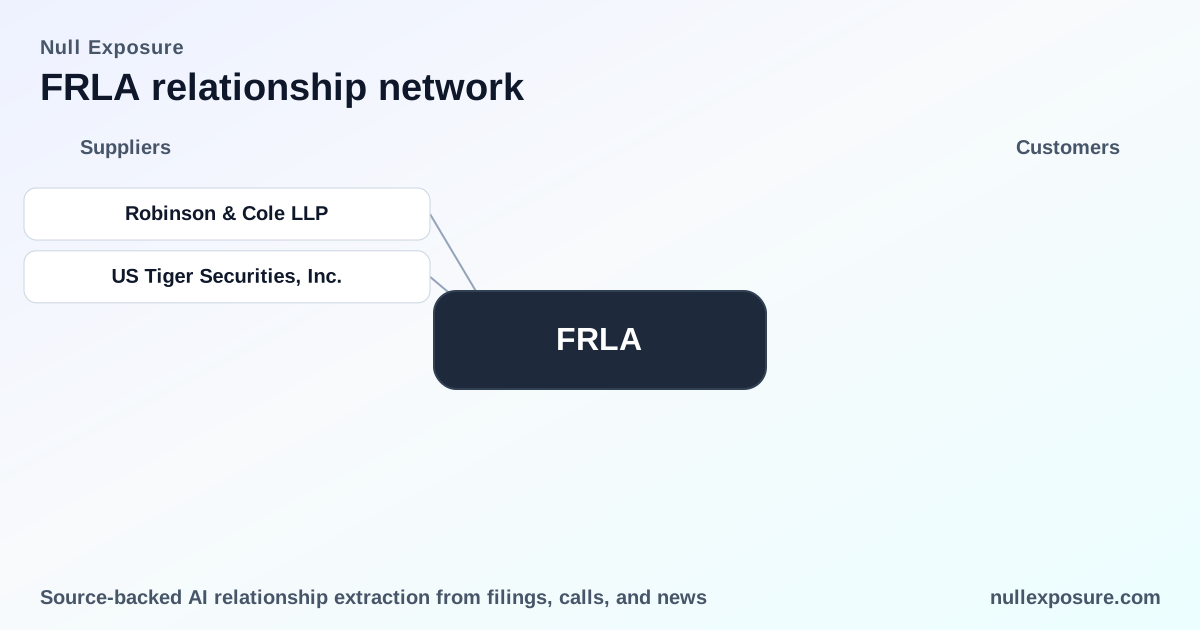
- Robinson & Cole LLP is acting as legal counsel to Fortune Rise. A PR Newswire release dated March 9, 2026, announcing the VCV Digital Technology business combination names Robinson & Cole LLP as the company’s legal counsel, establishing the firm’s role in transactional and securities work for the deal.
- US Tiger Securities, Inc. is serving as the financial advisor to Fortune Rise. The same PR Newswire release (March 9, 2026) lists US Tiger Securities as financial advisor, indicating responsibility for deal structuring, fairness considerations and adviser support during the combination process.
These disclosed suppliers match the standard SPAC playbook—external counsel and a financial advisor to manage legal/regulatory requirements and transaction economics. The PR Newswire announcement is the reporting vehicle for both relationship disclosures.
What these relationships signal for investors and operators
The engagement of an established law firm and a boutique securities advisor is consistent with a transactional execution model: legal counsel manages SEC and corporate governance tasks, while the financial advisor steers valuation, capital markets positioning, and buyer/seller negotiations. For investors and counterparties, the practical implications are:
- Execution risk is concentrated in a small advisory network. The quality and capacity of counsel and financial advisor materially affect speed of diligence, regulatory filings, and board/structural decisions.
- Operational dependency spikes during the deal window. Vendors that are peripheral pre‑deal become central to closing timelines; review billing and engagement terms for milestone‑based or conditional fee structures.
- Counterparty diligence matters for post‑close integration. Legal and financial advice affects representations, indemnities and deal mechanics that determine how value transfers to public holders.
If your evaluation hinges on governance and execution quality, examine engagement letters, fee arrangements and prior SPAC transaction track records for both Robinson & Cole LLP and US Tiger Securities. For tools and supplier intelligence to support that diligence, consult https://nullexposure.com/.
Public financial signals and supplier risk constraints
The supply‑side constraints in the public record are not enumerated as supplier‑specific contractual limits, but the company financials and profile create observable constraints for counterparties and investors:
- No operating revenue and negative book value: the vehicle carries balance‑sheet and liquidity signaling that all substantive value realization is contingent on a successful M&A event.
- Small equity float and market cap: limited free float constrains secondary market liquidity and amplifies volatility around deal announcements and outcomes.
- High stated institutional percentage (reported >100% in the summary): treat this as an anomalous reporting artifact that requires reconciliation in filings—concentration of institutional ownership is a governance factor worth unpacking in SEC disclosures.
Because supplier constraints were not explicitly listed, these are company‑level signals investors must fold into counterparty risk assessment rather than relationship‑level caveats.
Practical next steps for investors and operators
- Request engagement letters and prior transaction summaries from Robinson & Cole LLP and US Tiger Securities as part of legal and commercial due diligence. Focus on indemnity language, fee structures, and timelines.
- Verify the SPAC’s trust account and IPO cash status in SEC filings and proxy materials to quantify the deal runway and cash available for the combination.
- Monitor regulatory filings and subsequent press releases for any expansion of the supplier roster (placement agents, underwriters, integration advisors) because supplier concentration will increase during the deal phase.
For hands‑on supplier intelligence and to track evolving relationships in real time, visit https://nullexposure.com/ and subscribe to targeted monitoring.
Bottom line
Fortune Rise is a transaction‑centric SPAC with no operating revenue; its near‑term value is driven by closing a business combination. Public disclosures name Robinson & Cole LLP as legal counsel and US Tiger Securities, Inc. as financial advisor in the March 9, 2026 announcement of the VCV Digital Technology combination, placing legal and advisory execution at the center of risk and value creation. Investors and counterparties should prioritize diligence on advisor engagements, fee mechanics and proxy/regulatory filings to understand how deal economics translate to public equity outcomes. For ongoing coverage and supplier relationship tracking, see https://nullexposure.com/.