First Merchants Corporation (FRME): supplier footprint and what it means for investors and operators
First Merchants Corporation is the financial holding company for First Merchants Bank, a regional community bank that earns via net interest income, fee income, and treasury services while funding growth through deposits and short-term borrowings. The bank’s operating model combines relationship lending in the Midwest with a network of branch and leased premises, and reliance on third‑party software and services to host customer data and run operations. Investors should view supplier relationships through the twin lenses of contract duration (real estate and borrowing posture) and third‑party criticality (software and service providers). For deeper supplier intelligence, visit https://nullexposure.com/.
How the company stacks up financially — quick, investor‑oriented facts
First Merchants presents as a profitable regional bank with conservative capitalization and an attractive yield profile for income investors. Key finance signals: Revenue (TTM) $641.7M, Profit margin 35.2%, Return on equity ~9.5%, Trailing P/E 9.4, and Price-to-Book ~0.95, with a dividend yield around 3.93%. These numbers place First Merchants in the category of established regional banks that generate stable earnings while trading at modest valuation multiples. Institutional ownership is high (roughly 73% institutional), which underscores the stock’s appeal to long‑term investors.
What supplier relationships we found (complete list)
Below I cover every supplier relationship surfaced in the results and cite the source for each.
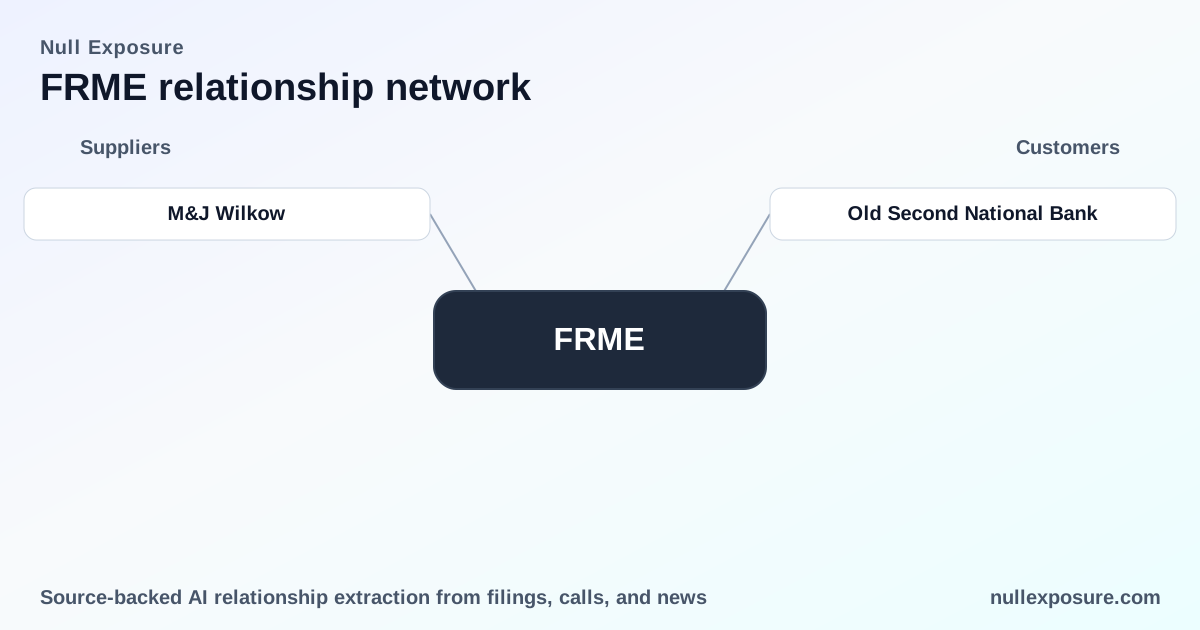
M&J Wilkow — landlord for Meridian Plaza (Carmel)
First Merchants Bank currently leases office space at Meridian Plaza in Carmel, and the building is owned by Chicago-based real estate investor M&J Wilkow; this is a landlord‑tenant relationship tied to the bank’s branch or office footprint. According to an IndyStar report from August 30, 2023, Meridian Plaza is owned by M&J Wilkow and First Merchants leases space there (https://www.indystar.com/story/money/2023/08/30/first-merchants-bank-moving-headquarters-carmel-meridian-street-indianapolis-keystone-fashion-mall/70719912007/).
Constraints and what they imply about operating posture
The document‑level constraints are company‑level signals that shape how First Merchants contracts and runs operations. They are not assigned to any single supplier unless explicitly named.
- Long‑term real estate commitments are the norm. The company’s filings state: “The Corporation's leases are generally for periods of five to twenty years with various renewal options.” That indicates a capital‑intensive, inflexible footprint for branches and offices that raises the importance of landlord relationships and site continuity for operations.
- Short‑term funding exists alongside long leases. The disclosures also itemize “borrowings maturing in one year or less,” signaling an active short‑term liquidity posture that requires treasury attention to match long‑dated lease obligations with available funding sources.
- Third‑party software and services are critical operational vectors. Filings directly note that “use of third‑party software and services... exposes the Corporation to cybersecurity risk as numerous service providers host critical data or have direct contact with our bank customers.” This establishes service providers and software vendors as high‑criticality suppliers whose security posture and business continuity directly affect customer trust and regulatory risk.
- Vendor type is explicitly software/service heavy. The constraint classification lists software and service_provider as material segments, signaling that technology vendors are central to the bank’s operating model rather than peripheral.
Taken together, these constraints paint a picture of a regional bank that balances long‑lived physical commitments with variable short‑term funding and a reliance on third‑party software. That mix increases the importance of vendor diligence, lease portfolio management, and liquidity planning.
For additional supplier scoring and bespoke diligence on FRME, see https://nullexposure.com/.
What investors and operators should focus on next
The supplier signals translate directly into diligence priorities for both buy‑side analysts and bank operational teams.
- Lease concentration and escalation risk. Long leases (5–20 years) reduce flexibility and increase the cost of strategic footprint changes; review lease expiries and renewal options across the branch network. Landlord performance (maintenance, access, and security) affects operational continuity.
- Counterparty criticality for software vendors. Vendors that host customer data or interface directly with customers are single points of failure for reputational and regulatory outcomes; prioritize SOC reports, incident history, and contractual SLAs.
- Liquidity alignment. Short‑term borrowings coexist with long‑term fixed obligations; assess the bank’s liquidity buffers, repo access, and contingency funding plans relative to maturities and potential deposit volatility.
- Operational resilience and cybersecurity governance. Because filings flag cybersecurity exposure tied to service providers, investors should look for robust third‑party risk management, penetration testing, and timely remediation metrics in board reporting.
Risk and opportunity checklist
- Risks (bold): long‑term lease inflexibility, third‑party cyber and data hosting exposure, funding mismatch between short borrowings and long leases.
- Opportunities (bold): stable franchise economics with healthy margins, attractive dividend yield, valuation near book value that supports upside if operational risks are managed.
Use these checklist items to shape vendor audits, board questions, and investment theses.
Practical next steps for relationship diligence
- Confirm lease schedules, escalation clauses, and sublease options for all material properties; map key sites to local operational risks.
- Obtain and review recent SOC/attestation reports, incident timelines, and remediation plans for any vendor that hosts customer data or executes customer‑facing transactions.
- Stress‑test liquidity assumptions against accelerated deposit outflows while accounting for fixed lease obligations.
- Integrate supplier criticality into scenario planning and ICAAP (internal capital adequacy) or similar enterprise risk frameworks.
Before you finalize vendor risk ratings or investment calls, validate these items against primary documents and onsite verifications.
For a consolidated view of supplier relationships and risk signals for FRME and comparable regional banks, visit https://nullexposure.com/ — our platform aggregates the filings and news signals that matter for operational and investment decision‑making.
Bottom line
First Merchants operates a stable regional banking model underpinned by profitable core operations and a modest valuation. However, its long‑term real estate commitments and reliance on third‑party software are material supplier dimensions that demand active oversight. Landlord relationships such as the Meridian Plaza lease with M&J Wilkow are operationally relevant, while company filings flag broader, bank‑level exposures that should drive investor due diligence and vendor governance improvements.