First Merchants Corporation (FRMEP): supplier posture and counterparty map for investors
First Merchants Corporation monetizes through net interest margin on commercial and consumer lending, fee income from wealth-management and transaction services, and targeted balance-sheet management. The depository shares ticker FRMEP offers exposure to a regional bank with a diversified product mix and a shareholder-return orientation that combines dividends and buybacks. This note distills the supplier- and counterparty-related signals that matter to investors evaluating FRMEP as a partner or portfolio holding. For a broader view of counterparties and supplier risk across the financial sector, visit https://nullexposure.com/.
How First Merchants runs the engine: operating model and commercial drivers
First Merchants operates as a midwest regional bank concentrating on commercial banking, consumer lending and wealth management. It generates revenue primarily from interest spread — loans funded by deposits and short-term borrowings — and from non-interest income tied to advisory and transaction services. In the trailing twelve months the company reported $642 million in revenue and a 35.2% profit margin, with return on equity near 9.5% and ROA at 1.21%, reflecting a profitable, mature regional franchise that prioritizes stable earnings and shareholder distributions.
Key operating characteristics that shape supplier risk and contracting posture:
- Contracting posture is short-term oriented. The company discloses material borrowings maturing within one year and reports total short-term borrowings (the cited line item reads "Total short-term borrowings $338,259"), indicating routine use of rollover funding that increases sensitivity to short-term wholesale markets. This is a company-level signal drawn from public filings.
- The bank acts as a buyer and an active capital allocator. First Merchants repurchased 1,648,466 shares under its repurchase program in 2024, demonstrating a shareholder-return posture that competes with liquidity otherwise available for operational suppliers or balance-sheet investments.
- Third-party services are material and operationally critical. The firm explicitly identifies its use of third-party software and services as a cybersecurity exposure, confirming that outside service providers host critical data or have direct customer touchpoints.
- Segment focus on services. The company-level language emphasizes service relationships — IT, payment processors, and custodial/clearing arrangements — as a component of its operating model.
These dynamics define a supplier ecosystem where short-term funding providers, cyber and cloud vendors, and payment/settlement partners are the most critical counterparties to monitor.
Supplier and counterparty map: the documented relationships
Below I cover every relationship disclosed in the supplier results for FRMEP.
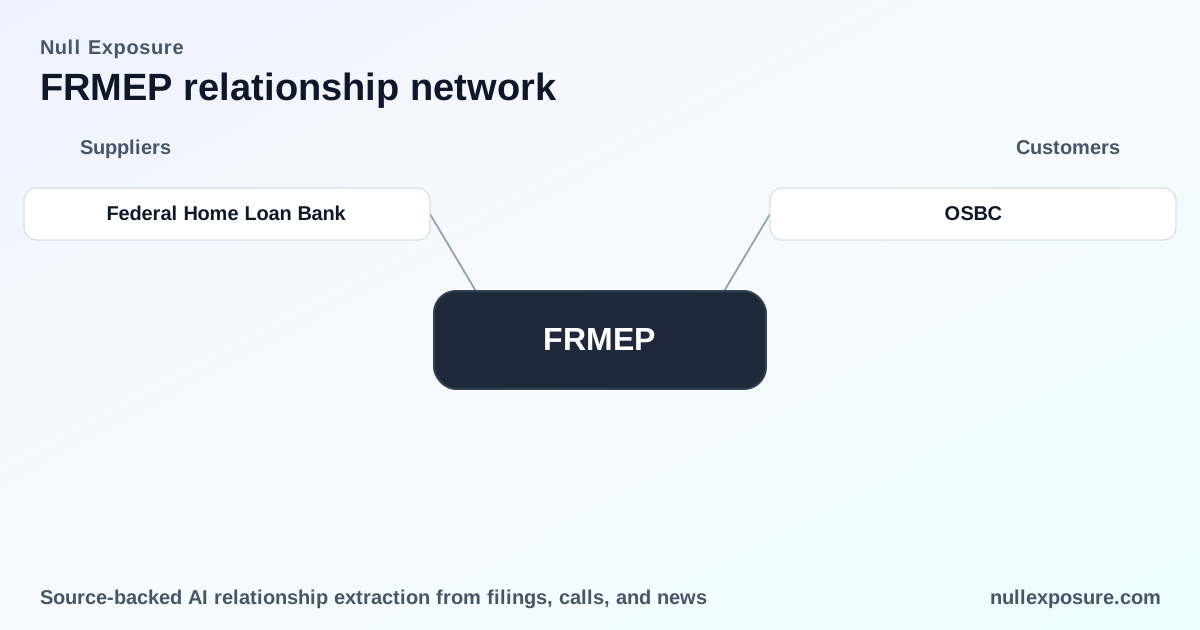
- Federal Home Loan Bank — advances and funding relationship. First Merchants reported advances from the Federal Home Loan Bank (FHLB) with line items reflecting the level of borrowings (for example, two advance balances listed as 798,549 and 822,554 in the filing excerpt). This is a direct wholesale funding relationship that supports liquidity and lending capacity. According to a GlobeNewswire press release on January 26, 2026 (First Merchants fourth-quarter 2025 results), the FHLB advances are cited in the company’s funding disclosures for FY2026. (Source: GlobeNewswire press release, Jan 26, 2026.)
Those entries constitute the full set of supplier relationships surfaced in the results package for FRMEP; the Federal Home Loan Bank is the explicit counterparty referenced.
What the constraints tell investors about operational risk
The extracted constraint signals are company-level and should be read as governance and exposure indicators rather than relationship-specific liabilities.
- Short-term contract exposure: Borrowings maturing in one year or less are material, indicating funding sensitivity to rate and liquidity shocks.
- Buyer posture: Active share repurchases show capital allocation toward buybacks, which reduces excess liquidity available for other priorities.
- Service-provider dependency: The firm acknowledges reliance on third-party software and services, and frames this as a cybersecurity and operational concentration risk.
- Segment emphasis on services: The language repeatedly highlights services (IT, transactional partners) as a critical part of the operating model, increasing the importance of supplier continuity planning.
Together these signals portray a bank that is operationally mature but reliant on short-duration wholesale funding and external service providers, raising the bar for counterparty due diligence and disaster recovery capabilities.
Investment implications and risk-reward for operators and counterparties
For investors and corporate operators evaluating FRMEP as a customer or vendor, the strategic takeaways are clear:
- Counterparty criticality is moderate-to-high. Critical suppliers are those that support payments, custody, and core banking software; a disruption would have immediate customer-facing impact.
- Funding concentration risk is real. The documented FHLB advances and the reported level of short-term borrowings create sensitivity to funding-market stress; counterparties that provide liquidity need to price tenor and haircuts accordingly.
- Contract maturity profile favors shorter tenors. Suppliers and partners should prefer flexible, shorter-term arrangements with FRMEP because their own exposure will be tied to FRMEP’s short-term funding posture.
- Operational resilience and cyber controls are investment criteria. Given the explicit third-party risk callout, vendors should expect robust security and business-continuity requirements in contracts.
For a structured supplier-risk scorecard and ongoing monitoring of FRMEP counterparties, see the comprehensive supplier intelligence offering at https://nullexposure.com/.
Practical next steps for investors and vendor managers
- Run focused counterparty checks on the Federal Home Loan Bank relationship and on any short-term funding lines; confirm collateral, covenants, and maturity ladders.
- Prioritize cyber-risk audits and SLAs for vendors that host customer data or process transactions.
- Reassess capital-allocation friction from the repurchase program when modeling stress scenarios that compress liquidity.
If you need a tailored counterparty due-diligence brief or continuous supplier monitoring for FRMEP, explore options and get started at https://nullexposure.com/.
Bottom line: First Merchants is a profitable regional bank with disciplined capital returns and a short-term funding posture that elevates the importance of liquidity counterparties and third-party service continuity. Investors and operators should treat FHLB advances and supplier cyber controls as the primary levers when evaluating risk and commercial terms.