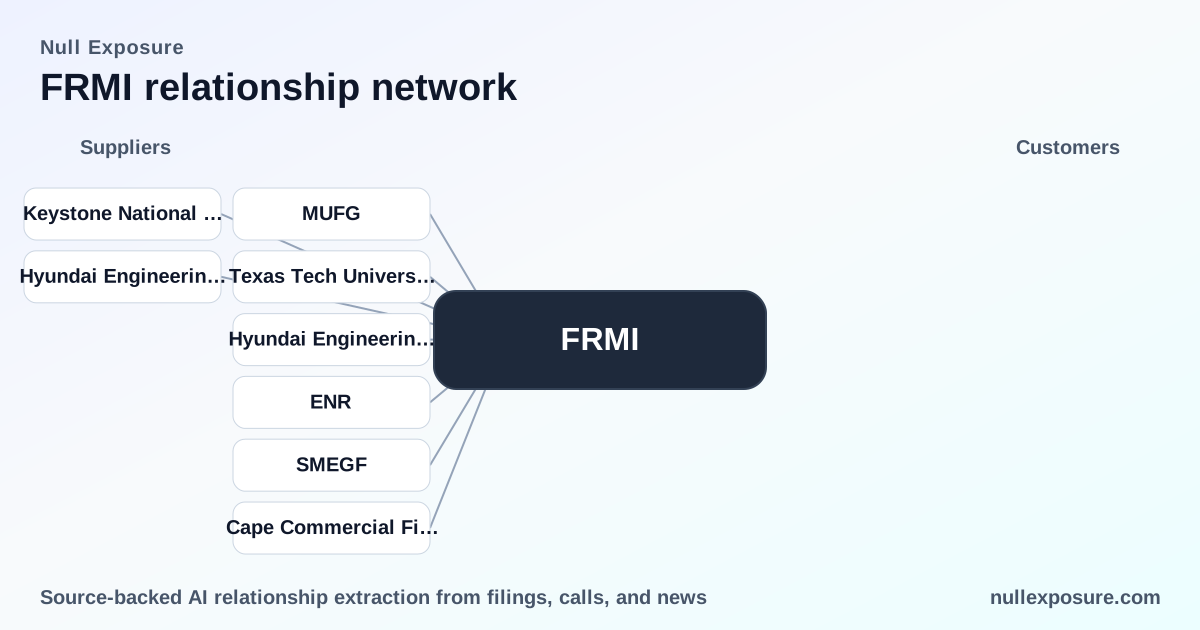
Fermi Inc. (FRMI) supplier map: who’s building Project Matador and what it means for investors
Fermi Inc. operates as a developer and operator of large-scale private power campuses, centered on Project Matador, an 11 GW private “hypergrid” campus that the company plans to deliver in staged capacity (initial 2.3 GW). The business monetizes by constructing and operating generation assets, securing long‑term equipment financing, and partnering with engineering and turbine suppliers to accelerate commercial operations — a capital‑intensive model that leverages outside debt and supplier commitments to move from permit to power. For a quick view of supplier counterparties and financing partners, visit https://nullexposure.com/.
How the supplier and financing picture is shaping execution
Fermi’s public disclosures and press coverage over early‑2026 show a clear playbook: lock long‑lead equipment and construction partners, line up committed equipment finance, and secure institutional lending to back early construction and turbine staging. That combination reduces early‑stage cash strain but concentrates execution risk on a handful of counterparties and financiers.
MUFG Bank — institutional lender backing Project Matador
MUFG provided a $500 million loan designated to support Project Matador’s initial execution and a turbine warehouse facility that underpins early delivery of generation assets. This is the largest single institutional financing disclosed and signals strong external credit support for near‑term execution. Source: Finviz coverage and StocksToTrade reporting on MUFG’s $500M loan (Feb–Mar 2026).
Keystone National Group — private debt manager supplying equipment finance
Keystone National Group manages a private debt fund that committed over $100 million of equipment financing to Fermi, structured as part of a larger facility intended to accelerate delivery of the first 2.3 GW. This is structured equipment finance rather than equity, aligning with Fermi’s capital‑light approach to procuring long‑lead turbines and other assets. Source: PR Newswire release (Feb 2026).
Cape Commercial Finance — arranger of the $200M equipment facility
Cape Commercial Finance arranged the broader $200 million equipment facility from which Fermi made an initial draw; the facility was publicized as accelerating the first tranche of Project Matador assets. Cape’s role is that of arranger and commercial lender for equipment procurement. Source: PR Newswire and MarketScreener articles (Feb 2026).
Siemens Energy — turbine supplier and mobilization partner
Siemens Energy is the primary turbine supplier in disclosures: multiple references describe Fermi acquiring SGT‑800 and F‑class gas turbines and mobilizing six assets from the Port of Houston to the Amarillo campus following a clean‑air permit. Siemens’ equipment is critical to the project’s first stages and represents a major operational dependency. Source: PR Newswire, Research‑Tree, TS2, and Finviz reporting (Feb–Mar 2026).
Hyundai Engineering & Construction — nuclear construction partner
Fermi has deepened a strategic partnership with Hyundai Engineering & Construction to advance large‑scale nuclear construction and to progress four AP1000 nuclear units as part of the longer‑term portfolio. Hyundai is positioned as a lead contractor on nuclear scope and large structural works for the company’s roadmap. Source: SimplyWall.St and MarketScreener coverage (Feb–Mar 2026).
Texas Tech University System — land lease and campus host
Project Matador is secured by a lease on land owned by the Texas Tech University System, establishing the campus footprint and land rights that underpin the project’s construction and permitting trajectory. The TTU System relationship is the real‑estate anchor for the Amarillo campus. Source: Intellectia.ai news reports and PR Newswire mentions (Feb 2026).
What this supplier set says about Fermi’s operating model and constraints
Fermi’s supplier and financing mix delivers a coherent execution strategy but also reveals structural characteristics investors must price into any valuation:
- Contracting posture: Fermi relies on long‑term equipment finance and large project loans rather than funding the build exclusively from equity, indicating a leverage‑friendly, contractor‑led delivery model that transfers near‑term capital needs to lenders and lessors.
- Concentration: A small set of counterparties (MUFG, Cape/Keystone, Siemens, Hyundai) carry outsized importance for early execution, creating single‑point risks if any counterparty stalls.
- Criticality: Suppliers are operationally critical — Siemens turbines and Hyundai construction capability are prerequisites for staging capacity; land rights from Texas Tech are legally foundational.
- Maturity: The project is in an early‑to‑mid execution phase: permits are clearing, initial draws and mobilizations are happening, but revenue generation is still future‑timed, so counterparties’ financing and delivery performance directly determine the timeline to cash flow.
For further analysis of counterparty exposures, modelling scenarios, and supplier risk scoring, see https://nullexposure.com/.
Investment implications: where upside and risk concentrate
- Upside: Institutional backing from MUFG and committed equipment finance from Keystone/Cape materially derisks early capital needs and supports staged deliveries that convert to revenue in phases. These financings accelerate the path to the announced 2.3 GW first phase.
- Execution risk: Heavy reliance on Siemens and Hyundai for critical hardware and construction magnifies schedule and completion risk — delays or supply disruptions will push capital needs and increase cost.
- Counterparty risk: A concentrated financing stack means that the withdrawal or renegotiation of a major lender or arranger would materially impact the project timeline and credit profile.
- Regulatory and land security: The lease with the Texas Tech University System and the clean‑air permit wins are prerequisites for vertical construction and give the project legal footing; regulatory reversals or disputes would be high‑impact events.
Key takeaways:
- MUFG’s $500M loan is the single most consequential financing event for near‑term execution.
- Siemens and Hyundai are operationally critical suppliers; they define the project’s delivery and technical capability.
- Keystone and Cape provide targeted equipment finance that complements larger institutional debt.
How investors should act now
- Validate counterparties and financing documentation where available, and model scenarios that stress supplier delays and lender repricing.
- Monitor turbine delivery manifests, construction milestones, and drawdown notices from the $200M equipment facility as leading indicators of on‑time execution.
- Keep watch on any further institutional commitments or equity infusions that would reduce single‑counterparty concentration.
If you want a deeper, counterparty‑level risk assessment and a timeline‑based stress test for Project Matador, start here: https://nullexposure.com/.
Final read: what matters most going forward
Fermi has assembled a tight group of financiers and suppliers that collectively enable the first stages of Project Matador — a pragmatic mix of institutional lending (MUFG), equipment finance (Keystone/Cape), gas‑turbine supply (Siemens), construction capability (Hyundai), and site control (Texas Tech System). Execution speed and supplier performance will determine whether these contractual relationships turn into predictable cash flow or into an elongated build schedule requiring additional capital. For ongoing tracking and supplier relationship intelligence, visit https://nullexposure.com/.