JFrog (FROG) — supplier profile and what investors should know
Thesis: JFrog operates a cloud-first DevOps platform that monetizes primarily through recurring software subscriptions, cloud consumption and enterprise services that enable continuous release management and secure software distribution. The company converts product-led adoption into predictable revenue while outsourcing most infrastructure to public cloud providers, producing a vendor-heavy operating model with meaningful long-term purchase commitments.
Learn more about supplier intelligence at https://nullexposure.com/
How JFrog makes money and why its supplier posture matters
JFrog sells developer-facing software and managed cloud services that accelerate build-to-release workflows and secure software supply chains. The company reports trailing twelve‑month revenue of $531.8 million and a market capitalization near $5.15 billion, signaling a growth-for-profitability profile: high gross margins (gross profit $408.4M TTM) but negative operating leverage (operating margin -13.7%, net EPS -$0.62 TTM). The business model is recurring and subscription-heavy, with additional revenue from enterprise support and professional services.
That subscription and cloud orientation governs supplier relationships in two ways: first, infrastructure and hosting are outsourced—JFrog relies on public cloud and third‑party hosting partners to deliver SaaS; second, the company carries non-cancelable purchase obligations for hosting and vendor services, which lock in future cash flows and create committed operating spend. These supplier dynamics convert product availability and security into an operational dependency that investors must price into valuations and scenario analysis.
What the regulatory and disclosure signals say about vendor commitments
Company disclosures describe purchase obligations for hosting services and software products with remaining terms of 12 months or longer, and a reported non‑cancelable purchase obligations figure presented as $49,058 as of December 31, 2024 (per the company’s filing language). The filing language also states: “We outsource substantially all of the infrastructure relating to our cloud products to public cloud providers chosen by our customers,” and that JFrog “engage vendors and service providers to store and otherwise process some of our and our customers’ data, including sensitive and proprietary information.”
Taken together, these disclosures produce clear company-level signals:
- Contracting posture: long-term, committed — purchase obligations with 12+ month terms indicate multi-period vendor commitments rather than purely elastic, month-to-month variable spend.
- Role: service-provider dependency — JFrog operates as a buyer of hosting and processing services, which makes third parties critical to service delivery.
- Spend scale: mid-range materiality — disclosed obligations and language correspond with a $10M–$100M spend band signal, suggesting material but not outsized single-vendor exposure.
These are company-level signals derived from JFrog’s filings; they are not assigned to any single supplier unless the filing explicitly names that supplier.
One relationship every evaluator must see: Forrester Consulting
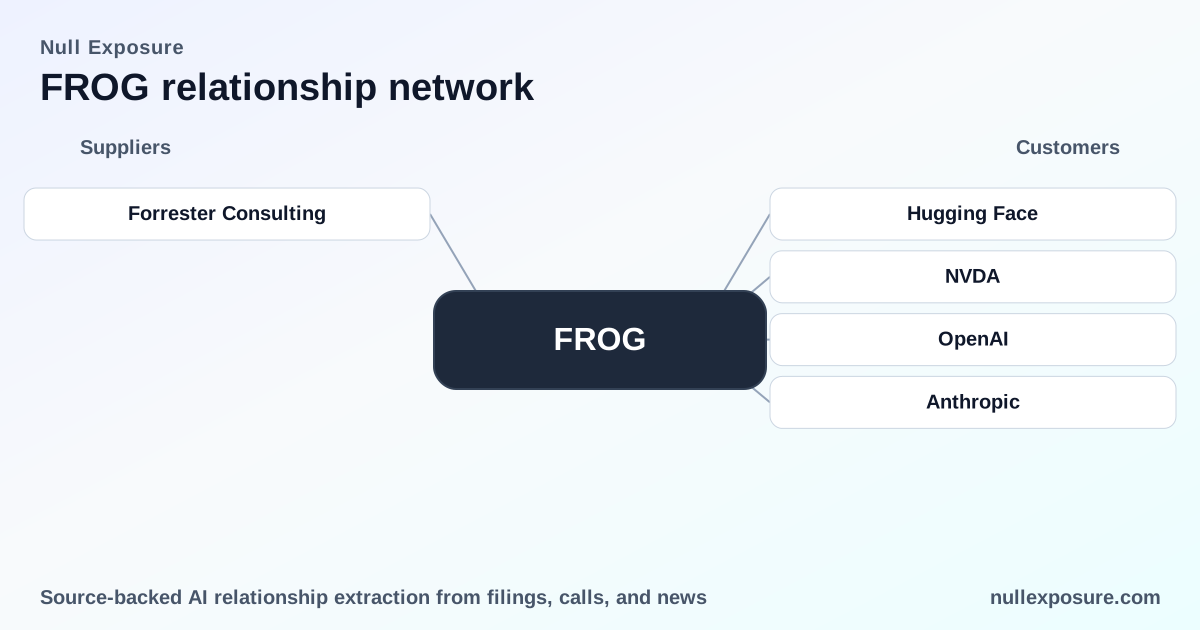
Forrester Consulting — In January 2026, JFrog released a Forrester Consulting Total Economic Impact (TEI) study showing enterprises using JFrog’s software supply chain security platform achieved stronger security, higher developer productivity, improved audit readiness and more efficient toolchains. The findings underpin JFrog’s value proposition for enterprise customers and are presented as part of the company’s go‑to‑market evidence base (news summary: March 2026). Source: a SimplyWallSt news summary of the Forrester TEI study published March 2026 at https://simplywall.st/stocks/us/software/nasdaq-frog/jfrog/news/what-jfrog-frogs-forrester-tei-study-says-about-its-unified
This is the only relationship flagged in the supplier-scope results; the Forrester TEI serves as third‑party validation rather than an operational vendor tie. Investors should treat this as market validation of product efficacy rather than an operating dependency.
Operational risk and concentration — what to watch in diligence
- Criticality: Outsourced infrastructure makes cloud providers and hosting partners mission-critical. Any material outage, pricing shift, or contractual dispute at the provider level has direct implications for uptime, SLAs and renewal risk.
- Concentration: The filings imply reliance on a small set of hosting vendors—typical for SaaS players—so supplier concentration is a practical vulnerability. The spend band signal ($10M–$100M) indicates these commitments are meaningful relative to operating cash flow.
- Maturity: JFrog’s procurement posture (non-cancelable, multi-year obligations) reflects a mature procurement process with negotiated longer-term contracts, which both stabilizes cost and reduces agility to switch vendors quickly.
Key risk: the combination of recurring customer revenue with outsourced hosting means investors must underwrite both top-line growth and vendor pricing/availability risk into scenarios.
Commercial implications and investor takeaways
- Revenue resilience is real but conditional. JFrog’s recurring model and product-market fit are validated by third-party analysis (Forrester), supporting predictable revenue streams. Investors must offset that optimism with the operational reality of committed hosting spend.
- Margin sensitivity to vendor costs. With infrastructure outsourced, gross margin and EBITDA can shift materially if cloud costs—or contract terms—move unfavorably; monitor cloud pass-throughs and any changes in purchase obligation disclosures.
- Contract structure matters for forecasting. The company’s long-term purchase commitments provide visibility into near-term cost baselines but limit downside expense flexibility during demand shocks.
Explore supplier risk and valuation impact further at https://nullexposure.com/
What active managers should monitor next
- Quarterly filings and the notes on purchase obligations for any change in magnitude or vendor breakdown.
- Any qualitative disclosure about multi-cloud vs. single-cloud dependency and contractual termination rights.
- Evidence of cost pass-through to customers or margin protection mechanisms embedded in product pricing.
Final read: balancing growth validation with vendor dependency
JFrog sits at the intersection of strong product validation and vendor-dependent operations. The Forrester TEI study is a positive commercial endorsement, but the company’s operating model—outsourced infrastructure, long-term purchase commitments and mid-range vendor spend—creates operational concentrations that require active monitoring. For investors, the right approach is to model durable revenue growth while stress-testing vendor cost and availability scenarios into margin forecasts.
For a structured supplier risk review and comparative supplier intelligence, visit https://nullexposure.com/ and use the JFrog profile as a model for how vendor commitments flow through valuation and operational risk.