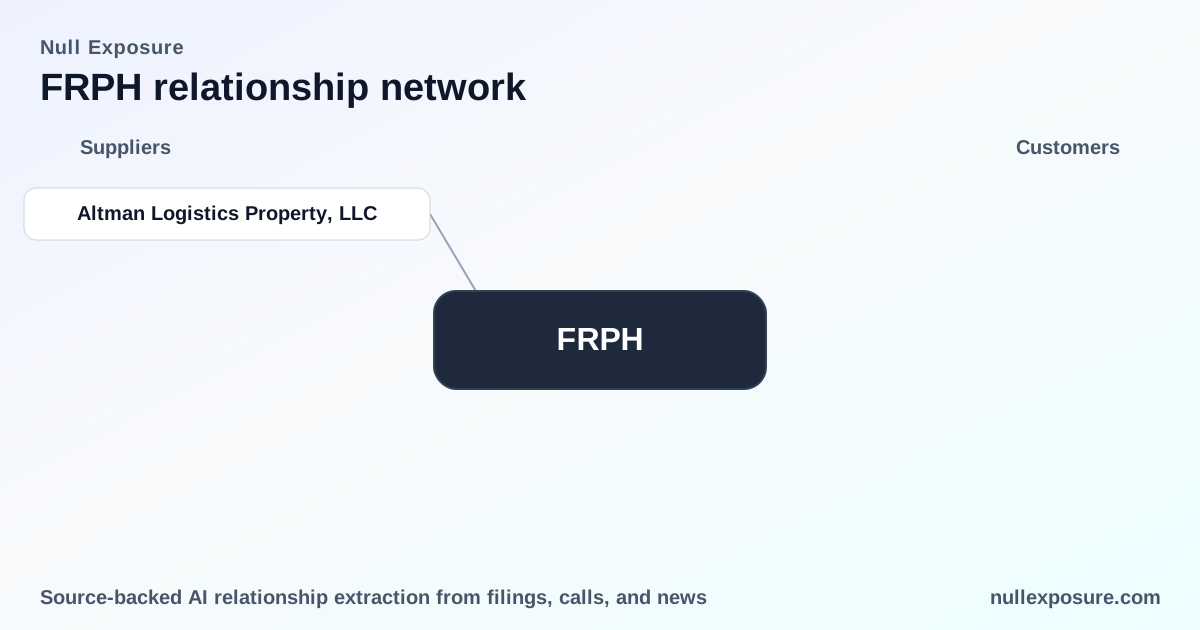
FRP Holdings (FRPH) — acquisition of Altman Logistics and what suppliers tell investors
FRP Holdings operates as a U.S. real estate investment and development company that monetizes through asset development, project sales and leasing income tied to logistics and industrial properties. The firm drives value by controlling development pipelines, moving projects from entitlement and construction into stabilized cash-flowing assets, and harvesting gains via sales or long-term leases; recent activity shows a deliberate move to internalize development capacity and consolidate project control. For due diligence on supplier and partner exposure, review FRP’s public notices on the Altman Logistics transaction and operational controls at scale.
Explore more at https://nullexposure.com/.
What FRP’s business model looks like in plain terms
FRP is a compact, development-focused real estate operator: market capitalization roughly $458.6M, trailing revenue about $33.1M and EBITDA about $12.0M, which signals a business that is profitable on current operations but dependent on cyclical development outcomes. The company’s margin profile (profit margin ~14% and operating margin near 4.9%) reflects a mix of development gains and recurring income; valuation multiples show a premium on expected earnings—trailing P/E ~96 vs. forward P/E ~17, indicating that public expectations incorporate meaningful near-term earnings growth. Insider ownership is meaningful (about 39.6% insiders and 57.6% institutional holders), creating concentrated governance and aligned incentives for execution and asset recycling.
The Altman Logistics relationship — the primary supplier/partner note
FRP’s supplier/partner disclosures in FY2025 center on a single material development relationship:
- According to FRP’s FY2025 third-quarter press release syndicated by Evening Tribune, on October 21, 2025 FRP acquired the business operations and development pipeline of Altman Logistics Property, LLC, including two projects already majority-owned by FRP and minority interests in a portfolio of institutional-grade assets under development. (Evening Tribune, press release first seen March 9, 2026.)
- The same acquisition language appears in the Citizen-Times post of FRP’s FY2025 third-quarter results, confirming the October 21, 2025 transaction and the inclusion of both majority-owned projects and minority interests in institutional assets under development. (Citizen-Times, press release first seen March 9, 2026.)
- A Daily Record syndication of the FY2025 third-quarter release repeats the acquisition disclosure and the scope of assets and minority interests absorbed into FRP’s control. (Daily Record, press release first seen March 9, 2026.)
Takeaway: FRP consolidated operational control over Altman’s development pipeline, converting previously shared or minority positions into a more centralized development posture.
For continued coverage and supplier relationship tracking, visit https://nullexposure.com/.
Why the Altman deal changes the supplier map
The acquisition of Altman’s operations and pipeline signals vertical consolidation: FRP wrests project-level control, reduces counterparty complexity on development management, and internalizes revenue opportunities that previously passed through a partner. That increases operational criticality of FRP’s internal development platform: execution now bears directly on asset returns rather than being shared. The deal also raises concentration on execution risk—if a concentrated internal team or newly-integrated platform underperforms, project returns and timing come under direct FRP exposure.
What the hosting/operational constraint tells investors
FRP’s public constraint evidence notes that FRP uses a third-party hosting provider that supplies SOC Type I and II reports annually, monthly bridge letters, and a separate disaster recovery site. This is a company-level operational signal rather than a relationship-specific attribute. From an investor standpoint this implies:
- Contracting posture: selective outsourcing of IT infrastructure and controls, relying on established third-party security attestations rather than building the stack internally. That reduces in-house capital expense but increases vendor-dependency.
- Criticality: IT and data hosting are operationally critical for finance, reporting, and project management functions; SOC reports and a DR site indicate the firm treats hosting as core to continuity and compliance.
- Maturity and governance: annual SOC I/II reports plus monthly bridge letters and DR provisions show mature vendor governance and a control environment consistent with institutional counterparties.
- Concentration risk: outsourcing to a single provider introduces a single-point-of-failure exposure if the relationship is exclusive or tightly concentrated; investors should monitor disclosure around provider identity and contract terms.
Risk profile and value-creation runway
FRP’s combination of development pipeline consolidation and mature vendor controls creates a mixed risk-reward picture. Upside drivers include capture of development economics previously shared with Altman, improved margin capture on projects already majority-owned, and clearer pipeline visibility after consolidation. Key risks are execution on construction and entitlement, concentration of management responsibility for a larger development inventory, and reliance on external capital markets for project funding.
Valuation signals are instructive: forward P/E materially lower than trailing P/E suggests the market expects near-term earnings to improve (or that recent trailing earnings were temporarily depressed), while EV/EBITDA ~24.6 and P/S ~13.2 denote a premium pricing relative to current revenue base—investors will expect tangible growth or capital recycling to justify that premium. Governance concentration (insiders ~39.6%) aligns management incentives with investors but also concentrates decision-making.
If you are evaluating supplier or partner risk across FRP’s network, the Altman consolidation is a pivotal data point: it reduces counterparty surface area but concentrates execution risk inside FRP’s organization.
Explore supplier-level exposure analysis and alerts at https://nullexposure.com/.
Bottom line — what investors should watch next
FRP has moved from partnership to ownership with Altman Logistics’ operations and pipeline, internalizing development upside while taking on direct execution risk. The disclosed third-party hosting controls indicate institutional-grade vendor governance that supports scale, but also introduces vendor concentration considerations. Investors and operators should focus on three near-term indicators:
- Progress and milestones on the two majority-owned projects absorbed in the transaction and the larger institutional-grade portfolio now under FRP’s control.
- Capital deployment plans and funding sources for the expanded development pipeline.
- Continuity and contractual terms for the third-party hosting provider given hosting’s operational criticality.
For ongoing supplier mapping, transaction monitoring, and to receive updates tied to FRP and related counterparties, visit https://nullexposure.com/.
Bold, focused monitoring of project execution and vendor concentration will determine whether FRP’s Altman move translates into durable value creation or concentrates downside risk.