Freshpet (FRPT) — supplier map and what certification news means for investors
Freshpet manufactures and sells fresh natural dog and cat food through retail channels and its in-store Freshpet Fridges program; the company monetizes by selling branded refrigerated products at premium price points and by capturing shelf presence through proprietary refrigeration and retail merchandising. Freshpet’s margins derive from branded packaged-food economics plus a higher-margin premium positioning supported by quality claims and certification. If you evaluate supplier relationships for operational risk or commercial upside, focus on ingredient and packaging concentration, refrigeration OEM partnerships, and certified ingredient provenance. For a concise supplier risk view and ongoing monitoring, visit https://nullexposure.com/.
How Freshpet runs its supply chain and why that matters to returns
Freshpet runs a vertically focused CPG model that relies on a relatively narrow set of upstream partners for raw materials and packaging and on specialized third parties for refrigeration equipment and field service. Supply concentration is a structural feature: the company purchased roughly 70% of raw materials from three vendors in 2024 and about 80% of packaging from two vendors across recent years, signaling high supplier concentration and materiality for production continuity and negotiating leverage. These relationships are with established vendors: Freshpet states its suppliers are large, well-established companies with scale—an operating posture that preserves reliability but reduces price flexibility.
Because Freshpet uses refrigerated merchandising as a distribution and marketing asset, the company sources Freshpet Fridges from global commercial refrigerator manufacturers and coordinates installation and maintenance through third-party service providers. That dual model—hardware OEMs for capital equipment and service providers for execution—creates two distinct vendor risk vectors: equipment continuity and field service quality. Both are integral to in-store availability and therefore to top-line realization.
Financial context: Freshpet reported roughly $1.10 billion in revenue TTM with a 15.6% operating margin and a 12.6% net margin, and trades at a forward multiple that reflects premium-growth expectations. Margin sustainability is directly connected to ingredient costs, packaging availability, and retail execution risk.
Key public relationship signals discovered in media
Below are every relationship reference surfaced in the public signals collected for FRPT. Each entry is a concise, plain-English summary followed by a source reference.
-
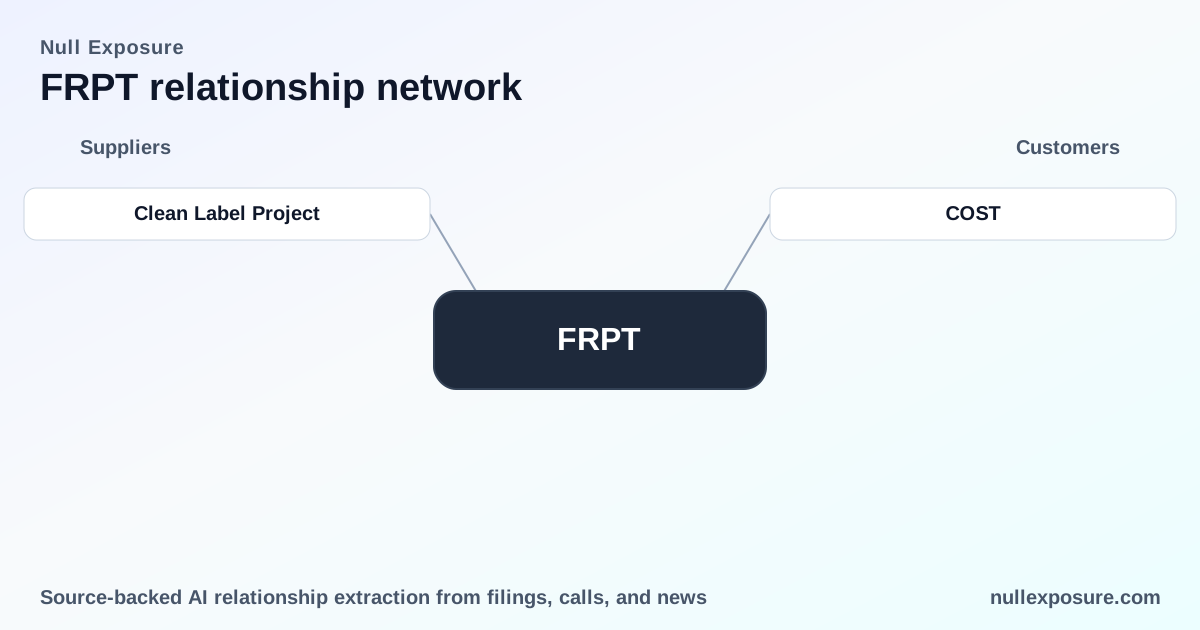
Freshpet and Clean Label Project (Finviz summary, March 9, 2026): Freshpet announced that its entire U.S. and Canadian product line earned the Clean Label Project Purity Award for ingredient quality and safety, a credential that supports its premium positioning. According to a Finviz news item on March 9, 2026, the certification covers the company’s U.S. and Canadian portfolios.
-
Freshpet and Clean Label Project (PR Newswire release, March 9, 2026): Freshpet issued a company release confirming Clean Label Project certification across its U.S. and Canadian products, emphasizing ingredient transparency and testing-based claims. The PR Newswire release dated March 9, 2026 conveys the company’s position on the award.
Why the Clean Label Project certification changes the supplier story
The Clean Label Project Purity Award is a public validation of ingredient quality and testing protocols. For investors, this certification delivers three concrete effects:
- Risk reduction for recalls and ingredient controversies: independent testing and labeling reduce the probability of consumer-safety headlines that would disrupt shelf velocity and growth.
- Commercial leverage with retail and pricing: certification supports premium pricing and can ease category listing decisions with retail buyers who prioritize trust signals.
- Counterparty signaling to suppliers: certification imposes higher inbound quality standards on raw material vendors and packaging partners, increasing downstream compliance expectations.
These effects are material to revenue realization and brand durability, given Freshpet’s premium-priced product mix.
Supplier constraints that shape procurement and operational risk
Public disclosures and company language generate clear company-level signals about Freshpet’s supplier posture and constraints:
- Concentration: Heavy sourcing concentration for raw materials and packaging creates material single- and few-vendor dependency, elevating operational risk in the event of supplier disruption or price shocks.
- Counterparty scale: Freshpet describes its suppliers as large enterprises with scale, which signals mature counterparties able to support growth but with less pricing malleability.
- Global sourcing for refrigeration: The company sources Freshpet Fridges from global commercial refrigerator manufacturers, reflecting a global supplier footprint and potential cross-border supply-chain exposures.
- Service-provider reliance: Installation and ongoing maintenance for in-store fridges are coordinated through third-party service providers, indicating critical reliance on field execution partners rather than captive teams.
These are company-level characteristics; they explain the operating model—contracting with established manufacturers, leveraging third-party service providers, and concentrating purchases—and set the framework for evaluating counterparty risk and negotiating strategy.
For operators conducting vendor diligence: prioritize continuity clauses and dual-sourcing strategies for packaging and critical raw ingredients, and embed SLA and escalation mechanics into field-service contracts for fridge uptime.
If you want a structured risk dashboard tied to these supplier signals, check practical monitoring options at https://nullexposure.com/.
Investment implications and action items
Freshpet’s certification and supplier posture give a clear playbook for investors and procurement teams:
- Opportunity: Certification supports premiumization and pricing power, which helps justify valuation multiples if volume growth sustains.
- Risk: High supplier concentration for raw materials and packaging is an earnings volatility vector; procurement disruption or input inflation will transmit quickly to margins.
- Operational priority: Fridge uptime and field servicing are mission-critical—retail distribution depends on installed-base performance as much as on wholesale logistics.
Actionable steps for due diligence:
- Validate dual-sourcing or contingency plans for packaging and major raw ingredients.
- Inspect service-provider SLAs and spare-parts inventories for Freshpet Fridges.
- Monitor certification follow-through: third-party audits, testing cadence, and whether certification extends to new SKUs or geographies.
For ongoing commercial monitoring and supplier risk tracking, see https://nullexposure.com/ for tools and continuous coverage.
Bottom line for investors and operators
Freshpet’s brand premium and margins rest on quality claims, refrigerated merchandising, and a compact supplier base. Certification from the Clean Label Project strengthens the company’s quality narrative and reduces certain risks, but supplier concentration and reliance on field service providers remain material constraints that require active mitigation. Investors should balance the upside of premium pricing supported by certification against the structural supply risks implied by concentrated sourcing and outsourced field operations.
For a concise supplier-risk briefing or to set up continuous monitoring of these supplier signals, visit https://nullexposure.com/.