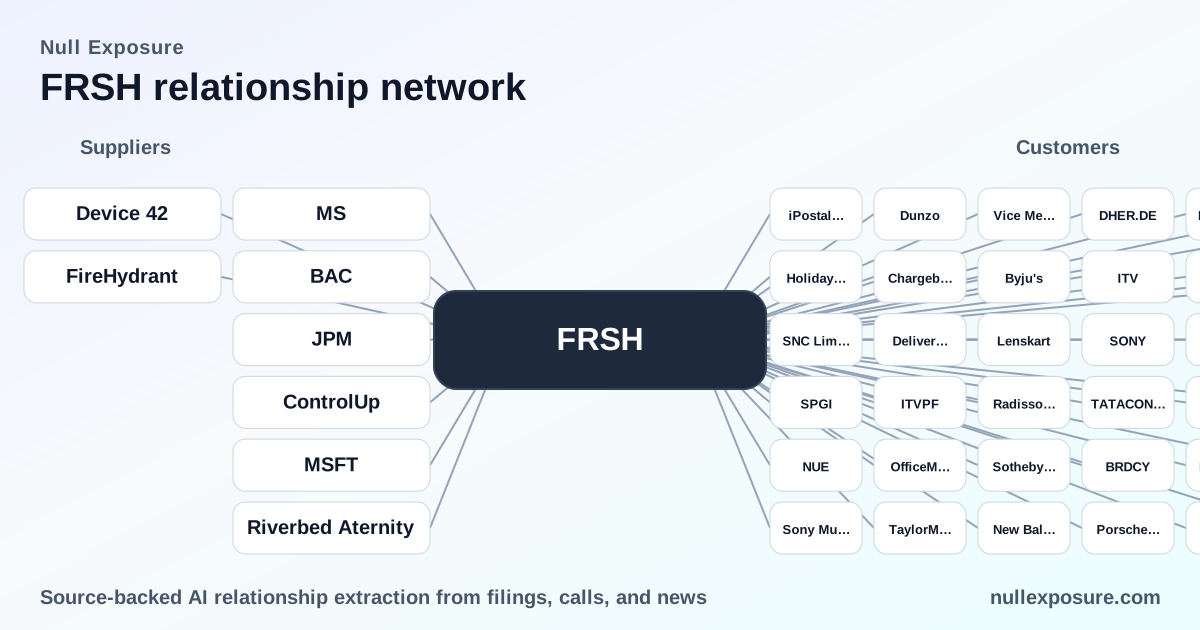
Freshworks Inc (FRSH) — supplier relationships and what they mean for investors
Freshworks is a cloud-native SaaS vendor that monetizes primarily through recurring subscription contracts for customer- and employee-experience software, plus higher-margin add-ons and integrations that drive upmarket expansion. The company leverages partner integrations and managed distribution through banks and underwriting partners at key corporate milestones (notably the IPO), and relies on large third‑party cloud and security vendors to operate services at scale. Investors should view Freshworks as a recurring-revenue SaaS operator with material third‑party infrastructure exposure and a partner-led route to enterprise customers.
Learn more about supplier risk signals and relationship mapping at https://nullexposure.com/.
Quick financial context: Freshworks reports roughly $839 million revenue TTM, a market cap near $2.3 billion, and positive operating margins, which supports continued investment in integrations and AI-enabled product expansion.
Why the partner list matters for revenue and delivery
Freshworks’ product strategy sells broader suites into enterprise accounts by bundling core SaaS with integrations that simplify operations for IT and support teams. That strategy both increases deal sizes and ties Freshworks’ service availability to the reliability of a small set of critical third‑party providers. The company’s risk profile is therefore a blend of subscription economics and vendor concentration on infrastructure and security suppliers. If you’re modeling counterparty risk into premium financing, weigh the replaceability of those suppliers and the potential for vendor‑related outages to affect renewal rates.
For additional detailed supplier intelligence, visit https://nullexposure.com/ for supplier-level analysis and sourcing.
The relationships disclosed in public coverage (one-by-one)
-
Morgan Stanley — Morgan Stanley acted as a lead underwriter/bookrunner during Freshworks’ U.S. IPO, part of the bank syndicate that took the company public in FY2021. This placement role is documented in media coverage of the IPO (ThePrint, March 2026). https://theprint.in/economy/freshworks-raises-1-billion-in-us-ipo-sells-shares-at-prices-over-marketed-range/737664/
-
Bank of America Corp. — Bank of America served as a book manager/underwriter in Freshworks’ FY2021 IPO, participating with other global banks to distribute the offering to institutional investors (ThePrint, March 2026). https://theprint.in/economy/freshworks-raises-1-billion-in-us-ipo-sells-shares-at-prices-over-marketed-range/737664/
-
JPMorgan Chase & Co. — JPMorgan was a lead manager on the IPO syndicate in FY2021, helping set pricing and placing shares with clients during Freshworks’ market debut (ThePrint, March 2026). https://theprint.in/economy/freshworks-raises-1-billion-in-us-ipo-sells-shares-at-prices-over-marketed-range/737664/
-
Morgan Stanley (duplicate entry from TechStory) — TechStory’s reporting of the IPO confirms Morgan Stanley’s role among the book managers for Freshworks’ offering in FY2021, reinforcing the same underwriting relationship noted elsewhere (TechStory, March 2026). https://techstory.in/freshworks-to-raise-912-million-via-ipo-at-9-billion-valuation/
-
ControlUp — ControlUp appears as an integration partner referenced in Freshworks’ product announcements for enhanced IT management; integrations surface real‑time endpoint telemetry into tickets, improving incident resolution workflow (QuiverQuant press summary, FY2025). https://www.quiverquant.com/news/Freshworks+Inc.+Introduces+Enhanced+AI+Capabilities+in+Freshservice+for+Streamlined+IT+Management+and+Improved+Employee+Experience
-
Microsoft — Freshworks integrates with Microsoft 365 and Copilot capabilities; product notes indicate Freddy AI Agents can surface data from Microsoft assets as part of ticket resolution, highlighting a strategic integration with Microsoft productivity tools (QuiverQuant, FY2025). https://www.quiverquant.com/news/Freshworks+Inc.+Introduces+Enhanced+AI+Capabilities+in+Freshservice+for+Streamlined+IT+Management+and+Improved+Employee+Experience
-
Riverbed Aternity — Riverbed Aternity is cited as an endpoint experience (DEX) integration that feeds telemetry into Freshworks’ workflows, enabling proactive incident detection and contributing to larger enterprise deals (QuiverQuant, FY2025). https://www.quiverquant.com/news/Freshworks+Inc.+Introduces+Enhanced+AI+Capabilities+in+Freshservice+for+Streamlined+IT+Management+and+Improved+Employee+Experience
-
Device 42 — Management has specifically cited Device 42 integrations as a way to sell broader EX solutions into enterprise accounts, converting point-product conversations into larger deals (The Globe and Mail / TipRanks coverage of FY2026 earnings commentary). https://www.theglobeandmail.com/investing/markets/markets-news/Tipranks/196403/freshworks-earnings-call-ai-ex-drive-profitable-growth/
-
FireHydrant — FireHydrant is referenced by management as an integration that supports larger upmarket contracts, positioning Freshworks to address enterprise incident response and reliability needs with bundled solutions (The Globe and Mail / TipRanks, FY2026). https://www.theglobeandmail.com/investing/markets/markets-news/Tipranks/196403/freshworks-earnings-call-ai-ex-drive-profitable-growth/
-
Bank of America (TechStory entry / BofA Securities) — TechStory lists BofA Securities among the appointed book managers for Freshworks’ IPO in FY2021; this is the same corporate group that appears elsewhere in media as Bank of America’s securities arm. TechStory, March 2026. https://techstory.in/freshworks-to-raise-912-million-via-ipo-at-9-billion-valuation/
-
BofA Securities — BofA Securities is named specifically as an IPO book manager in FY2021 reporting, confirming institutional capital markets relationships that supported Freshworks’ public listing and aftermarket liquidity (TechStory, March 2026). https://techstory.in/freshworks-to-raise-912-million-via-ipo-at-9-billion-valuation/
-
JP Morgan Chase & Co (TechStory duplicate) — TechStory corroborates JP Morgan’s role as a book manager in the FY2021 IPO syndicate, a repeat confirmation of the underwriting relationships used at the company’s market entry (TechStory, March 2026). https://techstory.in/freshworks-to-raise-912-million-via-ipo-at-9-billion-valuation/
What the constraints and disclosures imply for operative risk
-
Critical infrastructure dependency: Freshworks explicitly identifies Amazon Web Services as a primary cloud partner that is critical to service delivery; loss or disruption of that provider would materially impact operations. This is a company‑level materiality signal, not tied to a single counterparty entry in the results. Investors should treat cloud availability as a risk driver for renewal and SLA exposure.
-
Enterprise counterparty mix: Contract language indicates Freshworks’ contractual commitments include enterprise‑level cloud and subscription purchase arrangements, suggesting a contracting posture oriented toward large enterprise customers and multi‑year commitments, which supports revenue visibility but raises concentration risk if a few large customers dominate ARR.
-
Service provider posture and spend scale: The company uses a range of third‑party security and cloud services (SaaS security, CNAPP, dark web monitoring, code scanning), and reports non‑cancelable purchase commitments that imply > $100m future minimum payments; that is a clear signal of meaningful supplier spend and limited short‑term price flexibility.
-
Maturity and replaceability: Integrations with vendors like Microsoft, Riverbed, Device 42, and FireHydrant increase product stickiness for customers and assist upmarket sales, which is a positive for top-line expansion; however, reliance on a small set of infrastructure and security providers elevates operational concentration risk.
(If you want a structured supplier scorecard for Freshworks, explore detailed supplier mappings at https://nullexposure.com/.)
Investment implications and recommended actions
-
Positive: Freshworks’ integration strategy is a growth lever that expands average deal size and reduces churn by embedding into enterprise toolchains. Financials show scale and improving margins that justify continued product investment.
-
Risks: Vendor concentration on cloud infrastructure and high fixed supplier commitments represent the primary operational risk. For premium financing or counterparty exposure modeling, stress scenarios should include cloud outage-driven churn and increased supplier pricing.
-
Tactical: For underwriters and operators assessing FRSH exposure, price models should incorporate a supplier‑risk discount on ARR where AWS availability or large third‑party security outages could materially affect revenue recognition.
For further supplier-focused diligence and continuous monitoring, visit https://nullexposure.com/ for in-depth relationship analytics and risk scoring.
Bottom line
Freshworks is a scaled SaaS operator that grows by expanding into enterprise workflows with strategic integrations; that commercial strategy simultaneously improves upsell economics and increases operational dependence on a handful of critical infrastructure and security suppliers. Investors should value Freshworks as a recurring‑revenue growth company with meaningful third‑party concentration risk—manageable if monitored, material if unmitigated.