Primis Financial (FRST): Supplier relationships that shape a regional bank's operating risks and optionality
Primis Financial Corp is a regional bank that monetizes primarily through traditional banking spreads and fee income while selectively retaining and structuring specialty receivables on its balance sheet. The company generates interest income from loans it originates and holds, collects fees tied to loan performance agreements, and supplements margins through liquidity tools such as advances. Supplier relationships—counterparties that originate loans, provide funding, and deliver critical technology and services—directly affect Primis’ ability to originate, retain, and service earning assets. For investors evaluating FRST supplier exposure, the material supplier moves are concentrated, operationally critical, and in some cases contractually long-dated. For a searchable, investor-grade map of supplier exposures visit https://nullexposure.com/.
Why supplier relationships matter for a regional bank investor
Primis reported $211.3 million in trailing revenue with a 29.1% profit margin and a modest market capitalization (~$316.3 million). These figures confirm a classic regional banking economics profile: earnings driven by asset yields and discipline over funding and servicing costs. Supplier counterparties that provide funding, loan origination capacity, or core operations therefore have outsized influence on credit mix, liquidity and cost structure. The two named supplier relationships in public filings illustrate both a strategic divestiture and an episodic reliance on external funding.
The direct supplier connections the filings disclose
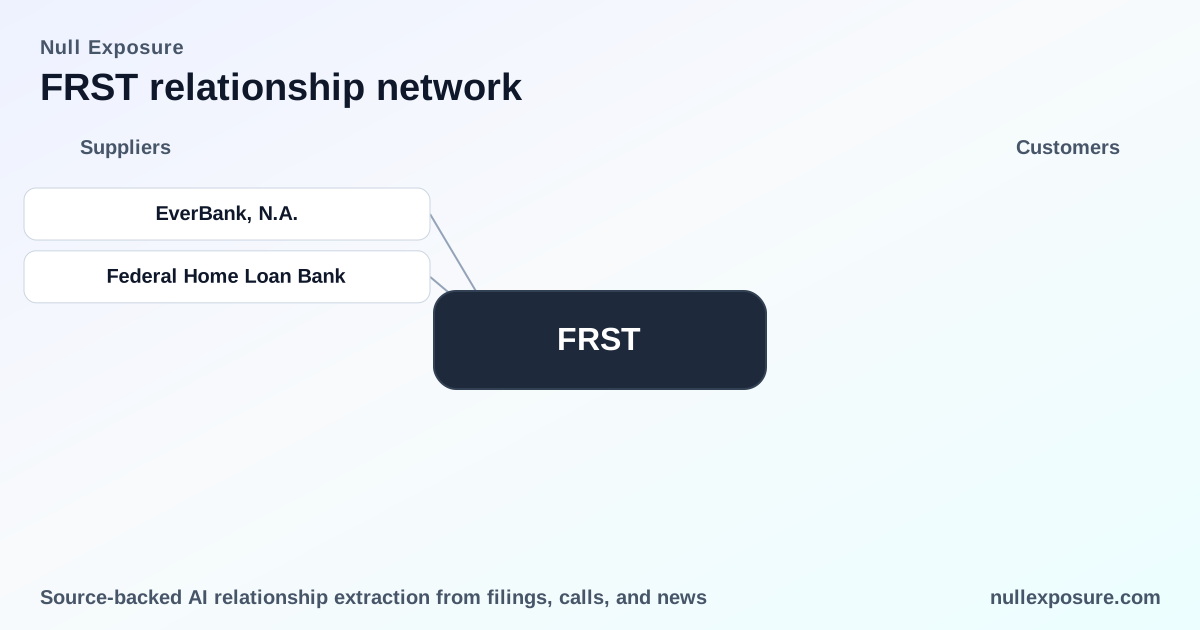
EverBank, N.A. — buyer of the Life Premium Finance division
On October 24, 2024, Primis executed a purchase and assumption agreement with EverBank, N.A. to sell its Life Premium Finance (LPF) division. This was a structural change in Primis’ business mix because it removes an in‑house premium finance book and transfers the related operational and credit responsibilities to EverBank under the agreement documented in Primis’ FY2024 filing. (Source: Primis 2024 Form 10‑K filing, FY2024.)
Federal Home Loan Bank — episodic advance liquidity provider
Primis used advances from the Federal Home Loan Bank system as a short-term liquidity tool: $25 million of FHLB advances were outstanding at December 31, 2025, down from $85 million at September 30, 2025 and versus no advances at December 31, 2024. This pattern signals active portfolio and liquidity management rather than a permanent structural funding shift. (Source: earnings release reported via Morningstar/PR Newswire, January 29, 2026.)
Company‑level constraints and what they reveal about Primis’ operating posture
The filings include extracted constraints that speak to Primis’ supplier contracting posture, concentration and the criticality of third‑party services. These are company-level signals investors must fold into any counterparty risk assessment.
-
Long‑term contractual commitments. Primis discloses a loan structure that allows maximum borrowing capacity up to $10 million, with higher tranches conditioned on documented capital infusion and a principal maturity dated September 30, 2030; quarterly interest payments may be capitalized to principal. This is indicative of multi‑year supplier or financing arrangements that can anchor funding costs and covenants through a business cycle. (Source: company filing excerpts.)
-
Operational criticality of vendors. The company explicitly warns that third‑party vendors provide key components of operations—data processing, transaction monitoring, online banking interfaces and network access—and that failures or cyber events at vendors would adversely affect delivery of products and services. This underscores high operational concentration risk in technology and processing relationships. (Source: Primis 2024 Form 10‑K.)
-
Service‑provider role for originators and consultants. Primis reports a structure where a third‑party originates loans that Primis holds on balance sheet under derivative/credit support arrangements; the third‑party provides credit support and reimbursement for lost interest, and Primis pays performance fees on performing loans. The company also engages third‑party compensation consultants (e.g., Pearl Meyer). This signals reliance on external originators for growth and on specialist consultants for governance and compensation decisions. (Source: Primis 2024 Form 10‑K excerpts.)
What the relationships imply for investors: concentration, criticality and timing
Taken together, the disclosed supplier relationships and constraints produce a clear risk‑return profile for FRST investors:
-
Concentration in vendor services is a primary operational risk. The 10‑K language on third‑party dependency is unambiguous—failure of key vendors would impair customer delivery and could be operationally and financially disruptive. Investors should prioritize vendor resilience and incident response controls in due diligence. (Company filing, FY2024.)
-
Funding agility is demonstrated but episodic. The oscillation in FHLB advances — $0 → $85M → $25M over one year—shows Primis can use advances opportunistically to manage liquidity but does not rely permanently on FHLB funding. Liquidity stress scenarios should test the speed and cost of replacement funding. (Earnings release, Jan 29, 2026.)
-
Strategic portfolio tightening via divestiture. Selling the Life Premium Finance unit to EverBank reduces Primis’ exposure to that specialty line and transfers servicing risk to the buyer; this reduces complexity but also removes a potential fee stream. The deal is material to franchise composition and should be reviewed for purchase price and transition servicing terms in the 10‑K. (Primis 2024 Form 10‑K.)
If you want a consolidated view of supplier relationships and constraints for portfolio monitoring, explore the supplier mapping resources at https://nullexposure.com/ — they speed analysis and give you a single reference for counterparty screening.
Practical due diligence checklist for investors and operators
- Confirm replacement funding paths and the incremental cost if FHLB access is constrained.
- Validate third‑party vendor SLAs, cyber insurance, concentration limits, and contingency arrangements.
- Review the EverBank LPF purchase agreement for transition obligations, indemnities and retained obligations by Primis.
- Map the loan origination arrangements that involve outside originators and the mechanics of the derivative/credit support and performance fees referenced in filings.
Midway through an investment review, anchor your counterparty assessment with a vendor resilience and liquidity test: see https://nullexposure.com/ for frameworks and templates that investors use to validate supplier continuity.
Bottom line: focused exposures, operationally critical suppliers, and active balance‑sheet management
Primis operates with a clear reliance on a small set of external partners—funding sources like the FHLB, buyers of specialty portfolios such as EverBank, and vendors that underpin operations. The company’s contractual posture includes multi‑year financing features and third‑party originator arrangements that influence credit and earnings volatility. For investors, the most material questions are vendor resiliency, liquidity replaceability, and the economics of the EverBank divestiture.
For investors and operating partners who need a compact, actionable supplier risk snapshot, visit https://nullexposure.com/ to download vendor‑focused checklists and relationship maps that accelerate due diligence.
Key takeaway: Primis’ supplier exposures are manageable but concentrated; investors should prioritize operational continuity and funding contingency planning when underwriting FRST.