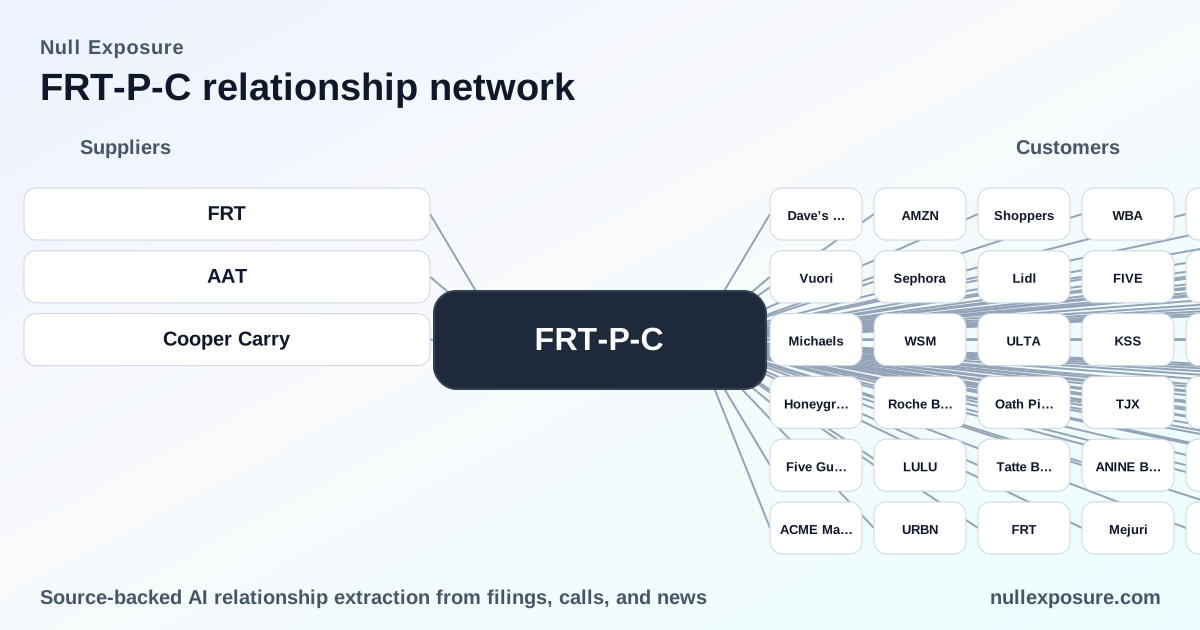
FRT-P-C: Federal Realty’s preferred stakes, development partners, and what supplier ties mean for investors
Federal Realty Investment Trust operates as a landlord and developer focused on high-quality shopping centers across the Northeast, Mid-Atlantic, California, and South Florida. The enterprise monetizes through stabilized rental income, active asset management and selective redevelopment, while depositary preferred shares such as FRT-P-C deliver fixed-income-like claims on the REIT’s cash available for preferred dividends. For investors evaluating counterparty and supplier exposure, the quality and stability of architects, engineers and transaction counterparties directly shape redevelopment execution, leasing velocity and ultimately cash flow available to preferred security holders. For an actionable supplier view and deeper due diligence, visit https://nullexposure.com/.
How Federal Realty makes money and why suppliers matter
Federal Realty’s core economics are straightforward: leaseable retail real estate in premium locations generates rent and ancillary NOI; redevelopment and repositioning expand income and asset value; capital recycling funds growth. Supplier relationships are not peripheral — they are operational levers that determine cost, schedule and tenant mix during value-add projects.
Key operating model signals for investors:
- Contracting posture: Project-oriented engagements with architects and engineers driven by discrete redevelopment cycles rather than long-term commodity supply contracts.
- Concentration: Public coverage shows multiple professional partners, suggesting low supplier concentration at the headline level, but project-specific concentration can be material when a single architect/engineer leads a major redevelopment.
- Criticality: Design and engineering partners are highly critical to execution and therefore to near-term cash flow conversion for assets under redevelopment.
- Maturity: Federal Realty’s recurring engagements with established firms indicate mature vendor selection processes, reducing vendor selection risk.
For proprietary supplier screening and scored relationship reports, see https://nullexposure.com/.
Publicly reported supplier and counterparty relationships
R&M Engineering — Huntington shopping center renovation
Greater Long Island reported on the Huntington shopping center renovation and quoted Christopher W. Robinson, president of R&M Engineering, describing the reconstruction as two structures connected at a point, reflecting a complex rebuild rather than a simple retrofit. This indicates Federal Realty uses local engineering firms for technically involved redevelopment work, which elevates execution importance (Greater Long Island, March 2026: https://greaterlongisland.com/everything-to-know-about-the-huntington-shopping-center-renovation-plans/).
American Assets Trust — seller in Del Monte Center acquisition
A ConnectCRE report on Federal Realty’s acquisition of Del Monte Center notes that San Diego-based American Assets Trust was the seller, underscoring Federal Realty’s willingness to source assets from institutional REIT peers in competitive markets. Transaction counterparty relationships like this reveal deal-sourcing channels and peer-to-peer pricing benchmarks (ConnectCRE, reported in coverage tied to FY2025: https://www.connectcre.com/stories/federal-realty-acquires-montereys-del-monte-center-for-123-5m/).
Cooper Carry — design partner on award-winning project
CityBiz covered Federal Realty and architect Cooper Carry jointly entering the ICSC Global Design and Development submission for Birch Broad, with the project winning recognition. Engaging a nationally recognized architect signals emphasis on placemaking and design-led value creation that supports leasing and tenant quality (CityBiz, FY2023 coverage: https://www.citybiz.co/article/497717/federal-realtys-birch-broad-wins-icsc-global-design-and-development-award/).
What these relationships tell investors about operational execution
The trio of relationships — local engineering (R&M), peer asset seller (American Assets Trust), and national design architect (Cooper Carry) — combine into a coherent operational profile:
- Execution stack balance: Federal Realty pairs local technical expertise with marquee design talent, aligning cost control and market-facing placemaking. This reduces single-point execution risk while preserving premium positioning.
- Transaction sourcing: Buying assets from institutional sellers demonstrates active capital deployment into stabilized or repositioning plays, revealing deliberate balance-sheet management rather than opportunistic flipping.
- Project criticality: Suppliers engaged are central to project outcomes, and timelines for redevelopment will directly influence cash available for preferred dividends. Investors in FRT-P-C should treat redevelopment schedules and the health of developer-supplier relationships as material to security performance.
For a vendor risk assessment tailored to preferred holders, explore services at https://nullexposure.com/.
Risk factors and watchpoints driven by supplier dynamics
- Execution delays and cost overruns: When a single engineering firm or architect leads a major redevelopment, schedule slippage can compress free cash flow and pressure dividend coverage for preferred securities.
- Counterparty concentration at project level: While public coverage shows multiple partners, project-level concentration is the operative risk, not portfolio-level supplier count.
- Market pricing and transaction counterparties: Purchasing from institutional sellers sets price references; overpaying for acquisitions sourced from peers can impair yield on invested capital and reduce distributable cash.
- Reputational and design risk: Award-driven projects raise expectations for tenant mix and foot traffic; failure to deliver the expected tenant experience erodes leasing economics.
Investors should monitor project milestones, vendor selection disclosures, and transaction comparables as leading indicators for preferred security stability.
Practical investor checklist
- Track major redevelopment partners and milestone timelines for projects where Federal Realty is the sponsor.
- Monitor acquisition counterparties and transaction pricing to understand capital deployment discipline.
- Place higher scrutiny on projects that cite a single-engineer or single-architect model, as these present concentrated execution risk.
Closing: actionable next steps
Federal Realty’s supplier signals in public coverage show an operator that combines local technical execution with nationally recognized design partners and peer-level deal sourcing — a configuration that supports value creation but leaves project-level execution risk as the primary watchpoint for preferred holders. For continuous monitoring of supplier relationships and to integrate these signals into your investment workflow, visit https://nullexposure.com/.
For bespoke supplier intelligence, relationship mapping, and alerts tied to preferred securities like FRT-P-C, request a targeted report at https://nullexposure.com/.