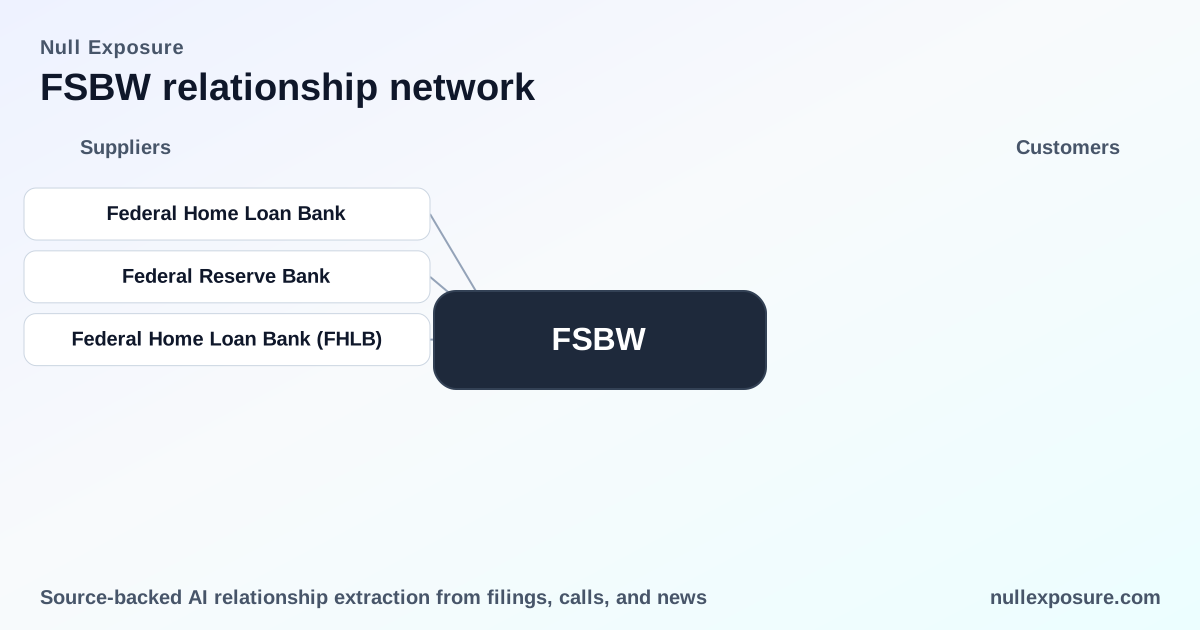
FS Bancorp (FSBW): Supplier and funding relationships that shape balance-sheet flexibility
FS Bancorp operates as a regional bank holding company for 1st Security Bank of Washington, generating net interest income from loans and securities and fee income from deposit and lending services while using short-term borrowings and external vendors to manage liquidity and branch operations. The company monetizes through a traditional regional banking model — spread income on loans versus deposits and selective non-interest income — supplemented by funding lines such as FHLB advances and Federal Reserve borrowings when needed. For a concise supplier-risk mapping and more supplier intelligence, visit https://nullexposure.com/.
How to read FSBW’s supplier relationships in an investor context
FS Bancorp’s supplier footprint is a mix of funding counterparties and operational service providers. Funding counterparties (Federal Home Loan Bank and Federal Reserve) are fundamental to interest-rate and liquidity management, while third-party vendors and lease arrangements influence branch footprint costs and operational continuity. The press disclosures tie these relationships directly to funding and liquidity reporting in FY2026, which affects capital allocation and dividend policy.
Visit https://nullexposure.com/ for deeper supplier relationship intelligence and comparative supplier scoring.
What the record shows: funding lines and counterparties
Below are the relationships surfaced in the company’s public disclosures and news releases. Each entry is a plain-English reading of the record followed by the source.
Federal Home Loan Bank
FS Bancorp reports using FHLB advances as part of its borrowing profile, indicating routine use of secured wholesale funding to manage liquidity and support lending. According to FS Bancorp’s press release, borrowings “comprised of FHLB advances and Federal Reserve Bank borrowings” (GlobeNewswire, January 21, 2026).
Federal Reserve Bank
The company discloses Federal Reserve Bank borrowings alongside FHLB advances, signaling occasional reliance on central bank facilities for short-term liquidity or contingency funding. The GlobeNewswire release for the fourth-quarter results explicitly lists Federal Reserve borrowings as part of the company’s borrowings (GlobeNewswire, January 21, 2026).
Federal Home Loan Bank (FHLB) — alternate listing
The same financing relationship appears again in the public record under a slightly different label, confirming recurring reference to FHLB advances in company reporting and press materials. The duplicate listing in the FY2026 release reiterates that borrowings include FHLB advances (GlobeNewswire, January 21, 2026).
Operational constraints and company-level signals
FS Bancorp’s filings and disclosures include several supplier-related constraints that describe how the company contracts and where operational risk concentrates:
- Short-term lease posture: The bank’s operating leases for branches and loan production offices have remaining terms from three months to 5.5 years with extension options, indicating a relatively short and flexible branch footprint that reduces long-duration fixed-cost exposure but increases renewal risk.
- Geographic reach of intermediary network: The company’s indirect home improvement contractor/dealer network spans multiple states across the West, Mountain, Midwest and Northeast, reflecting a geographically dispersed but regionally concentrated operational footprint that supports lending niches beyond Washington state.
- Material vendor dependence: Filings explicitly state that vendor failures could produce a material adverse impact on operations, signaling elevated criticality for certain external providers.
- Service-provider reliance and active vendor base: The company recognizes dependence on numerous external vendors for day-to-day operations and reports those relationships as active, which implies ongoing vendor management requirements and operational continuity planning.
These constraints function as company-level signals about contracting posture, concentration, criticality and maturity rather than being attributable to any single disclosed counterparty unless explicitly named.
How these relationships translate into financial and operational risk
FS Bancorp’s use of FHLB and Federal Reserve borrowings is a common liquidity tool for regional banks, but investors should treat these relationships as operationally and financially meaningful:
- Funding flexibility: Access to FHLB advances and Fed borrowings provides immediate liquidity alternatives and reduces the need to sell securities or shrink the loan book under stress. The GlobeNewswire FY2026 release confirms both are part of the bank’s borrowing mix.
- Counterparty criticality: While neither the FHLB nor the Federal Reserve are vendor-service providers in the conventional sense, they are critical funding counterparties whose availability and pricing feed directly into net interest margin and stress scenarios.
- Lease and vendor maturity profile: Short-term leases reduce long-term fixed-cost risk but increase exposure to market rent moves and branch consolidation decisions; similarly, the active vendor base underscores operational dependence that, per company filings, could be material if disrupted.
At the intersection of funding and operations, maintain focus on liquidity ratios, the composition and tenor of borrowings, and vendor contractual terms — these drive both near-term resilience and strategic optionality.
For a practical guide to assessing supplier concentration and funding-counterparty risk across peers, see our research hub at https://nullexposure.com/.
Investor takeaways and next steps
- Funding sources are explicit and active: FHLB advances and Federal Reserve borrowings are part of FS Bancorp’s reported borrowings in FY2026, providing measurable liquidity channels that support lending and dividend policy (GlobeNewswire, January 21, 2026).
- Operational supplier risk is non-trivial: The company’s vendor language and short-term lease profile indicate meaningful operational dependency and renewal exposure, which investors should monitor alongside liquidity metrics.
- Management must balance flexibility with concentration: Short lease terms and an active vendor roster provide agility but require disciplined vendor management and contingency planning to avoid material operational disruption.
For investors evaluating counterparty and supplier risk across regional banks, start with funding-tenor schedules, vendor-criticality mapping, and lease maturity profiles — and consult our supplier-risk tools at https://nullexposure.com/ to benchmark FS Bancorp against peers.
These focal points will guide engagement and risk monitoring through the next strategic cycle for FSBW.