FS Credit Opportunities Corp. (FSCO): Who runs the fund, who counts, and what investors should price in
FS Credit Opportunities Corp. is a closed-end credit investment vehicle that monetizes through income generation and capital appreciation on a diversified portfolio of debt instruments, while distributing cash to shareholders on a monthly cadence. The fund outsources portfolio management to external advisers and earns returns from first- and second-lien loans, high-yield bonds and specialty finance positions; its economic model is built around yield capture, leverage optionality within regulatory limits, and fee flows to the adviser. For investors evaluating supplier relationships, the critical questions are adviser control, distribution sustainability and where operational control and disclosure live — because those factors drive both performance and governance outcomes. Learn more about supplier relationships and risk signals at https://nullexposure.com/.
How the fund actually operates and how that matters to investors
FSCO is a classic externally-managed closed-end fund: shareholders own the fund but decision-making and day-to-day portfolio execution are delegated to a named investment adviser under an advisory agreement. That operating posture concentrates execution risk and governance leverage in the adviser-board axis rather than in an internally managed organization. The fund’s market capitalization (~$991m) and its listed P/E imply investor expectations for steady income, but the adviser relationship is the operational fulcrum that converts credit-market opportunities into distributable cash.
- Primary monetization: interest and principal cash flow from credit positions, distributed monthly to shareholders.
- Operational model: external adviser executes strategy under an advisory agreement; the board provides oversight.
- Investor implication: adviser selection, track record and transparency are the primary supplier risk vectors.
If you want a consolidated view of supplier footprints and governance signals, visit https://nullexposure.com/ for more structured research.
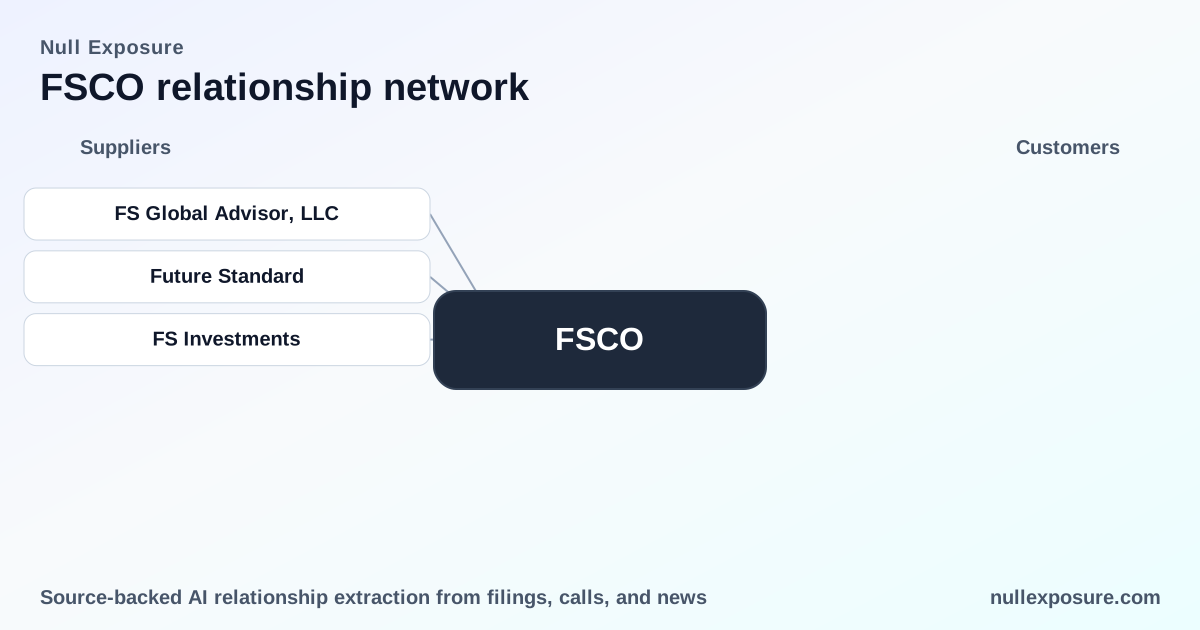
The supplier map: who the fund relies on
Below I list each supplier relationship surfaced in public documents and press; each entry includes a concise, plain-English summary and the source cited for verification.
FS Global Advisor, LLC — the investment adviser executing the strategy
FS Global Advisor, LLC is identified as FSCO’s investment adviser and the active manager responsible for portfolio construction and trading execution; public announcements reference the adviser as an affiliate of FS Investments. According to multiple press releases and distribution notices in March 2026, the fund explicitly names FS Global Advisor, LLC as its adviser (see Intellectia news items from March 9, 2026: financial-results and distribution notices — https://intellectia.ai/news/stock/fs-credit-opportunities-corp-announces-q4-financial-results-release-date and https://intellectia.ai/news/stock/fs-credit-opportunities-corp-announces-february-2026-distribution).
FS Investments — the affiliate / sponsor linkage
FS Investments is cited as the parent affiliate connected to the adviser structure, signaling an organizational sponsorship and brand-level control over investment capabilities used by the adviser. This affiliation is referenced in an Intellectia item covering institutional flows and adviser commentary (Intellectia, March 2026: Matisse Capital initiation mention — https://intellectia.ai/news/stock/matisse-capital-initiates-position-in-fs-credit-opportunities-corp).
Future Standard — distribution communications and reporting presence
Future Standard is shown acting as a public-facing channel for distribution announcements and investor communications related to FSCO, including quotes from portfolio management on dividend batching and cash flow strength. A November–December 2025 distribution press release attributed commentary to a Future Standard portfolio manager and emphasized monthly dividend disclosures (Sahm Capital press release referencing Future Standard, Oct 2025 — https://www.sahmcapital.com/news/content/fs-credit-opportunities-corp-fsco-declares-distribution-for-october-november-and-december-2025-2025-10-08). Another January 2026 notice hosted on Barchart references the fund’s reporting locations and directs investors to filings on EDGAR and the fund website (Barchart, Jan 2026 — https://www.barchart.com/story/news/37006065/fs-credit-opportunities-corp-fsco-declares-distribution-for-january-2026).
What these supplier relationships imply about governance and concentration
FSCO’s supplier topology shows an externally-managed fund with a single, named investment adviser and an affiliate sponsor — a common structure in closed-end credit vehicles but one that concentrates control and counterparty risk. From an investor and counterparty diligence perspective, that implies:
- Contracting posture: investment strategy and execution are governed by a formal advisory agreement and board oversight; investors should review the advisory fee schedule and any side agreements in SEC filings.
- Concentration: a single adviser handles portfolio decisions, so adviser continuity, succession planning and incentive alignment are material to performance.
- Criticality: the adviser is operationally critical — trading, liquidity decisions and risk management flow through that supplier. Any adviser disruption would be impactful.
- Maturity: the adviser relationship is with a seasoned industry player (affiliate of FS Investments), which signals institutional infrastructure but also standard fee economics for external management.
These are company-level signals about the operating model rather than line-item constraints tied to a specific supplier. For deeper supplier verification and board/adviser contract screening, see the research hub at https://nullexposure.com/.
Key risks and what to watch in ongoing monitoring
Investors evaluating FSCO should focus on a small set of observable indicators that flow directly from the supplier model:
- Adviser performance and turnover: given the adviser’s central role, any change in portfolio leadership or compensation structure is immediately material.
- Distribution coverage and cash-flow transparency: press notices highlight monthly distributions; investors should reconcile those announcements with reported net investment income and realized gains in quarterly filings.
- Disclosure channels and investor communications: the presence of third-party outlets (e.g., Future Standard posts) matters for market messaging — confirm the primary source via SEC filings and fund website links cited in press releases.
- Related-party economics: affiliation with FS Investments suggests typical sponsor-adviser fee relationships; confirm fee caps, expense reimbursement mechanics and any incentive allocations in the fund’s filings.
Bottom line and recommended next steps
FSCO’s economics are straightforward: yield-driven returns delivered through an externally-managed structure where the adviser relationship is the single largest operational dependency. That produces both upside (access to a seasoned credit manager and institutional distribution capability) and concentrated counterparty risk (adviser governance and fee alignment).
Actionable next steps for investors evaluating FSCO:
- Read the fund’s most recent advisory agreement and board minutes in SEC filings for fee and governance detail.
- Monitor adviser personnel disclosures and monthly distribution notices for early signals of stress or policy shifts.
- Keep a supplier watchlist (adviser continuity, third-party servicers and disclosure outlets) and revisit headline coverage after each quarterly filing.
For a structured supplier analysis and continuous monitoring tools that aggregate adviser, filing and press signals, visit https://nullexposure.com/ — the research hub centralizes the items investors need to triage counterparty and governance risk before sizing positions.