First Seacoast Bancorp (FSEA): Supplier relationships and operational posture investors should price in
First Seacoast Bancorp is a regional bank holding company that operates First Seacoast Bank and monetizes through traditional banking activities—net interest margin on loans and securities, deposit service revenues, and fee income from commercial and consumer services. The company runs a capital- and contract-intensive model with fixed-cost real estate commitments and a controlled counterparty acceptance framework, and supplier choices are organized to protect credit and operational continuity while supporting a lean branch and digital operating footprint. For a quick reference on supplier intelligence services, visit https://nullexposure.com/.
How to read supplier disclosures for a community bank
Regional banks do business through a small set of predictable supplier categories: core banking systems, payment and treasury vendors, facilities and equipment lessors, and a handful of cloud and communications providers that support remote work and customer access. First Seacoast’s public disclosures show a preference for long-term contracts and institutional counterparties, which drives a contracting posture that favors predictability over short-term flexibility.
- Long-term real estate and equipment leases create fixed operating leverage that investors should fold into liquidity and stress scenarios.
- Board-level approval for institutional counterparties elevates counterparty credit standards, reducing tail credit risk but increasing onboarding friction.
- A structured third-party risk management program signals formal vendor governance, which reduces operational and cybersecurity surprise events but increases vendor oversight costs.
Those company-level signals are spelled out in the bank’s own disclosures and should be considered part of the operating model rather than isolated procurement footnotes.
Contracting posture, concentration and maturity — what the constraints reveal
The public constraint excerpts frame the bank’s supplier relationships as deliberate and long-dated. Key, company-level signals:
- Contract term orientation: long-term. The company reports operating and finance leases, with many non‑cancellable operating leases and lease terms extending up to 15 years; a sale-leaseback cited an initial 15‑year lease with a 15‑year renewal option. This indicates high lease maturity and committed occupancy costs reported in filings.
- Counterparty quality: institutional, investment-grade bias. Disclosures require institutional counterparties to meet investment-grade thresholds and board approval, signaling a preference for lower counterparty credit risk.
- Vendor management: formal third‑party risk program. The bank maintains a program to identify and manage cybersecurity and supply-chain risks associated with external service providers.
- Licensee posture for real estate arrangements. The sale-leaseback and absolute net lease language confirm the bank routinely operates as a long-term licensee on property assets.
Takeaway: First Seacoast trades flexibility for stability—investors should underwrite longer fixed-cost horizons and higher governance overhead as part of baseline forecasts.
Relationship inventory: the one public supplier mention
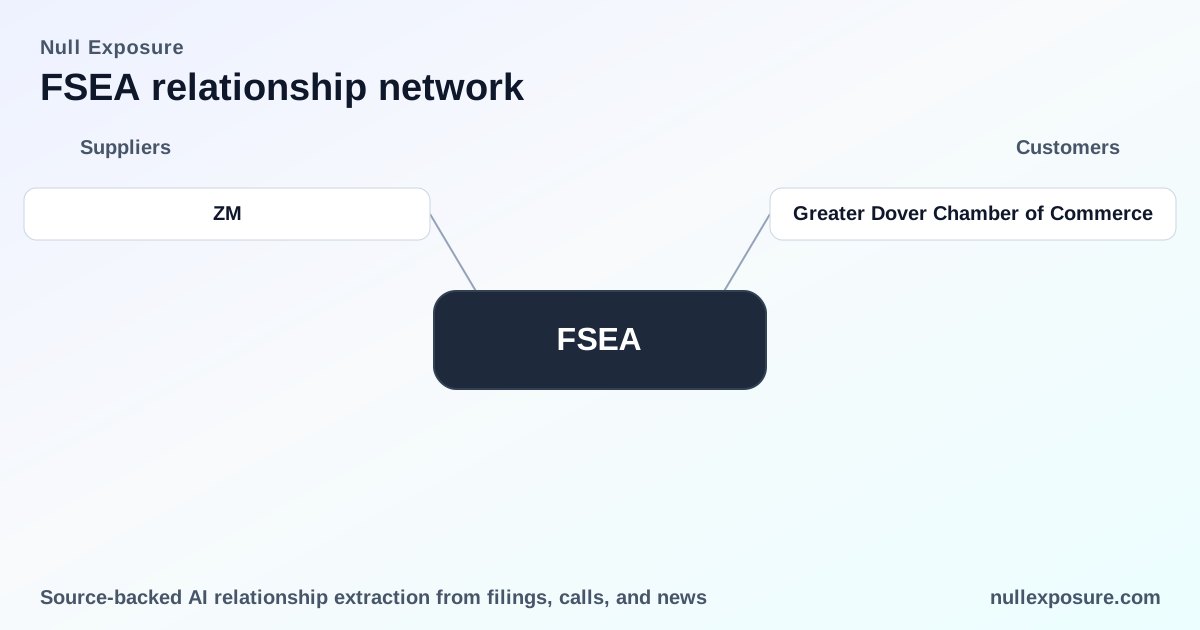
Zoom (ZM) — visible in public commentary
First Seacoast acknowledged adopting virtual meeting tools in public commentary, noting that transitioning to a virtual working environment (i.e., Zoom) "has created unanticipated efficiencies that have become part of our ‘regular’ business flow." This reference appears in a bank profile published in September 2021 and captures operational adoption rather than a material vendor contract disclosure. (Seacoast Online, September 26, 2021: https://www.seacoastonline.com/story/business/2021/09/26/10-watch-tiffany-melanson-advises-young-professionals-be-fearlessly-you/5795139001/)
Takeaway: The bank uses modern communications platforms to compress meeting cadence and support remote operations; this is operationally meaningful but not a material supplier exposure on its own.
What these relationships and constraints mean for investors
First Seacoast is small-cap and regional—market cap roughly $61.4m—with negative trailing EPS and modest profitability metrics on the latest trailing twelve months. Combine that capital profile with long-term real estate commitments and a governance posture that favors investment‑grade counterparties, and the investment case requires stress-testing fixed charges and vendor continuity.
- Operational criticality: Long-term leases are more critical to near-term earnings than any single SaaS or communications provider referenced in public press; they represent principal fixed obligations.
- Concentration: The firm’s supplier mix is not highly dispersed by vendor type; typical regional-bank supplier concentration risks cluster around core processing and payment rails. The recorded use of Zoom reflects a broader, low-cost communications strategy rather than single-vendor concentration in mission‑critical banking systems.
- Maturity: Vendor relationships skew toward mature, contractually stable arrangements (leases and institutional counterparties) rather than short-term spot purchasing.
For a deeper review of supplier risk implications and to monitor counterparties at scale, see https://nullexposure.com/.
Operational and financial risk vectors to monitor now
Investors evaluating FSEA supplier relationships should prioritize these monitoring items:
- Track the bank’s lease schedule and covenant impacts tied to long-term real estate commitments, including near-term renewal or refinancing events.
- Assess the third‑party risk management program’s scope and whether it covers critical providers (core processing, payments, cloud, and communications).
- Monitor counterparty onboarding and concentration reports for any exposure to non-investment-grade or single-source vendors that could create operational fragility.
- Watch for any meaningful shift from legacy on‑premise vendors to cloud or outsourced models that could change cost structure and vendor concentration dynamics.
A practical next step for operational diligence is to review company filings and vendor schedules the bank files with regulators and in investor materials.
Final read: portfolio implications and action
First Seacoast runs a conservative supplier governance model with long-term leased infrastructure and board‑vetted counterparties—a configuration that supports stability but amplifies fixed-cost leverage for a small-cap regional bank. The public relationship evidence is limited (the Zoom mention is operationally relevant but not material); the true investor risk sits in lease commitments and core banking vendor continuity.
If you need ongoing supplier intelligence and monitoring for regional financials, consider the coverage and analyst tools at https://nullexposure.com/. For targeted supplier due diligence and to align vendor risk with credit and liquidity scenarios, begin with the bank’s filings and the vendor governance disclosures in its annual report.