Flag Ship Acquisition Corp. (FSHP) — supplier relationships, operating constraints, and what investors should act on
Flag Ship Acquisition Corp. (FSHP) is a publicly listed SPAC that raises capital through an IPO trust and seeks a business combination with a middle-market consumer or hospitality company; it currently monetizes indirectly through sponsor economics and the eventual closing of a merger rather than recurring operating revenue. FSHP’s balance sheet shows no operating revenue and limited liabilities today, while its operating model depends on a small set of service arrangements and capital markets partners to execute a deal in the $200–$400 million enterprise value range. For an executive or investor evaluating supplier counterparty risk and contracting posture, the focus is on sponsor-provided services, short-term subscription-style fees and the capital markets relationships that enable the SPAC to transact. Visit https://nullexposure.com/ for additional supplier intelligence and verification tools.
The capital markets relationship you need to know about
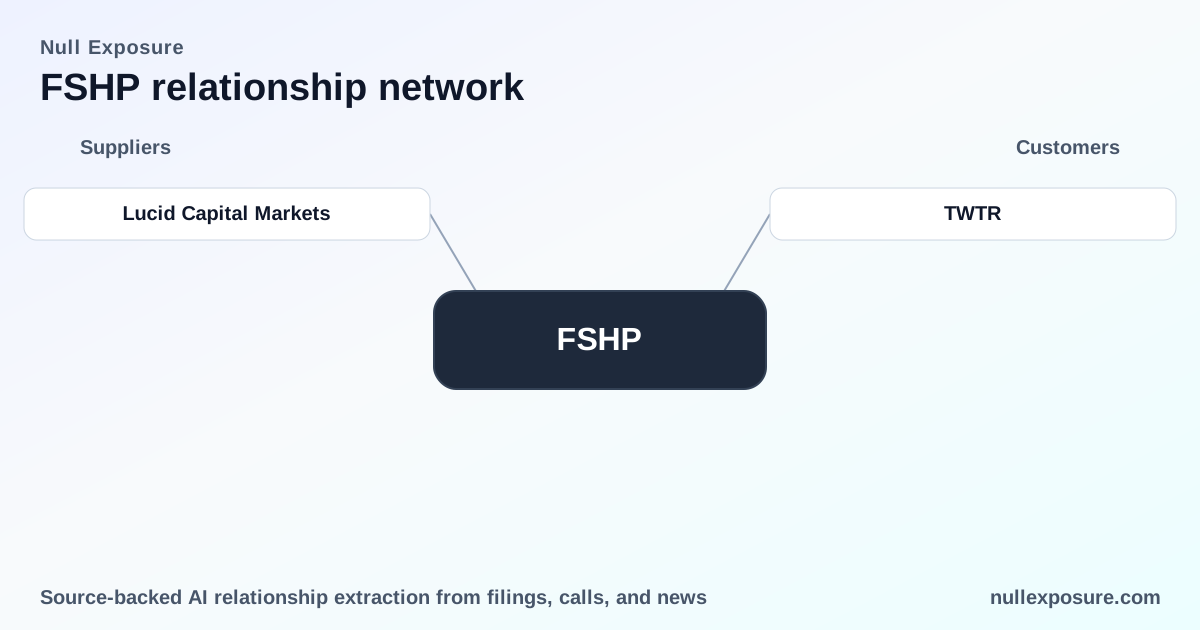
Lucid Capital Markets acted as sole bookrunner on FSHP’s $60 million IPO. Renaissance Capital’s IPO coverage (news, FY2024) notes Lucid filled the underwriting role, which places it as a primary execution partner for FSHP’s fundraising and initial public distribution. This relationship is transactional and critical for deal execution — underwriters shape market access and pricing for any subsequent capital actions. (Source: Renaissance Capital IPO coverage, FY2024.)
What FSHP’s disclosures say about suppliers and spending
FSHP’s public filings and offering documents describe several company-level supplier dynamics that shape contracting posture and operational risk:
- Subscription-style supplier payments. FSHP discloses a monthly $10,000 fee paid to an affiliate of its sponsor for office space, administrative and support services; the company has been incurring these fees since June 20, 2024. This reads as a subscription-like commitment for basic G&A that will continue until a business combination or liquidation. (Source: FSHP filings / prospectus language, FY2024.)
- Service-provider dependency. FSHP depends on third-party digital technologies and vendors for systems, infrastructure and cloud services, and it acknowledges it cannot fully guarantee vendor waivers related to trust-account claims. That elevates the legal and operational surface area for counterparty claims during a deal process. (Source: FSHP filings, FY2024.)
- Active, short-tenor relationships. The fees began mid-2024 and continue monthly, establishing an active service relationship posture that is operationally necessary but not long-term indebtedness. (Source: FSHP filings, FY2024.)
- Spend profile and deal target scale. FSHP expects sponsor payments of roughly $210k–$240k if the deal timeline reaches 21–24 months (i.e., $10k monthly), and it explicitly targets acquisitions in the $200–$400 million enterprise value band — a signal of intended deal size and future capital requirements. (Source: FSHP filings, FY2024.)
These elements together indicate a low-complexity, high-dependency contracting posture: recurring small-dollar service payments today, but outsized dependency on a handful of counterparties (sponsor and underwriter) to deliver the strategic outcome investors seek.
How the supplier constraints translate into operational risk
FSHP’s supplier declarations generate concrete implications for counterparty exposure and governance:
- Concentration and criticality: The $10,000 monthly sponsor fee covers essential office and admin services; that places outsized operational importance on a single affiliate for day-to-day functioning. If that affiliate’s service falters or the parties dispute terms, FSHP’s pre-combination operations could be disrupted. (Source: FSHP filings, FY2024.)
- Legal exposure to vendors: FSHP attempts to secure waivers from vendors concerning the trust account, but concedes enforceability is not guaranteed. That creates direct legal risk—vendors could seek remedies that compete with public shareholders’ interests in extreme scenarios. (Source: FSHP filings, FY2024.)
- Maturity and sourcing: The relationship stage is active but immature; current spend is modest (aggregate sponsor payments in the low hundreds of thousands over the SPAC life if extended), while the capital execution risk hinges on third parties (bookrunners, legal and financial advisers) to consummate a large-scale transaction. (Source: FSHP filings, FY2024.)
Relationship-by-relationship brief (complete and explicit)
- Lucid Capital Markets — Lucid served as sole bookrunner on FSHP’s IPO, establishing it as the capital market execution partner for the SPAC fundraising. This is a transactional, execution-critical role tied directly to FSHP’s ability to raise or syndicate capital. (Source: Renaissance Capital IPO coverage, FY2024.)
This article covers every reported supplier relationship in FSHP’s public results; Lucid Capital Markets is the sole named external market intermediary in those items. (Source: consolidated results and news coverage, FY2024.)
What investors and operators should monitor next
FSHP’s structure and supplier posture lead to three practical, prioritized monitoring actions:
- Track the sponsor fee arrangement and counterparty stability. The sponsor affiliate provides core G&A for a modest but material monthly fee; any change to that arrangement alters operational continuity and short-term spend expectations. Regularly review amendments or escrow arrangements tied to that fee. (Source: FSHP filings, FY2024.)
- Validate vendor waivers and trust-account protections. Because vendors could challenge the trust account, confirm whether key vendors have executed enforceable waivers and whether legal counsel has opined on waiver enforceability. Legal clarity reduces deal-execution tail risk. (Source: FSHP filings, FY2024.)
- Monitor capital markets partners and underwriting depth. Lucid’s role as sole bookrunner is consequential; investors should watch for any expansion of the underwriting syndicate, explicit commitments from additional banks, or changes in bookrunning arrangements that affect distribution capacity for follow-on capital. (Source: Renaissance Capital, FY2024.)
For a practical vendor-risk playbook and supplier impact scoring on SPACs like FSHP, visit https://nullexposure.com/ and review our supplier intelligence reports.
Bottom line: measured exposure, concentrated dependencies
Flag Ship Acquisition Corp. is a classic small SPAC: no operating revenue, modest recurring sponsor-funded G&A, high dependency on sponsor and a single underwriting partner, and a stated target acquisition range that implies substantial future capital requirements. That combination produces a profile of low current spend but concentrated operational dependency and litigation-sensitive counterparty risk. For investors and operators, the decisive questions are governance (waivers and trust protections), sponsor alignment (terms and continuity of services), and underwriting depth (bookrunner capacity to support capital actions). These are the levers that determine whether FSHP’s transactional model converts into shareholder value at the $200–$400 million deal scale. Check FSHP supplier risk assessments and ongoing alerts at https://nullexposure.com/ to stay ahead of developments.