FSML: Who Runs and Distributes the Franklin Small Cap Enhanced ETF — and Why it Matters to Investors
FSML is a listed ETF product whose economics are driven by management and distribution agreements with Franklin Templeton affiliates and several specialist sub‑advisers. The fund generates revenue through management fees and distribution/servicing fees paid to the named advisor and distributor, while portfolio construction and active decisions are supported by a multi‑manager approach that brings in specialist boutique teams. For investors and operators evaluating FSML supplier risk, the critical facts are concentration of control with Franklin entities, reliance on third‑party specialist managers for alpha, and a traditional sponsor/distributor monetization model.
If you want a concise supplier risk briefing for counterparties and portfolio due diligence, start with a targeted supplier map at https://nullexposure.com/.
How the supplier map is organized — a quick investor view
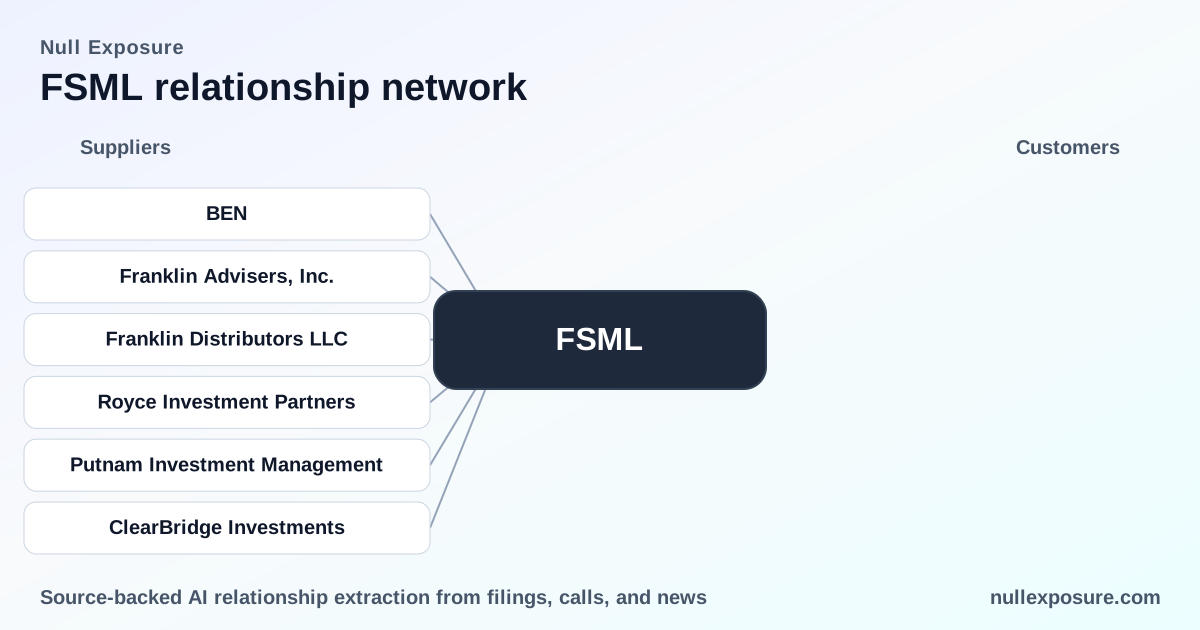
The publicly visible supplier relationships for FSML show a classic ETF operating structure: an issuer/sponsor, a primary advisor, a distributor, and multiple specialist investment managers contributing to the investment process. Each relationship below is listed with a plain‑English description and the reporting source.
- According to the TradingView listing for AMEX‑FSML (reported 9 March 2026), Franklin Resources, Inc. is the issuer/sponsor — the corporate entity that stands behind the fund vehicle and holds legal responsibility for the ETF’s governance. (Source: TradingView AMEX‑FSML page, first seen Mar 9, 2026 — https://www.tradingview.com/symbols/AMEX-FSML/)
- Franklin Templeton is the investment management organization behind the product and is identified in press coverage as the sponsor launching the Franklin Small Cap Enhanced ETF, which sits in the firm’s active ETF lineup and underpins the fund’s go‑to‑market distribution and brand. (Source: Family Wealth Report, product launch coverage, Mar 2026 — https://www.familywealthreport.com/article.php/What%E2%80%99s-New-In-Investments%2C-Funds%3F-%E2%80%93-Franklin-Templeton?id=206477)
- Franklin Advisers, Inc. is recorded as the primary advisor on the trading listing, responsible for day‑to‑day portfolio management oversight and operational control of the investment mandate. (Source: TradingView AMEX‑FSML page, first seen Mar 9, 2026 — https://www.tradingview.com/symbols/AMEX-FSML/)
- Franklin Distributors LLC is named as the distributor, handling fund share distribution and intermediary servicing relationships that convert advisor relationships into assets under management. This is the channel through which the fund captures flows and collects fees. (Source: TradingView AMEX‑FSML page, first seen Mar 9, 2026 — https://www.tradingview.com/symbols/AMEX-FSML/)
- Royce Investment Partners contributes as a specialist sub‑adviser, with the fund’s investment process incorporating holdings‑level views from Royce as part of a multi‑manager conviction signal. That allocation supports the small‑cap value/quality tilt described in launch materials. (Source: Family Wealth Report, fund launch commentary, Mar 2026 — https://www.familywealthreport.com/article.php/What%E2%80%99s-New-In-Investments%2C-Funds%3F-%E2%80%93-Franklin-Templeton?id=206477)
- Putnam Investment Management is similarly listed among the specialized managers whose holdings‑level views feed the fund’s proprietary multi‑factor model and conviction framework. This provides an outsized role for sub‑advisers in the portfolio construction signal. (Source: Family Wealth Report, Mar 2026 — https://www.familywealthreport.com/article.php/What%E2%80%99s-New-In-Investments%2C-Funds%3F-%E2%80%93-Franklin-Templeton?id=206477)
- ClearBridge Investments is the fourth specialist manager cited as part of the conviction and holdings‑level input set used in the fund’s multi‑factor active approach, reinforcing the multi‑manager construction. (Source: Family Wealth Report, Mar 2026 — https://www.familywealthreport.com/article.php/What%E2%80%99s-New-In-Investments%2C-Funds%3F-%E2%80%93-Franklin-Templeton?id=206477)
If you want a tailored supplier due‑diligence pack for FSML that aggregates contracts, fee schedules, and counterparty concentration, request it at https://nullexposure.com/.
What this structure means for revenue and execution
- Monetization is traditional and centralized. The sponsor/advisor/distributor triad captures the recurring fee stream: advisor management fees and distribution/servicing fees flow to Franklin entities, while sub‑adviser arrangements will be paid out of that pool or via explicit sub‑advisory fees.
- Operational control is concentrated with Franklin affiliates. Issuance, brand, primary advisory oversight, and distribution are all handled by Franklin entities, which concentrates legal and operational risk with the sponsor.
- Investment alpha generation is distributed across boutique managers. The fund’s active methodology deliberately aggregates holdings‑level conviction from ClearBridge, Royce, Putnam, and Franklin’s in‑house teams to drive stock selection, creating reliance on external sub‑advisers for performance.
Company‑level signals and constraints investors should note
There are no explicit third‑party contractual constraints surfaced in the available supplier relationship listings for FSML. Presenting this as a company‑level signal:
- No reported supplier constraints in the relationship feed — this translates to a neutral signal on contractual fragility; investors should therefore baseline diligence on fee schedules, termination clauses, and service‑level commitments since none were disclosed in the relationship extract.
- Concentration and criticality are the primary structural risks. Because issuer, advisor, and distributor roles are all within the Franklin family, a sponsor‑level event would have outsized impact on the product’s continuity and brand distribution.
- Maturity and market positioning are implied by the sponsor’s scale. Franklin Templeton’s scale (noted in coverage as managing over $1.6 trillion AUM in the Family Wealth Report piece) indicates institutional support and distribution reach, which reduces execution risk relative to a boutique‑only sponsor. (Source: Family Wealth Report, Mar 2026 — https://www.familywealthreport.com/article.php/What%E2%80%99s-New-In-Investments%2C-Funds%3F-%E2%80%93-Franklin-Templeton?id=206477)
Investment implications and risk checklist
- Concentration risk: The sponsor‑centric model concentrates counterparty exposure; underwrite sponsor credit, regulatory standing, and continuity provisions first.
- Sub‑adviser dependency: Performance attribution will be sensitive to the boutique teams’ decisions; evaluate sub‑advisory contracts and resource commitments.
- Fee capture and economics: Confirm the fund’s fee structure and sub‑adviser compensation to assess effective revenue split and margin for the sponsor.
- Distribution mechanics: Distributor relationships will determine flow velocity; Franklin Distributors LLC is the named channel on the trading listing and therefore a key commercial lever. (Source: TradingView AMEX‑FSML page, Mar 9, 2026 — https://www.tradingview.com/symbols/AMEX-FSML/)
For operators building monitoring frameworks around fund suppliers, use a supplier‑centric dashboard that tracks contract expiration, fee changes, and any shifts in sub‑adviser lineup — we cover templates and workflows at https://nullexposure.com/.
Bottom line for investors and operators
FSML is a Franklin‑sponsored active ETF that monetizes via traditional management and distribution economics while outsourcing substantive alpha generation to specialist managers. The primary decision for investors is whether to accept sponsor concentration in exchange for active, multi‑manager exposure to small caps. Operational continuity looks robust on paper due to Franklin’s scale, but the fund’s performance and reputation are materially dependent on the boutique sub‑advisers named above — ClearBridge, Royce, Putnam, and Franklin’s internal teams.
If you require a formal supplier risk memo or a one‑page executive summary tailored to investment committees, order it at https://nullexposure.com/.