FSOL: Fidelity’s Staking-Enabled Solana Fund — supplier relationships and what they mean for investors
Fidelity’s FSOL is an ETF that gives investors direct exposure to Solana while incorporating a staking-enabled mechanics that can generate incremental yield on underlying holdings; the product is monetized through traditional ETF management fees plus any operational staking returns captured for fund investors. This vehicle is distributed through established exchange infrastructure and leverages Fidelity’s scale and brand to accelerate adoption — a combination that creates an asset-management-style supplier relationship profile worth tracking closely. Explore deeper supplier intelligence at https://nullexposure.com/.
The business in plain English: how FSOL operates and earns revenue
FSOL is a Fidelity-launched exchange-traded fund that holds Solana and has been structured to allow staking of Solana holdings, creating a potential additional revenue stream for investors beyond price appreciation. The fund collects management fees in line with ETF economics and will retain or pass through staking proceeds according to fund documents and manager policy; Fidelity’s role as sponsor, manager and marketer positions it to capture distribution scale advantages. According to CoinDesk’s launch coverage (18 November 2025), Fidelity introduced FSOL as a first-of-its-kind staking-enabled product for its ETF lineup (https://www.coindesk.com/markets/2025/11/18/fidelity-launches-fsol-fund-bringing-major-wall-street-name-to-solana-etfs). Analytics Insight also lists FSOL as a Fidelity offering in 2026 commentary on Solana ETFs (https://www.analyticsinsight.net/amp/story/cryptocurrency-analytics-insight/best-solana-etfs-for-2026-compare-fees-staking-rewards-promos).
Who’s on the other side of the table — the relationships you need to know
Below I cover every relationship surfaced in available reporting, with a short plain-English takeaway and source reference.
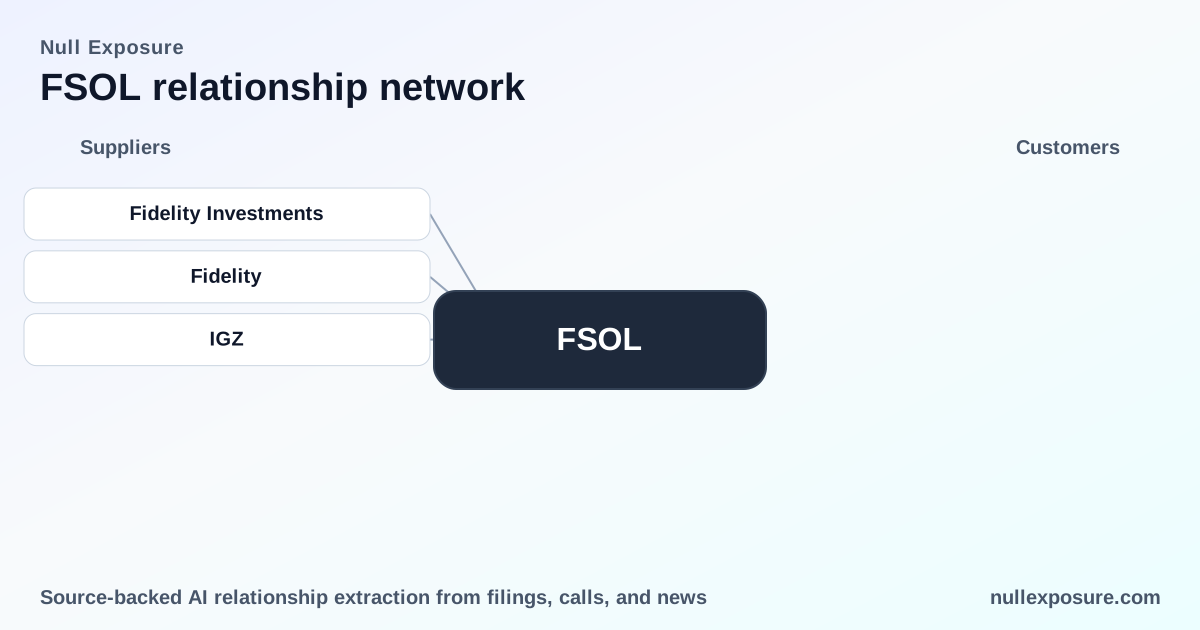
Fidelity Investments / Fidelity
Fidelity is the sponsor and asset manager bringing FSOL to market; the firm positioned FSOL as a staking-enabled Solana ETF, leveraging Fidelity’s distribution and brand to drive investor adoption. According to CoinDesk’s November 18, 2025 coverage, Fidelity introduced FSOL as a first staking-enabled crypto product in its ETF lineup (CoinDesk, 18 Nov 2025 — https://www.coindesk.com/markets/2025/11/18/fidelity-launches-fsol-fund-bringing-major-wall-street-name-to-solana-etfs). Analytics Insight’s March 2026 roundup of Solana ETFs similarly lists Fidelity as the provider of FSOL (Analytics Insight, Mar 2026 — https://www.analyticsinsight.net/amp/story/cryptocurrency-analytics-insight/best-solana-etfs-for-2026-compare-fees-staking-rewards-promos).
NYSE Arca
FSOL began trading on NYSE Arca, which provides the exchange listing and primary market for investor flows and liquidity; the exchange relationship is critical for tradability and market access. CoinDesk’s reporting on the fund launch notes that FSOL started trading on NYSE Arca, bringing Fidelity’s product to the regulated U.S. exchange market (CoinDesk, 18 Nov 2025 — https://www.coindesk.com/markets/2025/11/18/fidelity-launches-fsol-fund-bringing-major-wall-street-name-to-solana-etfs).
Operating model and business-model characteristics investors and ops teams should factor into decisions
- Contracting posture: FSOL is distributed by a vertically integrated asset manager (Fidelity) that controls product design, marketing, and distribution. That implies centralized contracting with Fidelity for most commercial and operational questions, with specialized third-party contracts likely for custody and staking operations.
- Concentration: The product benefits from single-sponsor concentration — Fidelity’s scale lowers distribution risk but concentrates counterparty exposure to the sponsor for governance and operational choices.
- Criticality: The staking-enabled feature makes the fund operationally dependent on custody and staking partners and on exchange connectivity (NYSE Arca) for liquidity; these elements are critical to realized yield and investor experience.
- Maturity: FSOL is a new product (launch coverage from late 2025/early 2026), so the fund’s operational processes, liquidity profile, and market acceptance are still forming; early-stage product risks should be priced accordingly.
If you want a structured supplier risk assessment built around these dimensions, see how we map issuer and market relationships at https://nullexposure.com/.
Risk and opportunity implications for investors and operators
- Opportunity: differentiated yield profile. FSOL’s staking functionality gives it a structural product differentiation versus plain-vanilla spot or index-based crypto ETFs; this can attract yield-seeking inflows and improve gross product economics.
- Operational risk: custody and staking execution. The fund’s ability to realize staking returns hinges on custody and validator relationships, operational governance, and on-chain mechanics; failures or operational shortfalls would erode the fund’s value proposition.
- Market and regulatory exposure. Being a regulated exchange-listed product eases some custody and distribution concerns, but crypto ETF regulation and compliance scrutiny remain heightened and will influence product economics and disclosure requirements.
- Liquidity and market-structure dependence. Listing on NYSE Arca ensures primary-market access, but investor outcomes depend on secondary-market liquidity and authorized participant flows; early trading volumes are a key monitoring metric.
Practical next steps for investor diligence
- Request the fund prospectus and operational exhibits to confirm how staking proceeds are allocated (net of fees) and who performs custodial/staking services.
- Validate the custody and validator counterparties and obtain SLAs and incident history for staking operations.
- Track trading volumes and spreads on NYSE Arca in the first 6–12 months to assess liquidity and price discovery dynamics.
For a full supplier mapping and ongoing monitoring of FSOL counterparties and operational risk, visit https://nullexposure.com/ and subscribe to issuer monitoring tools.
Final read: what matters most
FSOL combines Fidelity’s distribution scale with a novel staking mechanic; that juxtaposition creates both a meaningful commercial opportunity and a concentrated operational dependency. Investors should value the potential yield premium but underwrite custody/staking execution and exchange liquidity as part of any investment or operational decision. For ongoing supplier intelligence and to see how this fund’s relationships evolve, go to https://nullexposure.com/.