Franklin Street Properties (FSP): who they hire, who lends them money, and why it matters for investors
Franklin Street Properties (FSP) operates as a small-cap REIT that acquires, develops and manages office and industrial assets across the United States, monetizing through rental income, selective asset dispositions and financial engineering (debt refinancings and strategic reviews) to enhance per-share returns. Recent activity shows management leaning on external legal and capital markets partners to restructure balance-sheet liabilities and to explore strategic alternatives that could unlock shareholder value.
For a fast check on the supplier map and relationship signals, visit https://nullexposure.com/.
A concise supplier map — legal, capital and market counterparts that matter
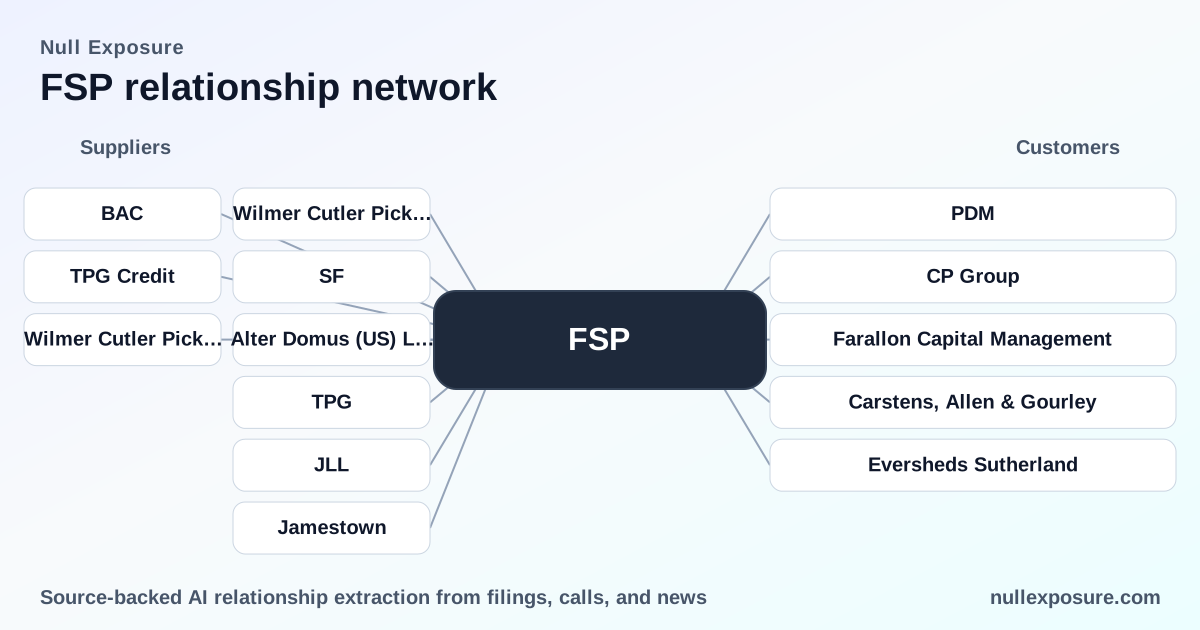
FSP’s supplier relationships cluster into three practical buckets: legal and advisory counsel, capital providers and property-market services. The company’s operating posture is capital-intensive and debt-driven, with multiple long-dated loans and senior notes that concentrate counterparty and refinancing risk. The relationships below are drawn from public notices and real-estate coverage between 2021–2026 and should be read as active counterparts to FSP’s balance-sheet and strategic processes.
Legal and financial-advisory partners
- Wilmer Cutler Pickering Hale and Dorr LLP — Wilmer acted as legal counsel to FSP in connection with the company’s $320 million secured credit facility and related refinancing, confirming FSP used top-tier outside counsel for its capital transactions. (Source: BizWire/markets.financialcontent, Feb 27, 2026.)
- BofA Securities — The board engaged BofA Securities as financial advisor during a company-wide strategic review; BofA’s role underscores that the board is exploring sale or value-maximizing options with a major investment bank. (Source: ConnectCRE, 2025; TradingView Q3 2025 results release.)
Capital, administrative and lending counterparties
- TPG Credit — An affiliate of TPG Credit provided the $320 million secured credit facility that refinanced FSP’s outstanding indebtedness, positioning TPG as the primary lender behind the company’s current leverage package. (Source: BizWire/markets.financialcontent, Feb 27, 2026; Pulse2, Feb 2026.)
- Alter Domus (US) LLC — Alter Domus is serving as administrative agent for the new $320 million facility, which signals a third-party operations layer for loan administration and covenant monitoring. (Source: BizWire/markets.financialcontent, Feb 27, 2026; Pulse2, Feb 2026.)
- Stifel — Stifel is listed as representing FSP alongside Wilmer in the refinancing announcement, indicating the company used Stifel in a capital markets or placement/advisory capacity for the debt transaction. (Source: BizWire/markets.financialcontent, Feb 27, 2026; Pulse2, Feb 2026.)
Property-services and historical counterparties
- JLL — JLL represented Franklin Street as landlord in leasing transactions, confirming FSP’s use of national brokerage services to source tenants and manage lease execution. (Source: REJournals, FY2022.)
- Jamestown — Historical market activity records show Franklin Street purchased 999 Peachtree from Jamestown in 2013, a past portfolio acquisition that speaks to FSP’s active asset rotation and market-level counterparties. (Source: Bisnow, FY2021.)
What the supplier list tells you about FSP’s operating model and constraints
Company disclosures and the relationship map point to several structural characteristics that investors should treat as operating constraints and risk signals:
- Contracting posture: long-term indebtedness dominates. Company filings as of December 31, 2024, document term loans and senior notes maturing on April 1, 2026, indicating a multi-counterparty debt maturity wall that requires refinancing or repayment pathways. This is a firm-level signal tied to FSP’s financing strategy.
- Concentration of capital exposure. Senior notes aggregate roughly $123.6 million and term loans of material size are reported, so a small number of lenders and a single large secured facility materially shape liquidity options. These figures are drawn from company filings for FY2024.
- Relationship criticality and role. The constraints identify service-provider roles and active relationships; FSP relies on third-party legal counsel, investment banks and an administrative agent to execute financing and strategic initiatives, making these suppliers operationally critical in execution windows.
- Maturity and near-term execution risk. Multiple instruments referenced in filings share an April 1, 2026 maturity; that calendar concentration creates a discrete refinancing event that elevated counterparties (lenders and admin agents) will influence directly.
- Spend and scale signal. The company-level spend bands include figures in both the $10–100M and $100M+ ranges, which is consistent with the mix of term loans and senior notes on the balance sheet.
For deeper diligence on these counterparties and how they influence FSP’s capital structure, see https://nullexposure.com/.
Investment implications — how suppliers change the picture
- Refinancing completed but counterparty risk remains. Closing a $320 million facility with an affiliate of TPG Credit reduces immediate rollover pressure and consolidates secured debt, but it replaces exposure to several lenders with concentrated exposure to a deep credit investor. This changes counterparty concentration rather than eliminating it. (Source: BizWire/markets.financialcontent, Feb 27, 2026.)
- Advisory and legal sophistication suggests management intends a sale or structured outcome. Hiring BofA Securities and Wilmer indicates an intent to pursue complex strategic alternatives that require top-tier advisory and legal execution. (Source: ConnectCRE, TradingView Q3 2025; BizWire Feb 27, 2026.)
- Operational leverage to market execution. Use of JLL and historical deals with sellers like Jamestown demonstrate the company executes through national brokers and institutional sellers when optimizing the portfolio; asset-level execution will determine cash flow resilience. (Source: REJournals FY2022; Bisnow FY2021.)
Clear takeaways for investors evaluating FSP supplier relationships
- Counterparty concentration is high: a small set of lenders and advisors control refinancing outcomes.
- Near-term maturities (documented April 1, 2026) create a binary execution timeline that pressures liquidity and strategy.
- Management’s engagement of major advisors and legal counsel is consistent with a sale or structured recapitalization strategy.
If you want a structured supplier-risk memo or a comparison across small-cap REITs, start here: https://nullexposure.com/.
Concluding, Franklin Street’s supplier footprint is a concise roster of top-tier legal counsel, institutional credit and national brokerage — a model that supports active balance-sheet management but concentrates execution risk in a few counterparties and a tight maturity window. For portfolio managers and operators, the actionable questions are clear: will TPG (as lender) and the administrative agent permit an operational runway long enough for asset-level execution, and can advisory-led strategic alternatives extract value before maturities compress options? For bespoke analysis, visit https://nullexposure.com/ and request a tailored supplier-risk brief.