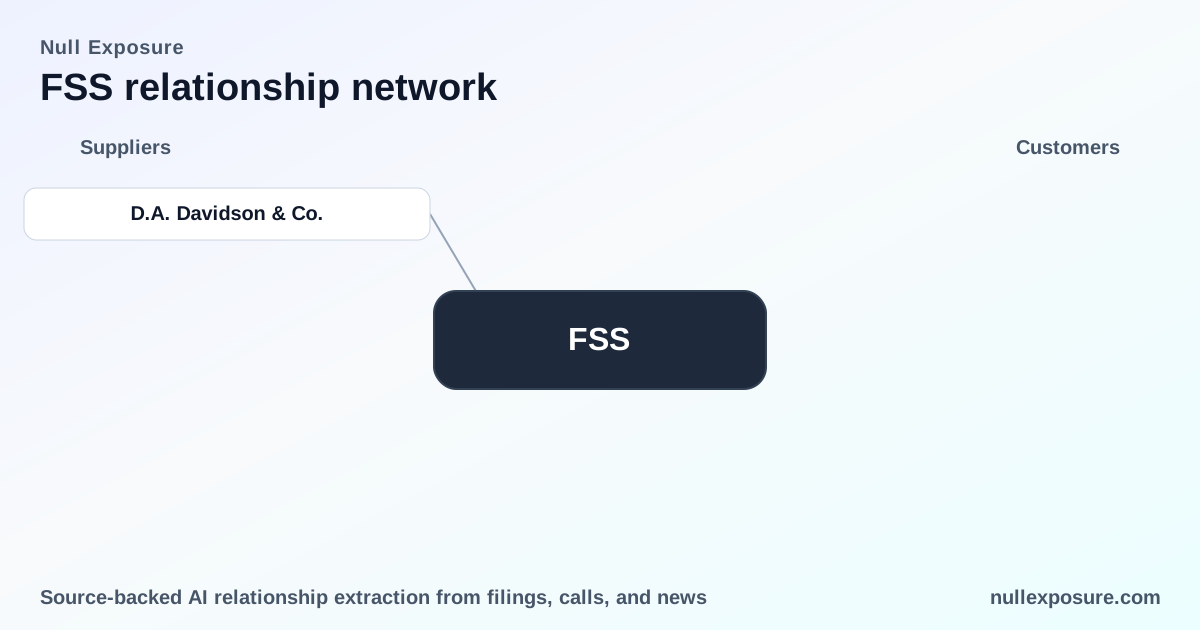
Federal Signal (FSS): Supplier relationships and what they tell investors
Federal Signal designs, manufactures and sells equipment and integrated solutions for municipal, government and industrial customers, monetizing through product sales, aftermarket parts and service work across safety, environmental and infrastructure markets. Revenue is driven by capital purchases from public agencies and recurring aftermarket/service revenue; operating leverage is visible in a 16% operating margin and $434.7m of EBITDA on $2.18bn of trailing revenue. This profile makes supplier and advisor relationships strategically important for execution risk and deal execution. Learn more or follow this coverage at https://nullexposure.com/.
How Federal Signal’s business model converts supplier exposure into cash flow
Federal Signal is a manufacturing-led industrial business: it buys raw materials and components, assembles engineered systems and sells finished products to municipal and commercial buyers. The company’s financials show stable unit economics and margin expansion potential—profit margin of 11.3% and return on equity near 19%—which supports a valuation that trades at a mid-teens EV/EBITDA multiple. Revenue diversification across product lines and geographic end-markets reduces single-point procurement risk, while aftermarket parts and service create higher-margin recurring revenue that buffers cyclical equipment sales.
Critical operational levers for investors:
- Procurement reach and supply concentration affect cost and lead times; Federal Signal states the majority of purchases are from North America, reducing exposure to asymmetric foreign sourcing disruptions.
- Aftermarket/service revenue increases lifetime customer value and smooths top-line volatility.
- Deal execution capability (M&A and carve-outs) is important for growth and was recently exercised by the company in a disclosed acquisition.
If you want a quick view of counterparties and sourcing risk across Federal Signal’s ecosystem, visit https://nullexposure.com/ for a centralized supplier assessment.
Procurement posture, concentration and maturity signals
Federal Signal purchases a broad set of raw materials “from around the world,” but the company explicitly reports that the majority of its purchases are currently from North American sources, which signals a regional tilt toward more stable logistics and regulatory environments. That procurement posture points to lower geopolitical sourcing risk compared with peers that rely heavily on Asia-based suppliers.
At the company level, available disclosures frame the supply picture as:
- Geographic concentration: North America-dominant procurement reduces cross-border execution risk.
- Supplier criticality: A wide variety of inputs implies no single simple commodity can fully derail production, but specialized components for engineered systems remain potential single points of failure.
- Maturity: Federal Signal is an established industrial business with multi-decadal customer relationships and an experienced procurement organization, supporting predictable production cadence and supplier management.
Notable counterparty relationships investors should know
Below I cover each relationship listed in the public results and provide a concise, source-backed summary.
- D.A. Davidson & Co.: D.A. Davidson acted as Federal Signal’s financial advisor in connection with the company’s acquisition of Mega Corp, supporting transaction execution and integration planning. A Pulse2 news post dated March 9, 2026 reported this advisory role in the completion announcement. (Source: Pulse2, March 9, 2026)
Constraints and what they reveal about supplier risk
Public constraint excerpts provide company-level signals that sharpen the supplier risk picture without linking those constraints to specific counterparties.
- Geography (North America bias): The company explicitly notes it purchases a wide variety of raw materials globally but that the majority of purchases currently come from North American sources. For investors, this reflects a deliberate procurement strategy that lowers exposure to long international supply chains and tariff/regulatory volatility.
- Materiality of recent acquisition: Federal Signal disclosed that the acquisition was not material to the company’s net sales or results of operations for any presented period. This indicates the transaction was a tuck-in or small-scale bolt-on rather than a transformational deal, limiting near-term integration risk and balance-sheet strain.
Taken together, these signals suggest a conservative contracting posture and measured M&A ambition—the company sources regionally, avoids oversized acquisitions and preserves operational continuity.
Practical investor takeaways and risk checklist
Federal Signal’s supplier and counterparty profile supports a view of steady operational execution with episodic growth through small acquisitions. Key points for investors and operators evaluating supplier relationships:
- Operational resilience benefits from North American sourcing, which reduces logistics and geopolitical risk relative to firms with high offshore procurement exposure.
- Small, immaterial acquisitions lower integration risk but limit rapid scale advantages; Federal Signal grows incrementally rather than by transformational M&A.
- Advisory relationships like D.A. Davidson indicate the company uses external financial advisors for transaction execution, which supports disciplined deal-making.
For investors needing a concentrated supplier and counterparty map tied to financial implications, consider reviewing an integrated supplier risk assessment at https://nullexposure.com/ to convert these qualitative signals into portfolio actions.
Final view and recommended actions
Federal Signal operates as a predictable industrial supplier with solid margins, recurring aftermarket revenue and a regionally conservative procurement stance. Supplier relationships and financial advisors support execution rather than define systemic risk for the enterprise. The most actionable monitoring items for holders are supplier lead times for specialized components, the cadence of small acquisitions, and any shift away from North American sourcing that would increase complexity.
If you evaluate industrials or manage counterparty exposure, prioritize tracking shifts in procurement geography and the nature of future acquisitions—these will be the earliest indicators of changing supplier risk. For a tailored supplier intelligence package and ongoing monitoring, visit https://nullexposure.com/.