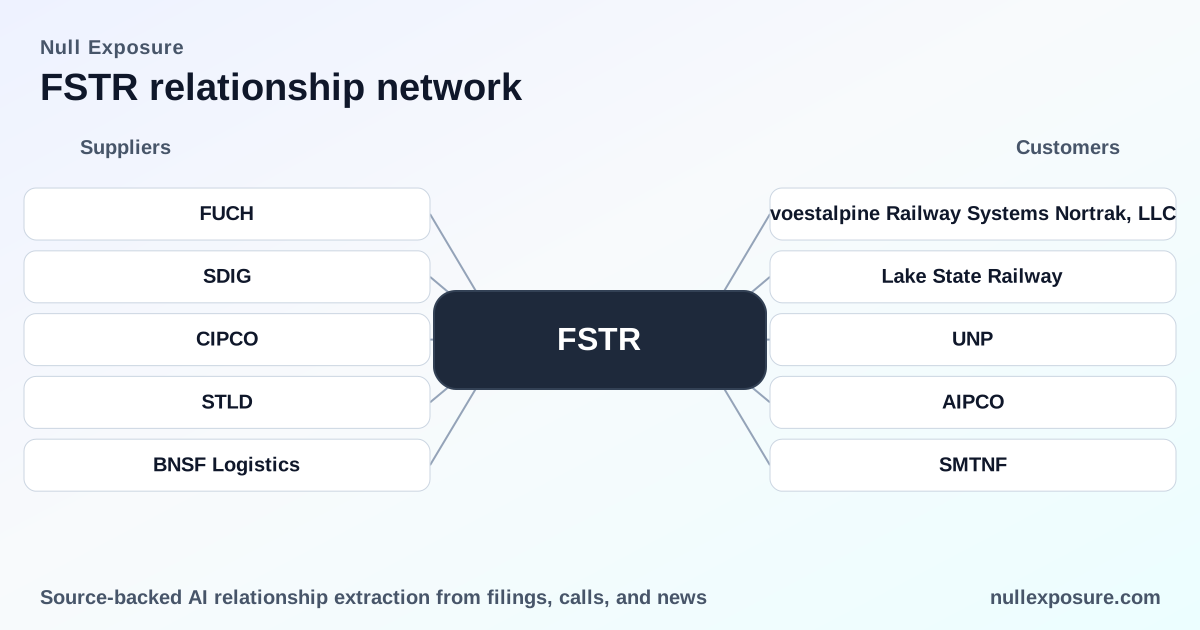
LB Foster (FSTR) — supplier relationships and what they mean for investors
LB Foster is a supplier-centric industrial business that designs, fabricates, and delivers rail products and infrastructure solutions, monetizing through product sales, installation services and engineered supply arrangements with railroads and material producers. Revenue generation is driven by large, project-based contracts for rail and infrastructure components and recurring sales of consumables and services, reflected in $540m of trailing revenue and a gross profit of $115.8m (TTM). For investors, the company’s economics combine modest operating leverage (6.25% operating margin) with concentrated supplier exposure that creates both execution risk and differentiated scale advantages in specialty rail products.
Explore LB Foster supplier coverage at Null Exposure
Why supplier relationships matter here: LB Foster’s ability to secure long-lead steel, specialized lubricants, and logistics capacity directly affects delivery times, margins and project cadence. Below I map the active relationships surfaced in recent reporting and explain the operational and financial implications for holders and counterparties.
How LB Foster actually uses suppliers — the operating picture
LB Foster purchases raw materials (steel, cement, epoxy, electronics) and partners with specialty manufacturers and logistics providers to deliver engineered rail solutions. The business operates as a buyer with a global supplier footprint and important domestic sourcing for heavy commodities. This hybrid sourcing model lets the company balance cost and availability for time-sensitive projects while retaining control over engineered product specifications.
Key company metrics that constrain supplier strategy:
- Revenue TTM: $540m; operating margin: 6.25%, which limits margin buffer against input-cost shocks.
- Certain divisions depend on a small number of suppliers, creating concentration risk that can be material to results.
- Sourcing is both global and North American: specialty components come from abroad, while steel, cement and aggregates are primarily domestic.
These characteristics produce a contracting posture that is procurement-focused, concentrated and operationally critical: LB Foster negotiates multi-stage supply relationships for long-lead items, runs project-level sourcing, and retains engineering control to protect margins and delivery schedules. For a deeper supplier map and workflow insight, visit Null Exposure.
Relationship inventory — what public reports disclose
The following relationships are pulled from recent corporate and industry reporting. Each entry is presented in plain English with the original source noted.
FUCHS Lubricants Co.
LB Foster named FUCHS as its preferred manufacturing partner for advanced friction-management lubricants, creating a supply relationship for rail lubrication products that LB Foster markets to the rail industry. According to a GlobeNewswire press release (Sept. 25, 2023), FUCHS is the preferred partner for manufacturing those lubricants for the rail market. (GlobeNewswire, FY2023)
SDI (as partner referenced with CIPCO)
LB Foster referenced SDI alongside CIPCO as distribution and rollout partners in its Q3 2025 commentary, indicating commercial partners ready to move new product offerings into the marketplace in Q4. Management discussed these partners on the Q3 2025 earnings call transcript posted to InsiderMonkey (Q3 2025). (InsiderMonkey, FY2025)
CIPCO
CIPCO is cited by LB Foster as a commercial partner helping to bring products to market, named explicitly by management in the Q3 2025 earnings call transcript as ready to drive product commercialization into Q4. This indicates a go-to-market alliance rather than a raw-material supplier role. (InsiderMonkey, FY2025)
Steel Dynamics Inc. (SDI / STLD)
LB Foster worked with Steel Dynamics’ rolled rail product in a project for Lake State Railway, delivering the first 320-foot rail train rolled by Steel Dynamics and transported by a specialized consist. An RT&S supplier-news article described the development, delivery and unloading of the 320’ rail produced by Steel Dynamics (FY2025). (RT&S supplier news, FY2025)
BNSF Logistics
For the same 320’ rail project, BNSF Logistics developed a five-car consist capable of transporting sixty 320‑foot pieces of rail, supporting LB Foster’s logistics execution on the Lake State Railway project. This is a logistics partnership for very long-length rail transport described in RT&S supplier reporting (FY2025). (RT&S supplier news, FY2025)
What these relationships imply for investors
Collectively, the relationships reveal a blend of manufacturing partnerships (FUCHS, Steel Dynamics) and commercial/logistics alliances (CIPCO, SDI, BNSF Logistics) that underscore two strategic facts: (1) LB Foster is leveraging third‑party specialists to scale specialized product lines quickly, and (2) execution risk is concentrated around a few critical suppliers and logistics providers.
- Concentration and criticality: Company disclosures note that some divisions rely on a small number of suppliers; that concentration is material to operations and earnings if a supplier is lost. This makes supplier continuity a top investment risk vector.
- Contracting posture: Evidence supports a buyer role for LB Foster with a mix of preferred-partner agreements (FUCHS) and project-based procurement (steel, logistics). Preferred partnerships reduce procurement volatility but do not eliminate dependency risk for long-lead items.
- Geography and maturity: Sourcing is global for specialty components and predominantly North American for bulk commodities like steel and aggregates, indicating mature domestic supply chains for heavy inputs but reliance on global suppliers for some electronic/chemical inputs.
For investors focused on earnings stability, the key operational constraint is margin sensitivity to input availability and logistics. LB Foster’s modest operating margin and project timing volatility amplify the financial impact of supplier disruptions.
Review supplier risk profiles at Null Exposure
Risk checklist and monitoring essentials
Monitor the following to anticipate earnings surprises and operational stress:
- Supplier continuity announcements for steel and friction‑management components.
- Logistics capacity developments for long‑length rail transport (agreements with BNSF Logistics or equivalents).
- Updates to preferred‑supplier arrangements (extensions, exclusivity, or termination notices with FUCHS).
- Material cost trends in steel, cement and epoxy that feed margins given a 6.25% operating margin buffer.
Bottom line for investors
LB Foster runs a supplier-dependent, project-driven business where a small set of partners materially affect operational delivery and margin outcomes. The company leverages preferred manufacturing relationships and logistics alliances to commercialize specialized rail products quickly, but concentration and long-lead items remain the primary operational risk. For portfolio managers and operators, the near-term focus is on tracking supplier continuity, logistics capacity and cost inflation against a relatively thin operating margin.
For a systematic view of LB Foster’s supplier ecosystem and comparable supplier exposures across industrials, see Null Exposure.