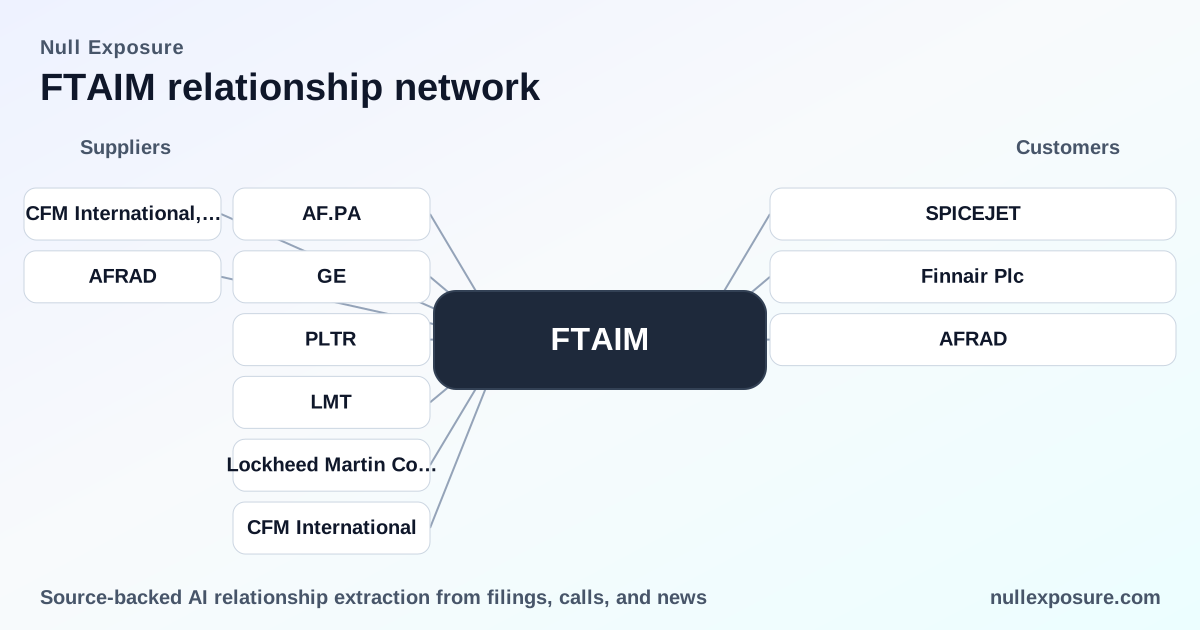
FTAI Aviation (FTAIM) — supplier relationships that anchor an aftermarket growth strategy
FTAI Aviation owns and acquires aircraft, engine maintenance facilities, and related infrastructure and monetizes those assets by leasing aircraft and providing maintenance, repair and overhaul (MRO) services and aftermarket parts and support. The company’s economics are driven by asset ownership plus a growing MRO/parts platform that converts fixed infrastructure into recurring service revenue and product margins. Investors should view supplier relationships as strategic extensions of that platform: they secure OEM parts, expand production capacity, and feed the company’s unit economics for narrowbody engines and aircraft maintenance.
Discover more supplier intelligence at https://nullexposure.com/
Why suppliers matter to FTAI’s business model
FTAI’s business model blends capital-intensive asset ownership with service-led aftermarket revenue. Critical inputs are OEM parts supply, long-term component support agreements, and facility acquisitions that convert landlord assets into operational MRO capability. Supplier agreements therefore drive both revenue predictability and margin upside: parts and repair agreements feed utilization of the Montreal MRO facility; engine support deals extend the life and cash flow potential of CFM56-equipped airplanes; AI and systems partnerships compress turnaround and reduce unit costs.
What the public record shows about contracting posture and financial scale
Public excerpts on FTAI point to a short-term contracting posture for certain legacy services and a clear role as a service consumer/manager during transition periods. Company disclosures state that a Transition Services Agreement required the former manager to provide services through October 31, 2024, and to support financial reporting through May 31, 2025, with fees set at cost plus a 10% markup. Financial disclosures list reimbursements to the former manager totaling $8,925 for 2024, which places some service spend in a $1M–$10M band on an annualized basis when scaled to comparable line items. These facts signal a company in active operational transition: contracts have short legal tenors in places, the company functions as a buyer of third‑party services, and spend is material but not outsized relative to asset scale.
Relationship rundown — who FTAI is working with and why it matters
Below are plain-English summaries of every relationship reported in the public feed, with source context.
Air France — aircraft acquisitions that expand the fleet footprint
FTAI closed the acquisition of seven off-lease Airbus narrowbodies from Air France, a transaction that directly increases FTAI’s owned narrowbody inventory available for leasing or MRO conversion (reported March 9, 2026). (Source: SimplyWallSt article, March 9, 2026 — https://simplywall.st/stocks/us/capital-goods/nasdaq-ftai/ftai-aviation/news/is-ftai-aviation-ftai-quietly-recasting-its-engine-platform/amp; also cited by Finviz, Feb–Mar 2026 — https://finviz.com/news/318258/ftai-aviation-ltd-ftai-boosts-asset-portfolio-as-analysts-raise-price-target)
GE Aerospace — OEM parts and upgrade support that extend engine economics
FTAI signed a multiyear agreement with GE Aerospace to secure OEM replacement parts and performance upgrades for CFM56 engines, which supports extended maintenance demand and reinforces FTAI’s competitive position in the global narrowbody engine aftermarket (reported March 2026). (Source: Intellectia News, March 9, 2026 — https://intellectia.ai/news/stock/ftai-aviation-partners-with-palantir-for-aidriven-power-turbines-aiming-for-100-units-annually)
Palantir — AI systems to improve throughput and unit economics
FTAI entered a multiyear strategic partnership with Palantir to deploy AI-driven production planning and analytics, aimed at faster turnaround and lower unit maintenance costs across its MRO footprint. This supports margin improvement and operational scale for new and acquired facilities (reported March 2026). (Source: Intellectia News, March 9, 2026 — https://intellectia.ai/news/stock/ftai-aviation-partners-with-palantir-for-aidriven-power-turbines-aiming-for-100-units-annually)
Lockheed Martin Canada — strategic divestiture that supplied a physical MRO asset
FTAI completed the acquisition of Lockheed Martin Commercial Engine Solutions (LMCES), a 526,000 ft² engine MRO facility in Montréal, from Lockheed Martin Canada; that transaction expanded FTAI’s physical capacity and immediate service revenue potential (announced in relation to the FY2024 period). (Source: Aviator Press Release, reported 2024–2026 — https://aviator.aero/press/ftai-aviation-closes-the-acquisition-of-lmces/; Avitrader coverage, Sept 10, 2024 — https://avitrader.com/2024/09/10/ftai-aviation-completes-acquisition-of-lmces/)
LMCES (Lockheed Martin Commercial Engine Solutions) — the acquired Montreal facility
The LMCES facility itself is now integrated into FTAI’s MRE (maintenance, repair and exchange) business and provides immediate scale to serve airlines and third‑party engine customers, strengthening FTAI’s ability to capture aftermarket dollars. (Source: Avitrader, Sept 10, 2024 — https://avitrader.com/2024/09/10/ftai-aviation-completes-acquisition-of-lmces/)
CFM International — multi-year component and repair support for the CFM56 fleet
FTAI announced a multi‑year materials and component support agreement with CFM International to supply OEM parts, repair services, and performance upgrades for the CFM56 engine population — the largest commercial engine fleet — which anchors recurring parts and repair revenue. (Source: Globenewswire press release, Jan 22, 2026 — https://www.globenewswire.com/news-release/2026/01/22/3223741/0/en/FTAI-Aviation-Announces-Multi-Year-Materials-Agreement-with-CFM-International-to-Further-Support-CFM56-Engines.html; additional market coverage in SimplyWallSt and SahmCapital, Jan–Feb 2026)
What investors should take away — risks and opportunities
- Opportunity: scaled aftermarket margin capture. The LMCES acquisition plus multi‑year OEM support for CFM56 engines and parts supply from GE position FTAI to convert asset ownership into recurring MRO and parts margin. The Palantir partnership accelerates that conversion by reducing cycle times and improving throughput.
- Risk: execution and integration. The Transition Services Agreement language and reimbursement line items indicate that FTAI recently ran a managed service-to-independent operator transition; that creates execution risk as internal teams replace former managers and as short‑term contracts expire.
- Concentration and spend signal. Public excerpts place certain service reimbursements in a $1M–$10M band and show short-term contractual tenors for transitional services, signaling that while supplier spend is meaningful it is not near monopoly scale — the model is asset-driven rather than purely outsourced services.
- Criticality of OEM relationships. Agreements with CFM/GE and OEM parts supply are operationally critical: without reliable OEM parts and repair support, asset utilization and margins fall quickly.
Explore detailed supplier mapping and risk scoring at https://nullexposure.com/
Conclusion — where to look next as an investor
FTAI is converting capital assets into a differentiated aftermarket platform through targeted facility acquisitions and OEM supplier agreements. The company’s value driver is the ability to monetize owned aircraft and engine MRO capacity via secured parts supply and productivity improvements. Monitor integration progress at LMCES, contract rollover terms for OEM partnerships, and measurable throughput gains from the Palantir implementation. For investors and operators evaluating supplier exposure and counterparty criticality, FTAI presents a clear asset-to-service monetization story with defined operational execution risks.
For ongoing supplier intelligence and to track counterparties, visit https://nullexposure.com/