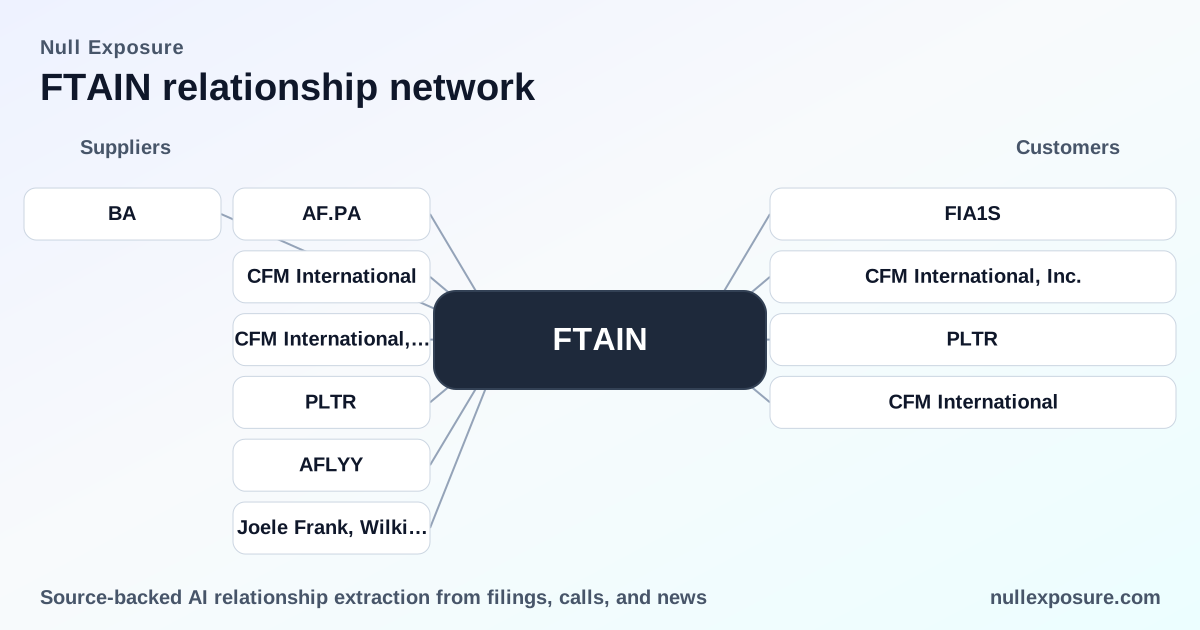
FTAIN: Fleet monetization and services driving recurring cash flows
Fortress Transportation and Infrastructure Investors (FTAI) operates as an asset owner-operator, acquiring aircraft and related infrastructure and monetizing them through long-term operating leases, targeted asset sales and service agreements that capture aftermarket margins. The company’s revenue mix blends stable lease cashflows from modern Boeing platforms with higher-margin component and MRO (maintenance, repair and overhaul) services tied to legacy CFM56 engines and data-driven maintenance partnerships, creating a capital-light route to scale fleet revenue while expanding services revenue.
If you evaluate supplier exposure or counterparty risk, start with the core supplier/service relationships below and the company-level contracting signals that shape FTAIN’s operating leverage. For more supplier intelligence and relationship visibility visit https://nullexposure.com/.
Why the recent partnerships change the narrative for investors
FTAI’s recent announcements reorient the business away from pure leasing toward a hybrid model: owning modern jets under long leases while running aftermarket service arrangements and component supply deals that increase recurring, higher-margin revenue streams. These tie-ups also reduce operational disruption risk when assets transition between airlines or into power-generation uses. This combination improves cash-flow visibility and raises the strategic importance of a few key partners.
- Want a detailed supplier map and risk scoring? See https://nullexposure.com/ for deeper signals and sourcing.
Air France: end-of-life fleet transaction that expands narrowbody inventory
FTAI closed the acquisition of seven off-lease Airbus aircraft from Air France to assist the carrier’s narrowbody modernization while enlarging FTAIN’s fleet and second-life assets. This transaction increases FTAIN’s asset base and gives the company optionality for lease or disposal strategies. (Sources: Yahoo Finance, Aviator press release; March 2026.)
CFM International / CFM International, Inc.: multi-year materials and component support agreement
FTAI signed a multi-year agreement with CFM International (the GE–Safran joint venture) to secure OEM parts, component repair support and performance upgrades for CFM56 engines, underpinning FTAIN’s engine maintenance operations and FTAI Power ambitions. The pact locks in supply and repair access for one of the largest installed engine populations, strengthening the company’s ability to offer cost-competitive maintenance solutions. (Sources: Globenewswire press release; Sahm Capital and AeroMorning coverage; January–March 2026.)
Palantir: AI platform to optimize maintenance and inventory workflows
FTAI entered a multi-year partnership with Palantir to deploy its AI platform for inventory management and maintenance scheduling, aiming to boost productivity across global equipment operations and reduce downtime. This digital collaboration targets operational efficiency gains that should translate to lower maintenance costs per flight-hour and improved asset utilization. (Sources: Intellectia.ai and SimplyWall.St; March 2026.)
Boeing: fleet composition anchored by modern widebody and narrowbody models
FTAI’s portfolio is concentrated in modern, fuel-efficient Boeing models—including the 767, 777 and 787 families—deployed under long-term operating leases, which provides predictable lease cashflows and residual value exposure aligned with airline demand for fuel efficiency. That concentration is a strategic asset for lease stability but creates exposure to Boeing-related supply and aftermarket dynamics. (Source: MarketBeat summary; March 2026.)
Joele Frank, Wilkinson Brimmer Katcher: retained investor relations and media counsel
FTAI’s communications and investor-relations contacts include Joele Frank, Wilkinson Brimmer Katcher, a retained media advisory referenced in company disclosures for executive announcements. Professional PR engagement supports market messaging around transaction-driven growth and helps manage investor expectations during fleet transitions. (Source: The Globe and Mail / GlobeNewswire notice; March 2026.)
What the supplier map implies for operating risk and strategy
The relationships above form a concentrated, strategically layered supplier posture:
-
Contracting posture: Evidence of short-term transition services at the corporate level indicates FTAIN recently shifted internal operating providers, creating a temporary dependence on legacy service arrangements while internal capabilities scale. The Transition Services Agreement required legacy support through defined cutoffs, signaling a deliberate, time-boxed handover. (Company filings and transition disclosures; 2024–2025.)
-
Concentration and criticality: CFM International and Palantir are critical partners. The CFM agreement secures parts and repair access for a globally common engine, making it central to FTAIN’s engine-MRO business and the reliability of any power-generation repurposing of engines. Palantir’s role in maintenance optimization raises the strategic importance of data and software partners to operating margins.
-
Spend profile and one-off items: Internalization disclosures show a mix of smaller recurring payments (reimbursements in the low millions) and significant one-time internalization fees (a $300 million affiliate payment disclosed in corporate tables), signaling both ongoing operating spend and elevated, non-recurring restructuring costs that affected near-term cashflow. Treat recurring procurement as mid-band (hundreds of thousands to low millions annually) but reserve capex or internalization penalties as outliers. (Company internalization tables; 2024 disclosure.)
-
Relationship maturity: The company maintains a mix of active (ongoing transition support through contractual cutoffs) and terminated relationships following internalization of management functions; this demonstrates maturation from manager-led outsourcing toward direct control. Expect short-term service dependencies to decline as internal teams assume responsibilities through defined dates in 2024–2025. (Transition Services Agreement excerpts; 2024–2025.)
Investor takeaway: FTAIN’s supplier relationships are deliberately concentrated on a few high-impact partners—CFM for parts and repair, Palantir for operational software, Boeing for asset composition and Air France as a transactional customer for aircraft purchases—making those relationships central to revenue quality and operational resilience.
- For a complete supplier risk profile and monitoring setup, visit https://nullexposure.com/ to map dependencies, contract timings and concentration metrics.
Bottom line: focused supplier relationships, higher-margin service runway
FTAI is evolving into a hybrid lessor-service provider where OEM component agreements and enterprise software partnerships materially lift recurring margins and reduce idiosyncratic downtime risk. The business now combines long-term lease cashflows from modern Boeing platforms with aftermarket revenue underpinned by secured OEM supply (CFM) and predictive operations (Palantir). Short-term transition agreements and a one-time internalization charge are important adjustments in the company’s cost base; they are not permanent operating costs but they affect near-term free cash flow and should be modeled accordingly.
If you evaluate counterparty concentration or need scenario analysis tools for supplier disruptions, FTAIN’s profile is a clear case for focused monitoring of CFM, Palantir and major airline counterparties. Learn how to build that monitoring and get vendor scores at https://nullexposure.com/.