FTC Solar (FTCI): Supply relationships that shape delivery risk and margin recovery
FTC Solar builds and sells utility-scale solar tracking systems, accompanying software and engineering services, and it monetizes through equipment sales and project services while outsourcing manufacturing to contract partners. Revenue depends on hardware margins, execution of purchase orders with contract manufacturers, and a growing emphasis on automation and geographically diversified suppliers. Investors should evaluate supplier concentration, related‑party mechanics and the company’s move to robotics-enabled installation when modeling margin recovery and fulfillment risk.
For deeper supplier intelligence, visit https://nullexposure.com/.
How FTC Solar operates and where supplier risk sits
FTC Solar’s core product set is mechanical trackers and the software/engineering that optimizes them; the company does not own manufacturing plants and outsources all production to contract manufacturers. That operating posture creates a sourcing-dependent cost base: procurement timing, supplier incentives and manufacturing agreements drive delivered cost of goods sold and working capital.
Important company-level operating signals:
- Outsourced manufacturing is central to FTC Solar’s model—manufacturing partners produce torque tubes and other hardware while FTC retains system integration and design responsibility (company disclosures, FY2024 10‑K).
- Geographic sourcing is concentrated in the U.S. but globally diversified, with purchase-order spend in FY2024 reported as United States 66%, China 11%, India 9%, Thailand 5% and other countries 9% (FY2024 10‑K).
- Contracting posture blends multi-year commitments and contingency exposure: FTC disclosed a three‑year equipment supply agreement tied to one manufacturing partner (see Alpha Steel excerpt below) and potential cash remedies up to $4.0 million if minimum purchase commitments are not met (FY2024 10‑K).
- Automation and installation robotics are an active vector for efficiency, evidenced by FTC’s public collaboration with robotics installers that position the tracker product as automation-ready (press release activity in 2025).
These signals translate into a supplier risk profile where execution and contract terms are as material as price: supplier selection, incentive capture (e.g., IRA-related benefits), and integration with automation partners will determine near-term margins and delivery cadence.
The supplier relationships you need on your model
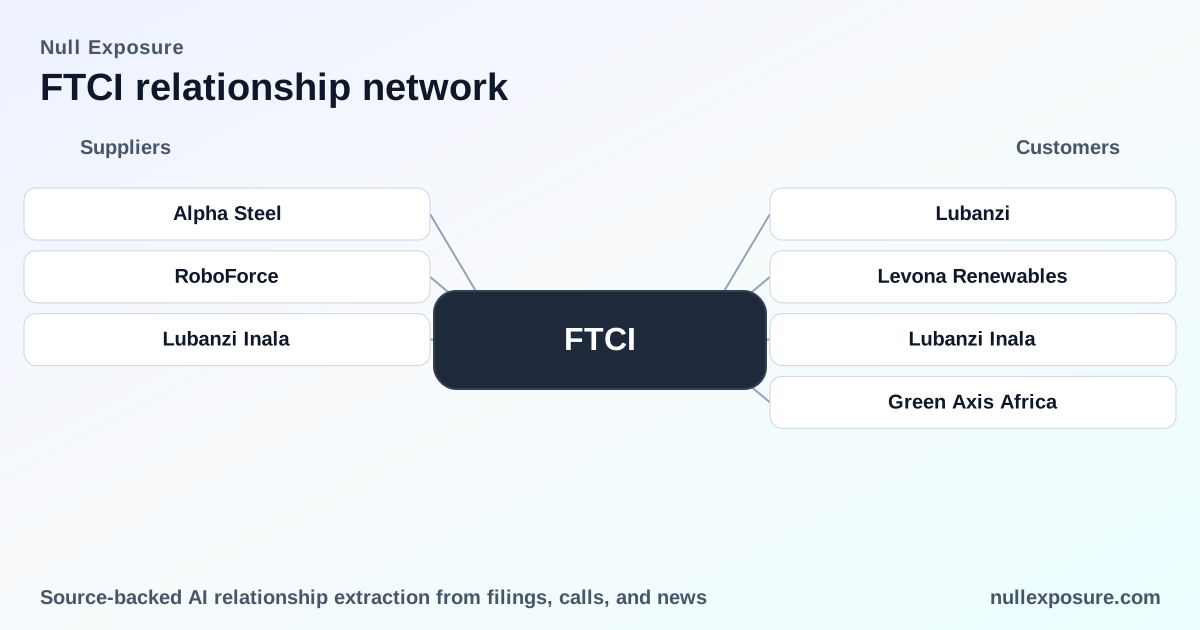
Below are the supplier and partner mentions captured in public filings and press coverage. Each relationship is summarized with the cited source.
Alpha Steel — a material, contractually-backed manufacturer relationship
FTC Solar reported related‑party receivables of $3.1 million at December 31, 2024 tied to expected material-cost discounts contractually owed by Alpha Steel under incentives available through the Inflation Reduction Act, and the company also described a three‑year equipment supply agreement with Alpha Steel governing equipment purchase orders. According to FTC Solar’s 2024 Form 10‑K, these items create both a cash flow receivable and a multi‑year supplier commitment (FTC Solar 10‑K, FY2024).
RoboForce — robotics partner validating automation-ready installation
RoboForce commented publicly on deploying its AI-enabled robots for FTC tracker system installation and module fastening, saying RoboForce has tested the robots at an outdoor facility and will deploy them at live FTC sites; this positions FTC’s tracker as compatible with automated installation workflows, which can compress labor costs and installation cycle time (GlobeNewswire press release, Nov 11, 2025).
Lubanzi Inala — a newly announced supply agreement expanding capacity
FTC Solar announced a supply agreement with Lubanzi Inala in a company press release tied to its Q4 and full-year 2025 results call, signaling another manufacturing partner brought into the supplier roster as of FY2026 (FTC Solar press release, Feb 20, 2026).
What these relationships imply for revenue, margins and risk
These three relationships illustrate the company’s tactical approach: secure multi‑year commitments where advantageous, expand the supplier base to diversify risk, and enable downstream cost reductions through automation.
- Concentration vs. diversification: The company’s spend remains U.S.‑heavy (66% in FY2024), but FTC is actively engaging partners across multiple countries to optimize cost and capacity; that reduces pure geographic concentration while leaving single‑partner exposure in certain product lines (Alpha Steel relationship and the three‑year supply contract).
- Related‑party mechanics are financially meaningful: The $3.1 million receivable from Alpha Steel tied to IRA incentives translates to a direct working capital linkage between supplier incentives and FTC’s reported cash position and gross cost of goods. Modelers should incorporate receivable timing and incentive pass-throughs rather than assuming immediate gross-margin improvement.
- Automation is a margin lever: Public commentary from RoboForce frames FTC’s products as installation‑friendly for robots—automation lowers installation labor and could materially improve lifetime installed costs, a positive for both gross and operating margins if adoption scales. Account for a phased impact rather than an immediate line-item savings.
- Contractual downside exists: FTC disclosed a potential aggregated cash payment not to exceed $4.0 million if minimum purchase commitments are not met; this creates a quantifiable tail risk to cash flow if demand contracts or order timing slips.
Practical actions for investors and operators
- Monitor related‑party balances and payment terms with Alpha Steel and other named partners in quarterly filings; changes in receivable collectability or incentive realization are direct profit drivers.
- Track announcements and on-site evidence of RoboForce‑style automation rollouts; realized labor savings require successful field deployments and should be reflected in installed-cost assumptions.
- Reforecast supply timing and potential $4.0 million contractual exposure into downside scenarios for near‑term liquidity planning.
- Use supplier diversification signals (Lubanzi Inala onboarding plus international partners) to stress-test capacity in base-case and upside scenarios.
For a structured supplier risk view and to monitor future supplier disclosures, visit https://nullexposure.com/ for ongoing coverage and supplier analytics.
Bottom line: what matters now
FTC Solar runs a lean, outsourcing-heavy manufacturing model underpinned by multi-year supplier contracts, related‑party incentive mechanics, and a clear push into automation. Alpha Steel represents a material, contractually-backed supplier relationship that affects working capital; RoboForce signals a path to installation cost reduction; Lubanzi Inala adds capacity and diversification. Investors should price in supplier execution risk, incentive timing, and phased margin improvement from automation when evaluating the equity and credit characteristics of FTCI.
For continuous updates on supplier relationships and material contract disclosures, check https://nullexposure.com/ — detailed supplier intelligence changes investment assumptions faster than top-line press releases.