Fuel Tech (FTEK): supplier relationships that shape an asset-light pollution-control business
Fuel Tech sells boiler optimization, efficiency and air-pollution-control solutions to industrial and utility customers and monetizes through a mix of product sales, licensing of proprietary technologies and services delivered under subcontracted manufacturing and installation arrangements. The company generates recurring and project revenue from selling chemical products (notably magnesium hydroxide formulations), licensed equipment such as DGI systems, and aftermarket services; its operating model is capital-light and IP-driven, with a reliance on external manufacturers and selected bolt-on IP acquisitions. For primary research on counterparty exposure and supplier concentration, see https://nullexposure.com/ for full supplier profiling and monitoring.
How Fuel Tech actually operates and where suppliers matter
Fuel Tech runs as an engineering/product company rather than as an integrated chemical manufacturer. That structure produces three investor-relevant characteristics:
- Outsourced manufacturing posture: Fuel Tech uses subcontractors to perform all manufacturing for customers, which reduces fixed-capex but increases vendor dependency and operational outsourcing risk.
- Single-source concentration for a critical chemical: The FUEL CHEM segment depends on magnesium hydroxide supplied under specification; sourcing disruptions have direct operational impact.
- IP and licensing-led expansion: The company augments its APC (air pollution control) portfolio through small strategic IP acquisitions and license deals, expanding addressable markets without heavy factory builds.
- Small scale and concentrated ownership: With roughly $26.7M revenue TTM and a $38.4M market cap, Fuel Tech operates as a micro-cap with meaningful insider (23.2%) and institutional (24.8%) ownership, implying governance and liquidity dynamics investors must price.
These dynamics produce high operating leverage to supplier execution and amplify the importance of vendor contracts and licensing terms; if you evaluate Fuel Tech as a supplier counterparty, focus on contract term lengths, exclusivity, and manufacturing redundancy. Learn more about supplier risk scoring at https://nullexposure.com/.
Counterparty map: the relationships disclosed in public filings and press
Below are every counterparty referenced in the available results and a concise summary of the commercial relationship, with source citations.
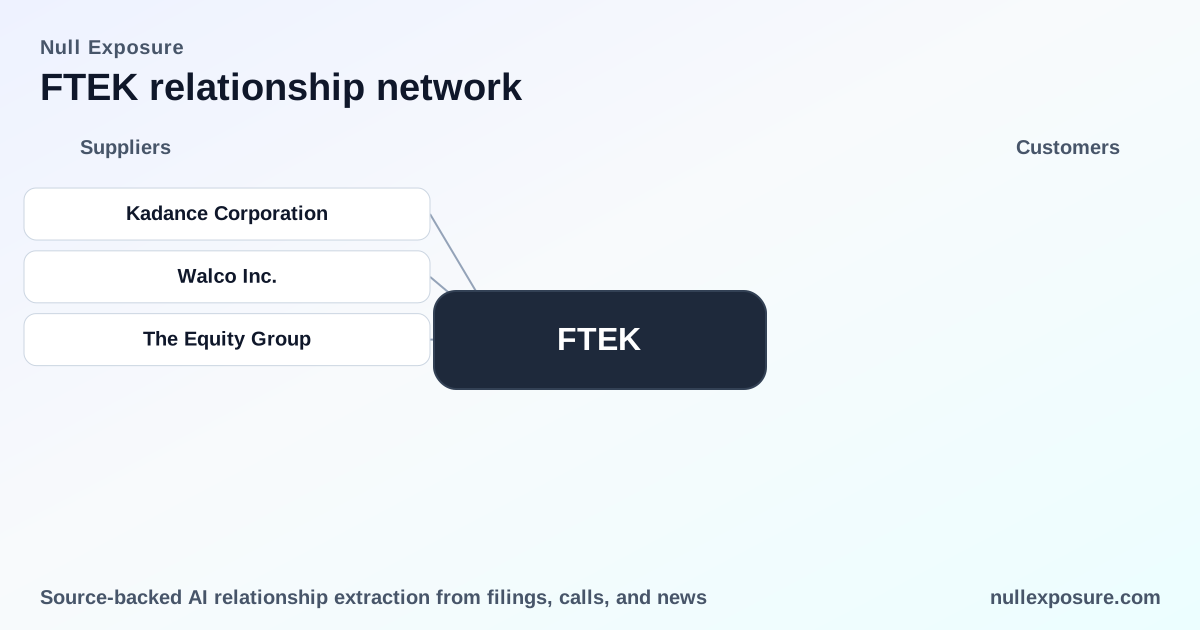
Kadance Corporation — licensee/licensor relationship for DGI technology
Fuel Tech expanded its rights to deploy DGI biological treatment systems through a new license agreement with Kadance Corporation, the entity that acquired the prior licensor NanO2’s assets; the arrangement grants Fuel Tech expanded market access outside municipal wastewater and the right to independently manufacture DGI systems. Source: ADVFN news items reporting on Fuel Tech’s historical license activity (ADVFN, reported March 2026 referencing 2020 filings) https://mx.advfn.com/bolsa-de-valores/NASDAQ/FTEK/noticias/83049719/fuel-tech-reports-2020-second-quarter-financial-results and https://mx.advfn.com/bolsa-de-valores/NASDAQ/FTEK/noticias/83654936/fuel-tech-reports-2020-third-quarter-financial-results.
Walco Inc. — small strategic IP and customer-asset acquisition
Fuel Tech acquired complementary intellectual property and customer-related assets from Walco Inc., a transaction described as a small strategic acquisition intended to expand the APC product portfolio and add installed base opportunities worldwide. Source: company remarks reported in earnings-call coverage (The Globe and Mail / Motley Fool transcript, March 2026) https://www.theglobeandmail.com/investing/markets/markets-news/Motley%20Fool/562923/fuel-tech-ftek-q4-2025-earnings-call-transcript/ and an earnings-call report on InsiderMonkey (March 2026) https://www.insidermonkey.com/blog/fuel-tech-inc-nasdaqftek-q4-2025-earnings-call-transcript-1709613/.
The Equity Group — investor relations / communications contact
The Equity Group served as a contact point for Fuel Tech’s Q4 2025 financial results and investor communications, indicating professional IR support for market engagement and disclosure distribution. Source: GlobeNewswire press release announcing Q4 2025 results and contact information (February 19, 2026) https://www.globenewswire.com/news-release/2026/02/19/3241583/0/en/fuel-tech-schedules-2025-fourth-quarter-financial-results-and-conference-call.html.
Operational constraints investors must price into valuation
The public evidence highlights operational constraints that directly affect supplier risk and execution:
- Criticality of magnesium hydroxide supply: Fuel Tech states that its FUEL CHEM business is dependent in part on magnesium hydroxide, and adverse availability changes will have an adverse impact on operations. This is a company-level signal of single-resource importance and operational exposure to chemical markets (company filing language reported in constraints evidence).
- Concentrated manufacturing sourcing: MMMS is explicitly named as a supplier that manufactures magnesium hydroxide to Fuel Tech’s specifications and has agreed to supply 100% of requirements for U.S. and Canada deliveries, indicating single-source contractual concentration for a key input. That creates a material supplier concentration risk when combined with outsourced manufacturing posture.
- Subcontracted manufacturing model: Fuel Tech uses subcontractors to perform all manufacturing for customers, which lowers fixed costs but increases execution dependency and quality-control risk across multiple suppliers and geographies.
- Maturity and strategy signal: Fuel Tech’s use of small IP acquisitions (e.g., Walco assets) and licensing arrangements (e.g., Kadance DGI rights) demonstrates a deliberate strategy to grow through intellectual property and licensing rather than heavy capital expansion; this reduces capital intensity but raises reliance on contractual protections and integration capability.
Collectively, these constraints imply that operational continuity and contract enforceability are as important as product demand when forecasting revenue and margin recovery.
Financial and strategic implications for investors and operators
Fuel Tech is a micro-cap industrial with negative EBITDA and modest revenue scale ($26.7M TTM). The commercial reality—outsourced manufacturing, single-supplier concentration for a critical chemical, and reliance on licensing/IP—translates into three clear investment implications:
- Upside is tied to execution: If subcontractors and MMMS continue reliable supply and contracted IP rights (Kadance/Walco) produce incremental sales, leverage to operating margin recovery is significant given low fixed capital.
- Downside is supply-chain driven: Supplier disruption or contract disputes can rapidly impair revenue; underwrite contingency scenarios and evaluate contract terms (duration, exclusivity, termination provisions).
- Catalysts are commercial rollouts and aftermarket conversion: Watch for conversion of acquired IP and licensed systems into repeatable project revenue and chemical volumes. For ongoing supplier monitoring and counterparty due diligence, visit https://nullexposure.com/.
Bottom line for supplier relationships
Fuel Tech’s supplier profile is defined by outsourcing plus targeted IP licensing/acquisitions, with material concentration risk around magnesium hydroxide and a small-company operating footprint that amplifies supplier events. Investors and operators should price in supplier continuity, contract scope, and the ability to scale manufacturing partners as primary drivers of near-term performance.
For a structured supplier risk report and ongoing alerts tied to these counterparty names, see https://nullexposure.com/ for tailored intelligence and monitoring.