Future FinTech (FTFT): how supplier relationships shape the risk-return profile
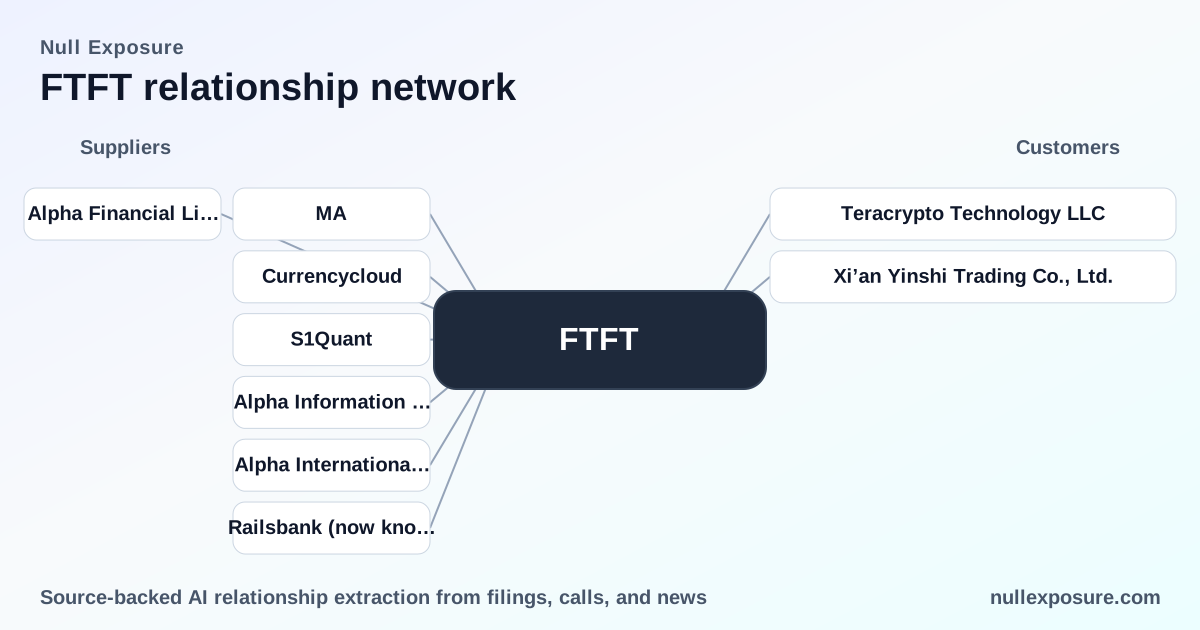
Future FinTech Group Inc. operates a real-name blockchain e‑commerce platform in China and monetizes through a mix of payments and wallet services, card issuance, fintech SaaS and financial product distribution, plus targeted acquisitions of securities and information-service assets. Revenue flows come from transaction fees, remittance and wallet spreads, card-program partnerships, and financial services enabled by acquired broker-dealers. For investors and operators assessing supplier exposure, the current supplier map highlights a playbook that mixes third‑party licensed rails, remittance partners, strategic technology alliances and recent securities-industry acquisitions that shift the company from pure platform to regulated financial services operator. Read a concise supplier-risk briefing or explore broader supplier intelligence at https://nullexposure.com/.
What investors need to know at a glance
Future FinTech’s commercial stance is supplier‑centric where third‑party licenses and integrations directly enable customer-facing products (cards, wallets, remittances, crypto asset-management offers). That creates a mixed set of operational characteristics: short-term tactical contracts for new product rollouts, high vendor concentration at the company level, and increasing regulatory dependency as FTFT acquires licensed securities businesses. Key takeaway: supply relationships are not marginal — they are core go-to-market enablers.
- FTFT leverages licensed card and EMI partners to deliver card/wallet services.
- The firm pairs fintech rails (remittance and currency-clearing providers) with in‑house app distribution and newly acquired securities operations.
- Recent agreements expand FTFT into compliant cryptocurrency asset management and consolidate broker-dealer capabilities via Hong Kong and Shenzhen acquisitions.
If you evaluate counterparty risk or procurement exposure, start with the partners below and the company-wide constraints section that follows. For a systematic supplier diligence brief, visit https://nullexposure.com/.
Relationship map — concise, sourced summaries
Mastercard
FTFT UK received permission from Mastercard to issue credit and debit cards as an agent on behalf of Railsr in February 2022, enabling FTFT’s card issuance and branded payment capability in the UK market. This relationship underpins card product monetization through interchange and ancillary fees (PR Newswire, FY2022 press release).
Railsbank (now Railsr)
FTFT UK entered a cooperation agreement with Railsbank (now Railsr), an Electronic Money Institution license holder, to enable e‑money issuance and the Orbit app launch; this provides the regulated rails necessary to offer wallets and card services in Europe (PR Newswire, FY2022).
Currencycloud
FTFT Labs partnered with Currencycloud to launch the low‑cost remittance app Tempo, giving FTFT a multicurrency digital wallet and lower-cost cross-border rails for sending funds to designated countries; this partner relationship is foundational for remittance spread and wallet transaction revenue (PR Newswire, FY2022).
S1Quant
FTFT signed an agreement with S1Quant to collaborate on cryptocurrency quantitative asset management, combining S1Quant’s quantitative techniques with FTFT Securities’ compliance qualifications to develop regulated crypto asset-management products (futunn.com and SahmCapital announcements, FY2026).
Alpha International Securities (Hong Kong) Ltd.
FTFT HK completed the acquisition of Alpha International Securities (Hong Kong) Ltd., adding a licensed Hong Kong securities broker to FTFT’s regulated financial services footprint and enabling onshore distribution of securities and asset-management products (PR Newswire, FY2023 acquisition announcement).
Alpha Information Services Shenzhen Limited
As part of the same transaction, FTFT acquired Alpha Information Services Shenzhen Limited, which brings onshore Shenzhen information‑service capabilities and supports the company’s China market execution and data services tied to licensed securities operations (PR Newswire, FY2023 acquisition announcement).
Alpha Financial Limited
FTFT HK entered into the acquisition agreement with Alpha Financial Limited to buy the Alpha HK and Alpha SZ businesses on February 27, 2023, making Alpha Financial the seller in the group’s strategy to internalize securities and information-service capabilities (PR Newswire, FY2023).
Company-level constraints and what they mean for suppliers and investors
The disclosed constraints reveal operational patterns that affect supplier risk and negotiation dynamics.
-
Short-term contracting posture. Company disclosures cite an exclusive placement agent agreement with FT Global in July 2020 that had a three‑month term, signaling FTFT’s willingness to use short, tactical contracts for capital and distribution activities. That contracting style accelerates product launches but increases churn and integration overhead for suppliers.
-
High vendor concentration and criticality. For the year ended December 31, 2024, one vendor accounted for 90.77% of FTFT’s total purchases, a critical concentration that exposes the business to single-vendor disruption and bargaining power risk. Concentration materially raises operational and procurement risk.
-
Seller role and logistical responsibility. FTFT’s disclosures state that the company signs purchase and sale agreements with suppliers and buyers where suppliers handle supply and transportation to end users or transfer title in warehouses; this positions FTFT as a marketplace seller and distributor in parts of its business, placing logistics and supplier compliance at the core of execution risk.
Together these constraints form a coherent company-level signal: FTFT runs a high-dependence, partner-enabled model with tactical contracting and increasing regulatory embedding via acquisitions. That combination accelerates product capability but concentrates counterparty risk and amplifies regulatory dependency as the firm shifts toward licensed securities and asset‑management offerings.
Financial context that shapes supplier posture
FTFT’s trailing figures show constrained scale and negative profitability: Revenue TTM of 2.67 million USD and EBITDA negative (‑35.2 million USD) alongside heavy insider ownership and low institutional ownership. These finance dynamics force FTFT to leverage partners for scale and compliance, which explains the aggressive use of third‑party rails and acquisitions rather than organic, capital‑intensive expansion. For suppliers, the implication is negotiating with a buyer that is capital‑conscious and reliant on partner financing/fees.
Risks and operational implications for counterparties
- Single-vendor dependency introduces supplier negotiation leverage and systemic operational risk.
- Short-term contracting increases supplier churn risk and limits long-term revenue visibility.
- Regulatory migration (acquisitions of licensed brokers) raises compliance standards for all partners and pushes suppliers toward stricter KYC/AML and audit requirements.
These are actionable signals for operators: insist on contractual protections for concentration, design transition plans for short-term engagements, and budget for elevated compliance burdens when partnering with FTFT.
For an investor-facing supplier diligence checklist and deeper relationship scoring, consult the FTFT supplier intelligence portal at https://nullexposure.com/.
Bottom line and next steps
Future FinTech is executing a partner-first strategy to deliver fintech products while buying regulated capabilities to capture higher-margin financial services. Suppliers and investors should treat FTFT as a high-dependency counterparty that accelerates growth via third‑party rails and acquisitions, which simultaneously increases procurement leverage and regulatory complexity. For a structured supplier risk assessment or to commission bespoke analysis, visit https://nullexposure.com/ and order a full supplier due-diligence package.