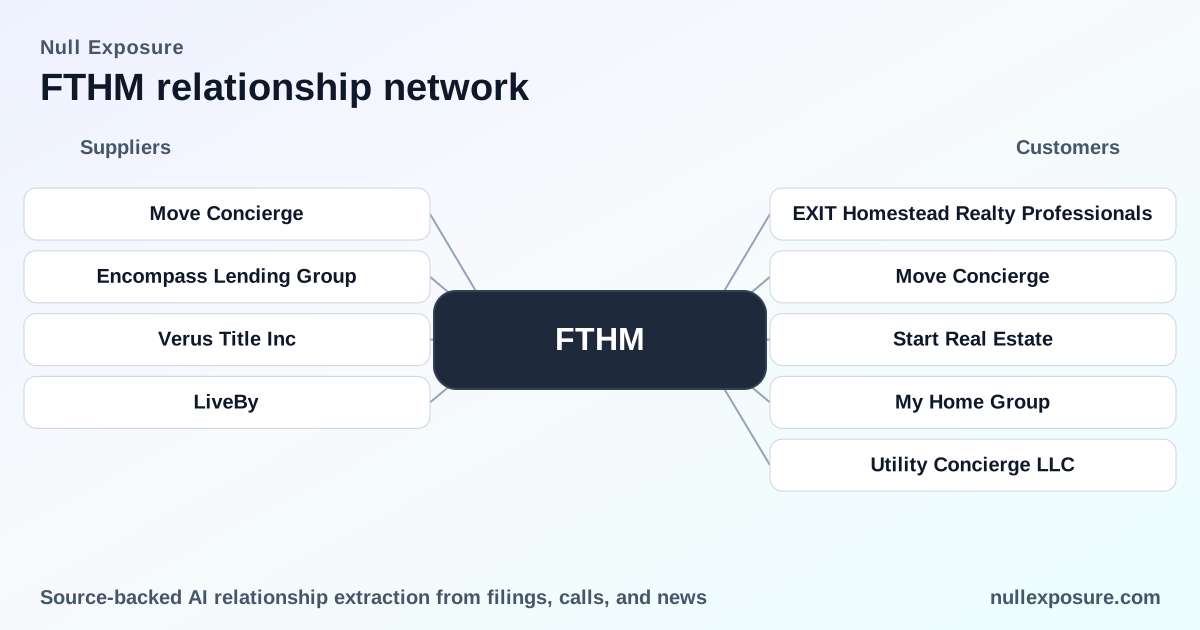
Fathom Holdings (FTHM): supplier relationships, commercial posture, and what counterparties should price in
Fathom Holdings runs a cloud-enabled real estate brokerage and ancillary services platform that monetizes through agent licensing/commissions, mortgage products, title insurance, and platform services to brokerages and agents. The company has actively recalibrated its tech stack and partner footprint—selling the LiveBy assets while retaining platform access and deepening services with third parties—to convert non-core assets into recurring commercial arrangements. For investors and operators, the key lens is platform continuity and counterparty risk: Fathom is small by market cap but leverages third-party partners to extend service reach and generate revenue beyond core brokerage commissions.
Explore how these relationships map to counterparty risk and commercial opportunity at https://nullexposure.com/.
How Fathom makes money and why suppliers matter
Fathom’s public filings show $421.6M of trailing revenue with a thin gross profit base ($33.4M) and negative EBITDA (−$12.7M), underscoring a business that is scaling revenue while compressing profitability. The firm’s operating model blends in-house brokerage with owned mortgage and title operations and an agent-facing technology platform (IntelliAgent). Supplier and partner arrangements therefore drive both customer value (agent services, mortgage/title integration) and operational cost (third‑party tech development, security testing). Given the small market capitalization (~$24.3M) and concentrated ownership (insiders ~38%), counterparty negotiation leverage and service continuity are economically material.
Check partnership profiles and supplier scoring at https://nullexposure.com/ to align diligence with execution risk.
Operating model constraints that shape supplier risk
- Company-level signals show offshore development and third‑party service reliance: Fathom discloses technology work being done in Brazil and India and use of third‑party offshore teams in the Philippines; the same filings call out engagement of third parties for cybersecurity testing. These are company-level facts investors must price into geopolitical, compliance, and security risk assessments.
- The business uses third‑party services both for functional development and for cybersecurity validation, which implies a contracting posture that counts on external specialists rather than fully captive engineering.
- Segmentally, the company treats these partners as part of its services delivery model—supplier relationships are operationally critical, not optional add-ons—and thus counterparty performance has direct revenue and margin implications.
Vendor and partner relationships you must account for
Move Concierge — deeper partnership after LiveBy divestiture
Fathom sold its LiveBy assets to Move Concierge while retaining access to the LiveBy platform for five years, and Move Concierge committed to extending its full service suite to all Fathom agents. This transaction shifts operational responsibility for certain consumer-moving services to Move Concierge while preserving agent-facing continuity for Fathom through contractual access. (Source: PR Newswire, December 2025).
LiveBy — asset divested but platform access preserved
Fathom divested the LiveBy business, but both LiveBy and Move Concierge will make services available to agents and brokerages licensing Fathom’s IntelliAgent platform, which preserves continuity for agent products even as ownership transferred. The deal represents a monetization of non-core assets with a commercial continuity clause. (Source: RISMedia, December 2, 2025).
Encompass Lending Group — owned mortgage capability
Fathom operates a mortgage arm, Encompass Lending Group, which integrates mortgage origination into the brokerage offering and therefore supports capture of mortgage spread and cross-sell revenue across closed transactions. This is an explicit component of the vertical strategy to diversify revenue beyond pure brokerage commissions. (Source: Inman, October 16, 2025).
Verus Title Inc — in-house title insurance capability
Verus Title provides title insurance services within the Fathom group, enabling the company to capture title fees and retain more value per transaction via vertical integration of closing services. This reduces dependence on outside title vendors for core transactions and supports margin recovery if volume holds. (Source: Inman, October 16, 2025).
What these relationships imply for counterparties and investors
- Contracting posture: Fathom uses a mix of owned and outsourced services; recent divestiture shows a willingness to monetize non-core assets while contracting for continued access. Operators negotiating with Fathom should expect commercial terms that preserve platform continuity rather than full ownership changes.
- Concentration and criticality: Ownership concentration (insiders ~38% of shares) and a small public float increase governance risk; simultaneously, the IntelliAgent platform and third-party providers are critical to day-to-day revenue generation, so service-level guarantees and transition provisions are high‑value negotiation levers.
- Maturity: Financials show revenue scale but negative profitability metrics (negative EBITDA and EPS), indicating a mid‑stage commercial model that has not converted scale into positive operating leverage; counterparty pricing should reflect the company’s cash flow dynamics.
- Third‑party operational exposure: Company disclosures explicitly cite development activity in Brazil and India and use of offshore service teams in the Philippines, along with engagement of third parties for cybersecurity testing—this elevates geopolitical, compliance, and information‑security risk as company-level signals to underwriters and counterparties.
Practical takeaways for market participants
- Operational continuity matters more than ownership. The LiveBy sale exemplifies a playbook where Fathom converts assets to cash/partnership while preserving agent access via multiyear contracts; counterparties should prioritize SLAs and migration rights.
- Price security and offshore risk into commercial terms. Given disclosed offshore development and third‑party security testing, require contractual representations on cybersecurity posture, audit rights, and controls.
- Value vertical integration but stress test economics. Encompass Lending and Verus Title widen revenue streams, but with negative margins overall, underwriters should model sensitivity to closing volume and interest-rate environments.
Action checklist for counterparties:
- Demand platform continuity clauses and explicit transition services for any divested assets.
- Include security and audit rights tied to third‑party offshore engagements.
- Align payment/commission cadence with Fathom’s cash-flow profile and include performance-based adjustments.
For a structured supplier-risk scorecard and template clauses tailored to Fathom-style partner arrangements, visit https://nullexposure.com/ for actionable diligence tools.
Final read for investors and operators
Fathom is a growth-oriented brokerage platform that monetizes through agent licensing, mortgage and title operations, and platform services; recent transactions demonstrate a pragmatic approach to asset monetization while protecting agent-facing continuity. The central investment question is whether Fathom can translate revenue growth into sustainable margins while managing third‑party and offshore execution risk. Operators negotiating with Fathom should prioritize service continuity, security assurances, and payment protections. For benchmarking comparable supplier relationships and to download negotiation playbooks, go to https://nullexposure.com/.