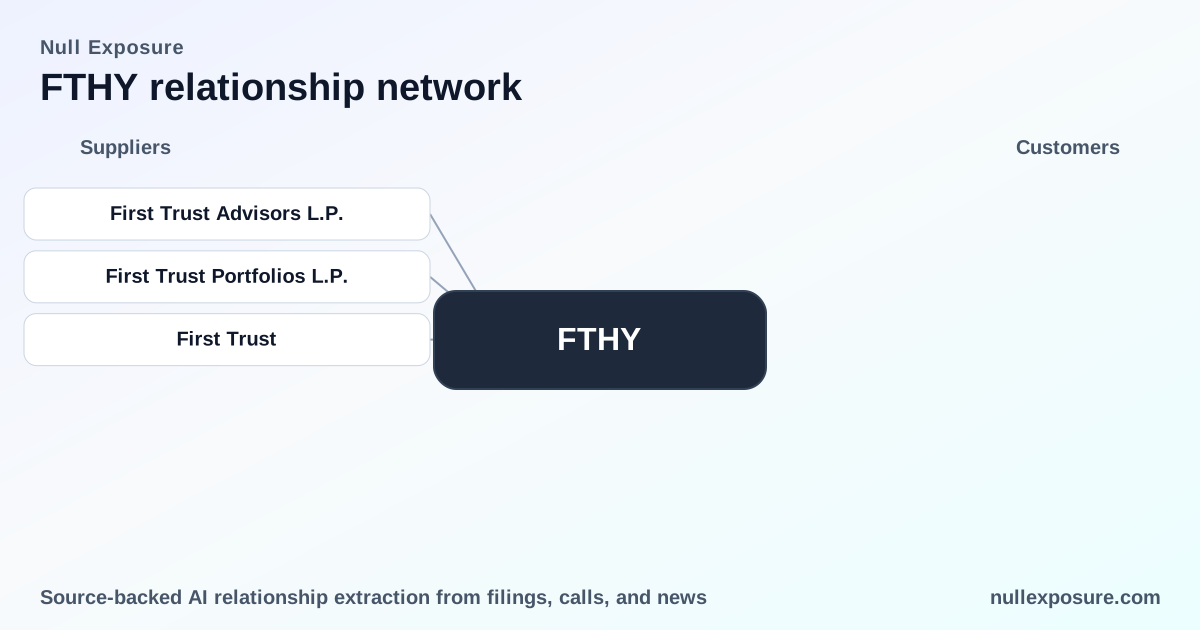
First Trust High Yield Opportunities 2027 Term Fund (FTHY): supplier map and commercial implications
Thesis — First Trust High Yield Opportunities 2027 Term Fund is a closed-end, term fund that monetizes by buying below‑investment‑grade credit, distributing yield to shareholders, and outsourcing portfolio management and distribution to third-party First Trust entities; the fund’s income profile and finite 2027 maturity create a defined liquidity and de‑risking horizon for investors while advisory fees and distribution mechanics capture operating economics.
For a quick, centralized view of supplier exposure and commercial signals, visit https://nullexposure.com/.
How FTHY runs and where money is made
FTHY generates returns for investors through a diversified portfolio of high‑yield bonds with a targeted end date in 2027. Revenue to shareholders is derived from interest income on the credit portfolio; revenue to operators comes from advisory and distribution fees tied to assets under management and share issuance. The term structure gives FTHY a deterministic wind‑down event (2027), which compresses long‑term operational uncertainty and concentrates counterparty and liquidity risk into a finite window.
What matters to investors: business drivers and structural risks
- Yield versus credit risk: The fund’s strategy is to extract carry from below‑investment‑grade bonds; total return depends on credit selection and default recovery rates.
- Fee capture and outsourcing: Management and distribution are outsourced, so investor returns and operational continuity depend on contractor performance and compensation terms.
- Finite maturity: The 2027 termination date delivers a clear exit, but also concentrates refinancing and liquidity events into a short calendar span.
- Ownership concentration: Institutional ownership (about 65%) indicates professional investor demand and potential for block trading events that affect liquidity.
For more on supplier concentration and counterparty intelligence, see https://nullexposure.com/.
Supplier relationships and what each disclosure tells investors
Below I cover every relationship mentioned in public reporting for FTHY; each entry is a concise investor‑oriented takeaway followed by the source.
-
First Trust Advisors L.P. — The firm is identified repeatedly in press releases as the Fund’s investment advisor, responsible for portfolio construction and ongoing credit selection (FY2025 reporting). Source: Yahoo Finance press release (FY2025) — https://finance.yahoo.com/news/first-trust-high-yield-opportunities-005900941.html.
-
First Trust Advisors L.P. — A business‑wire distribution announcing the monthly common share distribution also names First Trust Advisors L.P. as the Fund’s federally registered investment advisor (press release June 18, 2025). Source: Statesman Examiner / BusinessWire via Markets.FinancialContent (June 18, 2025) — https://markets.financialcontent.com/statesmanexaminer/article/bizwire-2025-6-18-first-trust-high-yield-opportunities-2027-term-fund-declares-its-monthly-common-share-distribution-of-0125-per-share-for-july.
-
First Trust Advisors L.P. — The Globe and Mail press release reiterates that First Trust Advisors L.P. serves as the Fund’s investment advisor in the announcement of monthly distributions (FY2025). Source: The Globe and Mail press release (FY2025) — https://www.theglobeandmail.com/investing/markets/stocks/FTHY-N/pressreleases/36239361/first-trust-high-yield-opportunities-2027-term-fund-declares-its-monthly-common-share-distribution-of-0-125-per-share-for-december/.
-
First Trust Portfolios L.P. — That same Globe and Mail release identifies First Trust Portfolios L.P. as the sponsor and a FINRA‑registered broker‑dealer involved in distribution, marking it as the sales/distribution arm connected to fund flows (FY2025). Source: The Globe and Mail press release (FY2025) — https://www.theglobeandmail.com/investing/markets/stocks/FTHY-N/pressreleases/36239361/first-trust-high-yield-opportunities-2027-term-fund-declares-its-monthly-common-share-distribution-of-0-125-per-share-for-december/.
-
First Trust Advisors L.P. — MarketScreener’s coverage of distribution announcements (FY2026) again confirms FTA as the Fund’s investment advisor, highlighting persistent outsourcing of portfolio management across reporting cycles. Source: MarketScreener press release (FY2026) — https://www.marketscreener.com/news/first-trust-high-yield-opportunities-2027-term-fund-declares-its-monthly-common-share-distribution-o-ce7e58dddb89f425.
-
First Trust Advisors L.P. — A Markets FinancialContent (PennWell/ELP) article (Nov 20, 2025) repeats the advisory disclosure in the context of monthly distributions, underscoring consistent governance and service arrangements (FY2025). Source: Markets.FinancialContent / PennWell (Nov 20, 2025) — https://markets.financialcontent.com/pennwell.elp/article/bizwire-2025-11-20-first-trust-high-yield-opportunities-2027-term-fund-declares-its-monthly-common-share-distribution-of-0125-per-share-for-december.
-
First Trust Advisors L.P. — Another MarketScreener distribution notice (FY2026) bluntly states "The Fund's investment advisor is First Trust Advisors L.P.", reinforcing the single‑advisor operating model across public notices. Source: MarketScreener press release (FY2026) — https://www.marketscreener.com/news/first-trust-high-yield-opportunities-2027-term-fund-declares-monthly-common-share-distribution-paya-ce7e5dddd98ef622.
-
First Trust Advisors L.P. — The National Law Review carried the distribution announcement language (FY2026) that again identifies First Trust Advisors L.P. as the federally registered adviser, reinforcing regulatory and disclosure consistency. Source: National Law Review press release (FY2026) — https://natlawreview.com/press-releases/first-trust-high-yield-opportunities-2027-term-fund-declares-its-monthly-0.
-
First Trust Portfolios L.P. — MarketScreener’s FY2026 coverage also documents that FTP acts as sponsor and distributor alongside the advisory function, validating a two‑entity operating split between advisory and distribution roles. Source: MarketScreener press release (FY2026) — https://www.marketscreener.com/news/first-trust-high-yield-opportunities-2027-term-fund-declares-its-monthly-common-share-distribution-o-ce7e58dddb89f425.
-
First Trust (brand) — A trade news release references the fund under the First Trust brand and ticker (FTHY), confirming market communications and ticker listing activity under the First Trust umbrella (FY2025). Source: StockTradersDaily news release (FY2025) — https://news.stocktradersdaily.com/news_release/40/FTHY_Movement_as_an_Input_in_Quant_Signal_Sets_123125050201_1767218521.html.
Operating model signals and structural constraints
- Contracting posture: Company‑level disclosures show an outsourced operating model: investment strategy and distribution are handled by external firms rather than in‑house teams, which concentrates operational risk in service contractors.
- Concentration: Institutional investors hold roughly 65% of shares, creating potential for concentrated flows and block trades that can amplify price volatility at distribution or maturity events.
- Criticality: The adviser and sponsor/distributor roles are functionally critical to portfolio management, fee realization, and shareholder communications; service continuity is material to investor outcomes.
- Maturity and liquidity profile: The term structure (2027 wind‑up) imposes a deterministic liquidity event that reduces infinite-horizon risk but increases near‑term execution risk as the termination window approaches.
Market implications and what investors should do next
Investors should weigh the yield pickup against concentrated counterparty exposure and a defined maturity tail‑risk. High institutional ownership and outsourced management drive operational efficiency but increase vendor dependence at a critical time window before 2027.
If you are evaluating counterparty exposure or preparing for portfolio rebalancing around the 2027 termination, start with a supplier risk review and scenario modeling focused on default rates, liquidity at wind‑up, and contractual fee terms. For a granular third‑party supplier map and to track ongoing press disclosures about FTHY, visit https://nullexposure.com/.
Final step: review the fund’s filings, confirm fee schedules and distribution mechanics, and confirm service agreements with the adviser/sponsor before committing new capital. For tailored supplier risk research and monitoring solutions, go to https://nullexposure.com/.