Flotek Industries (FTK): Strategic Supplier Moves and What They Mean for Buyers and Investors
Flotek Industries operates as a technology-led chemical and data company serving the oil & gas value chain, selling proprietary chemical products, field-delivered services, and commercial data tools that increase well performance and lower operating cost. The company monetizes through product sales, long-term service contracts and now by owning and leasing energy infrastructure — converting operational capabilities into recurring revenue. Investors should view Flotek as a mid-cap energy-services operator that blends chemistry, field service execution and asset-backed revenue to diversify cash flow.
If you want systematic supplier and counterparty intelligence for active diligence, visit the NullExposure homepage: https://nullexposure.com/
What the business model looks like in plain terms
Flotek sells chemical formulations and associated field services to oilfield operators, then layers analytics and proprietary IP to command premiums and multi-year engagements. Revenue drivers include product volume in active basins, service contract scope, and increasingly, asset-backed lease income from complementary infrastructure. Financially, Flotek is profitable on a modest scale (2025 trailing revenue ~$237m, EBITDA ~$29.9m) with a mid-teens operating margin profile and a return on equity above 25%, signaling efficient capital deployment in its operating footprint.
Recent supplier/asset relationship: a single, material deal
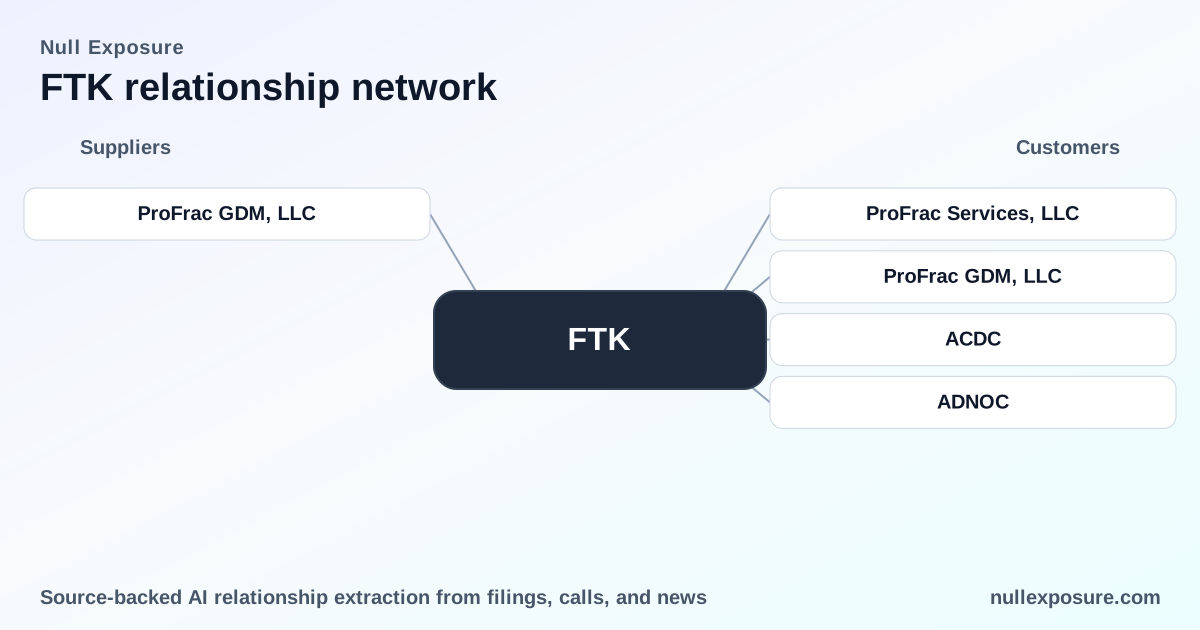
Flotek announced a transaction with ProFrac GDM, LLC — a subsidiary of ProFrac Holding Corp. — where Flotek acquired mobile power generation assets and related intellectual property for $105 million, and simultaneously secured a multi-year lease that provides a $160 million revenue backlog and immediate earnings accretion. The company disclosed the transaction in a press release dated March 2026. This deal converts previously outsourced or third-party power capacity into owned and leased revenue, enlarging Flotek’s asset base and predictable cash flow. (Source: PR Newswire, March 2026.)
How that ProFrac relationship changes the supplier landscape
- The acquisition transitions Flotek from a pure chemical-and-services supplier profile toward an owner-operator of energy infrastructure, reducing dependence on third-party power providers. According to Flotek’s announcement, the assets provide both capital ownership and a contracted revenue stream through the lease arrangement (PR Newswire, March 2026).
- For procurement and operations teams, that means one fewer external counterparty to manage for power capacity; for investors, it means Flotek has increased the criticality and duration of contracted cash flows through an asset-backed lease.
All identified third-party relationships (complete coverage)
- ProFrac GDM, LLC — Flotek purchased mobile power generation assets and associated IP from ProFrac GDM for $105 million and secured a multi-year lease that produces approximately $160 million of revenue backlog, according to the company press release in March 2026. (Source: PR Newswire, March 2026.)
Company-level constraints that shape supplier posture and risk
Flotek discloses procurement and sourcing language that signals a deliberate, diversified supplier strategy. The company states it sources raw materials from multiple suppliers both domestically and internationally when possible, which creates the following operating characteristics:
- Contracting posture: flexible buyer. Flotek uses the open market and multiple vendors to purchase raw materials, which provides bargaining leverage and continuity options during supply shocks.
- Concentration: intentionally low for raw materials. The firm’s language suggests avoidance of single-supplier dependency for inputs; concentration risk is therefore reduced for commodities and chemical feedstocks.
- Criticality: moderate to high for inputs but mitigated by diversification. Chemical inputs remain central to product capability, but multiple sourcing reduces single-point failure risk.
- Maturity: transactional, market-oriented procurement. Using open-market purchases implies mature, price-aware sourcing rather than captive or bespoke supply chains.
These constraints should be treated as company-level signals rather than supplier-specific claims; they indicate management’s preference for supplier flexibility and cost discipline.
If you want to track counterparty moves and how they affect revenue backlogs, visit the NullExposure homepage: https://nullexposure.com/
What operators and investors should take away
- Revenue diversification is real and timely. By acquiring power assets and locking in lease revenue, Flotek converts volatile service economics into longer-duration cash flow, improving earnings visibility for investors and operators reliant on consistent field services.
- Procurement flexibility reduces input risk. The company’s multi-supplier approach for raw materials lowers the probability of commodity-driven disruptions and supports scalable deployment across basins.
- Ownership of complementary infrastructure increases operational control. Owning or leasing power generation reduces outsourced exposure and gives Flotek both margin uplift and strategic optionality in how it offers integrated field services.
- Governance and ownership concentration matter. Insiders hold a large stake (~53% insider ownership), a double-edged signal: alignment with long-term value creation but reduced public float and potential governance centralization that investors should monitor.
Risk vectors to watch
- Integration risk from asset acquisitions: converting a supplier relationship into an owned asset requires capital discipline and operational integration, which affects near-term free cash flow and leverage.
- Market cyclicality in oil & gas activity remains the primary demand driver for Flotek’s core products and services; the company’s success depends on basin activity intensity and capex cycles.
- Valuation sensitivity: FTK trades with EV/EBITDA multiples that reflect both growth expectations and cyclical risk; monitor execution against the new lease-based backlog.
If you want to drill deeper into counterparty exposure and supplier-backed revenue streams for due diligence, visit the NullExposure homepage: https://nullexposure.com/
Final read for investors
Flotek is executing a deliberate shift from being a product-and-service provider to an integrated operator that combines chemistry, field services, and asset-backed, contracted revenue. The ProFrac asset purchase and lease represents a concrete step toward revenue durability and margin enhancement. For investors and operators evaluating FTK supplier relationships, the principal conclusion is simple: Flotek is reducing external supplier dependence while converting activity-driven sales into steadier leased cash flows — a strategic move that increases predictability but requires execution discipline.
Sources referenced include Flotek’s corporate press release announcing the ProFrac transaction (PR Newswire, March 2026) and Flotek’s most recent reported financial metrics through FY2025.