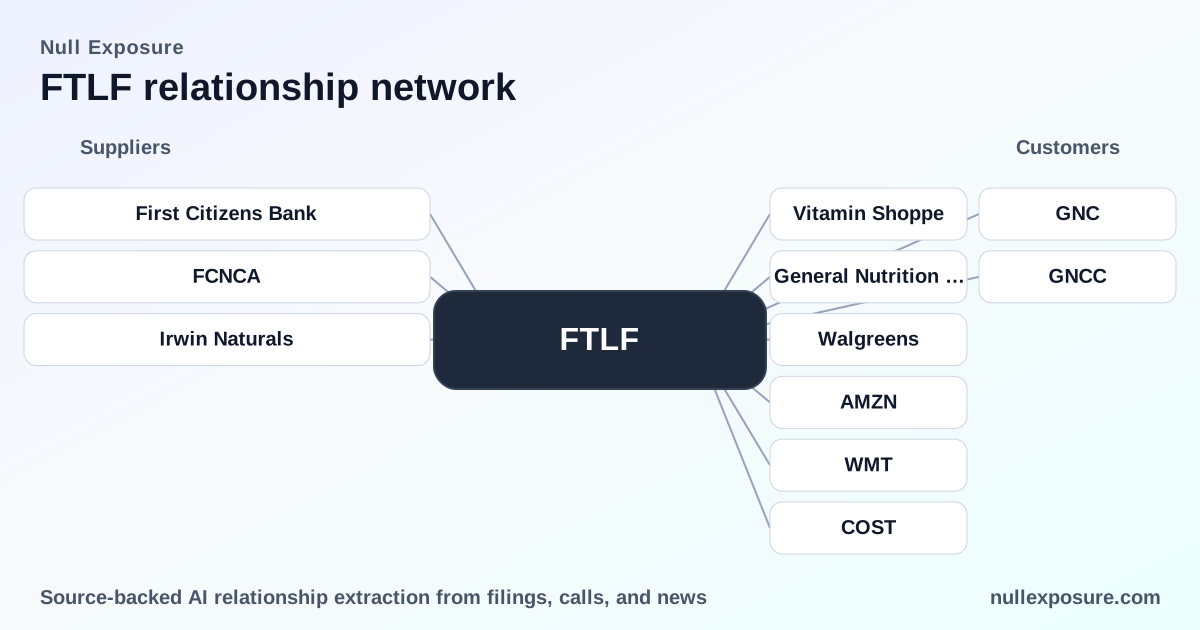
FitLife Brands (FTLF) — Supplier relationships and operational constraints that shape growth
FitLife Brands operates as a branded nutritional‑supplements company that monetizes through product sales and bolt‑on acquisitions, leveraging FDA‑regulated U.S. contract manufacturers to supply finished goods for domestic and international distribution. The company funds growth inorganically and with leverage: recent asset acquisitions were explicitly financed with committed term loans and an upsized revolving facility rather than equity issuance, reflecting a capital strategy that blends cash on hand with bank credit to accelerate scale. For primary supplier and financing exposure analysis, visit https://nullexposure.com/ to see how these counterparties interact with working capital and M&A activity.
What matters for investors: financing, manufacturing posture, and concentration
FitLife’s financial profile and operating posture give a clear read on where counterparty risk sits. Revenue of $70.6M and gross profit of $29.1M (TTM) show solid unit economics for a packaged‑foods/subsidiary strategy, but the company’s use of acquisition financing and concentrated payables creates specific supplier and lender dependencies that are material to operations and liquidity.
- Contracting posture: FitLife outsources manufacturing to FDA‑regulated contract manufacturers in the United States, which means the company is not vertically integrated on production but retains control over brand, distribution, and acquisition integration. This structure speeds time‑to‑market but makes FitLife dependent on a small set of manufacturing providers for regulatory compliance and product continuity.
- Concentration risk: FitLife’s own disclosures show one vendor accounted for 59% of consolidated accounts payable at year‑end 2024 and 51% in 2023, a concentration signal that is material to working capital stability and negotiating leverage.
- Criticality and maturity: Manufacturing relationships are critical and appear mature: production occurs with FDA‑regulated contract manufacturers domestically, implying established quality controls and a regulatory compliance posture that supports scaled retail and wholesale channels.
These characteristics justify active monitoring of lender arrangements and primary manufacturer counterparties as leading indicators of operational resilience. For a concise view of these supplier relationships and financing links, explore https://nullexposure.com/.
How FitLife funded recent deals — bank relationships are a primary lever
FitLife funded acquisitions with a mix of cash and bank credit rather than equity, which pushes counterparty importance onto its arranging banks and lending syndicate. The practical result for investors is a funding pattern that heightens sensitivity to bank covenants, revolver availability, and refinancing risk, particularly as the company integrates acquired brands and converts inventory into cash flow.
The counterparties you need to know
First Citizens Bank
First Citizens Bank provided committed term loans and a revolving credit facility that funded multiple FitLife acquisitions, including the MusclePharm asset purchase in FY2023 and the Irwin Naturals transaction in FY2025; the MusclePharm term loan was reported at $10 million at SOFR+275, and the Irwin financing included a new term loan plus an upsized $10 million revolver and a combined $35.75 million funded for the purchase alongside cash on hand. According to company press releases (GlobeNewswire, Sep 27, 2023; GlobeNewswire, Aug 11, 2025) and market coverage (QuiverQuant, FY2025), First Citizens is the primary financing counterparty for recent strategic acquisitions.
Irwin Naturals
FitLife closed the acquisition of substantially all of the assets of Irwin Naturals as approved by the U.S. Bankruptcy Court for the Central District of California, with the transaction funded in part by proceeds of a new term loan and revolving facility arranged with First Citizens Bank alongside FitLife’s cash balances. This closing was announced in a GlobeNewswire press release dated August 11, 2025.
What these relationships imply for operational risk and upside
- Financing concentration is a double‑edged sword. Having First Citizens as a repeat lender simplifies deal execution and provides predictable financing terms, but it also concentrates refinancing and covenant risk with a single bank counterparty. That becomes especially important if FitLife’s acquisitive posture continues.
- Manufacturing dependency is material. The company’s reliance on U.S. FDA‑regulated contract manufacturers makes those supplier relationships operationally critical; the disclosure that a single vendor represents a majority share of payables underscores the potential for supply disruption to cascade into inventory and sales volatility.
- M&A‑driven growth encourages earnings leverage. The acquisitions increase revenue per share and scale gross profit but also push leverage higher in the near term, placing emphasis on successful integration and working‑capital conversion to service bank debt.
Investors should track covenant schedules and the maturity profile of the First Citizens facilities as leading indicators of refinancing risk and liquidity pressure.
For investors and operators who want a structured, third‑party view of counterparty concentration and supplier exposure, check out https://nullexposure.com/ for comparative analyses and supplier linkage maps.
Practical checklist for due diligence
- Confirm the maturity schedule and covenant tests on the First Citizens term loan and revolver; covenant compression is the most immediate financial risk given repeated acquisition funding.
- Validate the identity and capacity of the large vendor that accounted for 59% of payables in 2024; a contingency plan is required if that supplier is a single contract manufacturer or a logistics partner.
- Review integration milestones and inventory conversion metrics for MusclePharm and Irwin Naturals to ensure acquired product lines contribute cash flow on schedule.
- Monitor FDA‑related manufacturing compliance records and any signs of supplier throughput constraints that could interrupt retail replenishment.
Bottom line for investors
FitLife Brands is executing an acquisition‑led growth model financed predominantly through bank credit, with First Citizens Bank as the pivotal financing counterparty and U.S. contract manufacturers as the operational backbone. High supplier concentration and bank‑centric funding amplify both upside from consolidation and downside from refinancing or supply disruption. Active monitoring of the First Citizens facilities, the single large vendor, and integration performance of acquired assets defines the near‑term investment thesis.
If you evaluate supplier and lender exposure for portfolio companies, visit https://nullexposure.com/ to add these counterparty signals to your credit and operational diligence workflow.