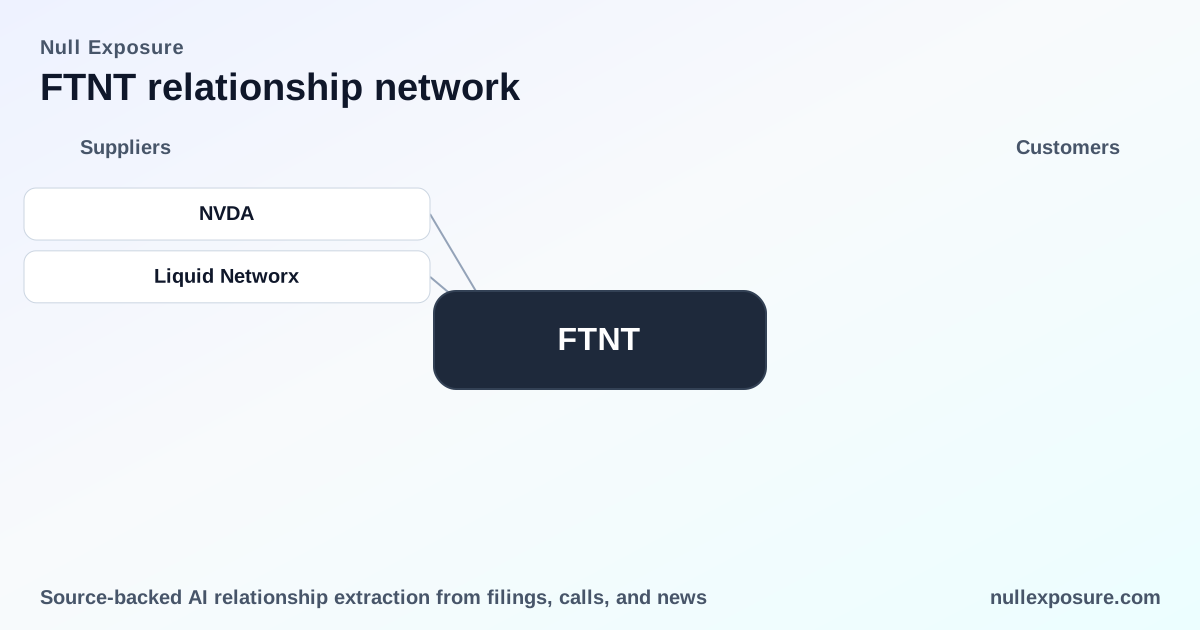
Fortinet (FTNT): Supplier relationships and operational constraints that drive the security franchise
Fortinet operates as a vertically oriented cybersecurity company that sells hardware appliances, software licenses and high-margin recurring services (support, subscriptions, and managed offerings). The company monetizes by combining one-time product revenue with a growing annuity base of security subscriptions and services, delivering visible recurring revenue while preserving exposure to hardware cycles; Fortinet’s trailing revenue of $6.80 billion and a gross profit margin consistent with infrastructure software economics reflect that blended model. For investors focused on operational risk, supplier posture and partner ecosystems are primary levers that influence margin stability and go-to-market velocity. Learn more about supplier mapping and exposure analysis at https://nullexposure.com/.
Why supplier and partner footprints matter for a security vendor
Fortinet’s business mixes product manufacturing with cloud and service delivery. That hybrid model produces two contrasting supplier dynamics:
-
Concentration and criticality in manufacturing: Fortinet outsources the assembly of appliances and relies on a small set of contract manufacturers, with approximately 88% of hardware manufacturing centered in Taiwan and Japan, and a portion of proprietary ASIC production tied to contract manufacturers. Company disclosures highlight exposure to limited or sole sources for some chips and components. This creates concentrated supply risk that can translate into inventory pressure, shipment delays and margin compression if component lead times extend.
-
Operational reliance on service providers and cloud: Fortinet depends on public cloud providers (AWS, Azure, Google Cloud), colocation providers such as Equinix, and its own PoPs for service delivery. Service availability interruptions at these providers would translate directly into service-level pressure for Fortinet’s managed and cloud-delivered offerings.
-
Contractual maturity and cash commitments: Fortinet reported $591.1 million of non-cancelable inventory purchase commitments as of December 31, 2024, demonstrating a meaningful committed spend profile with contract manufacturers that increases fixed exposure to component cycles.
Together these signals mean Fortinet’s contracting posture is outsourced and concentrated, its supplier relationships are material and critical to product delivery, and the company carries meaningful forward procurement commitments that will drive near-term supply dynamics and working capital. For deeper supplier relationship intelligence, visit https://nullexposure.com/.
Supplier relationships disclosed in recent public sources
NVIDIA — securing AI infrastructure with a data‑center DPU partner
Fortinet disclosed on its 2025 Q4 earnings call that it partnered with NVIDIA to leverage the BlueField‑3 DPU to secure AI infrastructure, integrating NVIDIA’s data‑processing unit into Fortinet’s security stack for AI workloads. According to the 2025 Q4 earnings call (reported 2026‑03‑07), this is a strategic technology partnership focused on embedding hardware acceleration into Fortinet’s AI security posture.
Source: Fortinet 2025 Q4 earnings call (first reported 2026‑03‑07).
Liquid Networx — channel expansion through an Engage Preferred Services Partner
A SimplyWall.st article in early March 2026 reported that Liquid Networx became North America’s first Fortinet Engage Preferred Services Partner, a partnership that assigns certified Fortinet engineers to enterprise customers and expands Fortinet’s professional services reach through trusted channel operators. The announcement signals an intent to scale managed delivery and professional services capacity via partner engineering resources.
Source: SimplyWall.st coverage of Fortinet partner expansion (published 2026‑03‑09).
What these relationships mean for investors
Both disclosed relationships are complementary to Fortinet’s monetization model but carry different operational and financial implications:
-
NVIDIA partnership is strategic for product differentiation. Integration with NVIDIA’s BlueField‑3 DPU supports Fortinet’s move to secure AI infrastructure — an area of rapid enterprise spend. This partnership accelerates product roadmaps and can increase hardware ASPs and adjacent subscription uptake if customers adopt the integrated solution. The strategic tie to a leading chip vendor also helps offset some supplier concentration risks for certain performance-sensitive applications.
-
Liquid Networx strengthens service delivery and recurring revenue expansion. Bringing certified engineers into a preferred‑partner model accelerates enterprise deployments and upsell of security subscriptions and managed services, improving time-to-revenue and customer retention metrics.
-
Supply chain concentration remains the principal operational risk. Fortinet’s dependence on a small group of contract manufacturers and limited component sources is material and critical. Any prolonged disruption in Taiwan/Japan manufacturing, or shortages of specific ASICs or chips, would pressure shipment schedules and could reduce gross margins — particularly if the company must source substitute components at higher cost.
-
Balance sheet and procurement posture amplify exposure. With >$590 million in non‑cancelable purchase commitments, Fortinet has a locked-in procurement profile that benefits scale when demand is stable but increases downside during demand shocks.
Financial context is important: Fortinet’s recent results show profitability (profit margin ~27.3%) and strong gross profit, which provide a buffer against transient supply costs; however, elevated valuation multiples (trailing P/E ~34.9, EV/Revenue ~8.7) require steady execution on both product innovation and partner-led services growth to justify investor expectations.
Monitoring checklist: what investors should watch next
- Track component lead times and inventory build patterns disclosed in quarterly filings; changes in the Taiwan/Japan manufacturing footprint are direct leading indicators of supply risk.
- Follow adoption momentum for the NVIDIA BlueField integration and any early customer wins or reference deployments that convert into subscription or appliance orders.
- Watch channel partner rollouts and their contribution to services bookings — partner‑led certified engineering programs (like Liquid Networx) accelerate deploy-to-revenue cycles.
- Monitor provider availability and any material outages at cloud or colocation partners that could trigger service-level issues.
- Assess capital and procurement commitments in subsequent filings to see if committed spend is growing relative to backlog and revenue guidance.
For structured supplier intelligence and signal monitoring tailored to operational risk and investment decisions, explore NullExposure’s coverage at https://nullexposure.com/.
Bottom line: balance of strategic partnerships and concentrated supply risk
Fortinet’s supplier and partner disclosures show a company actively building product differentiation and channel reach while operating under concentrated manufacturing risk and meaningful procurement commitments. The NVIDIA relationship enhances Fortinet’s capability in securing AI workloads and supports higher‑value hardware initiatives; the Liquid Networx partnership accelerates services scale and recurring revenue. Investors should balance these strategic upside drivers against the operational exposure rooted in contract manufacturing concentration and non‑cancelable inventory commitments. For ongoing monitoring and supplier-level alerts that matter to institutional investors, visit https://nullexposure.com/.