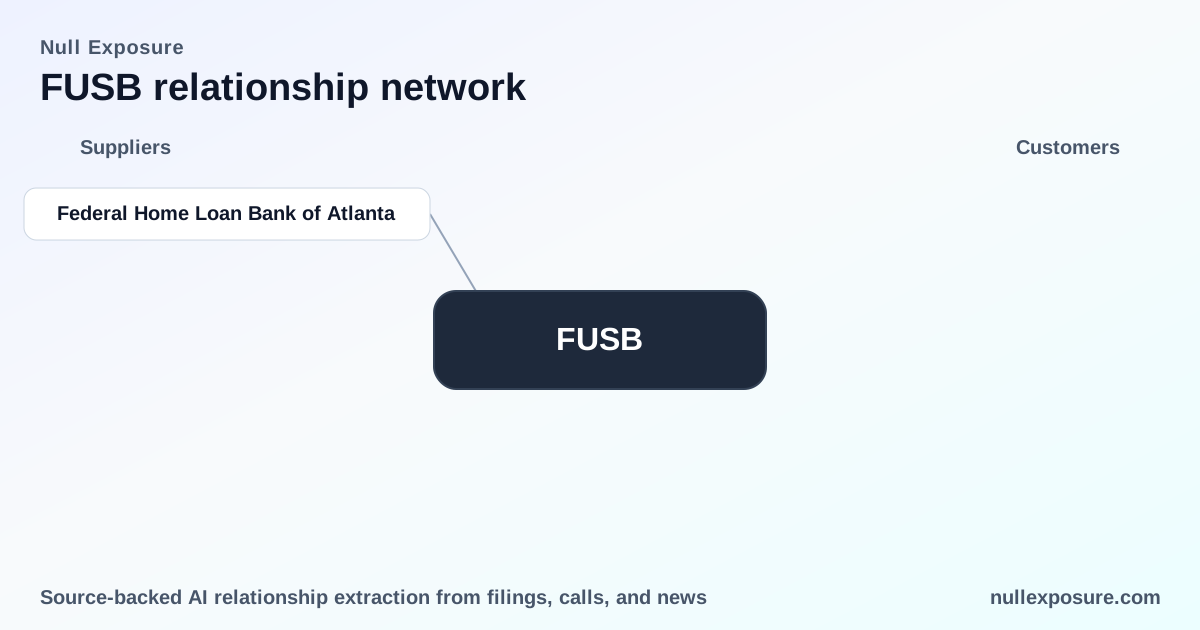
First US Bancshares (FUSB): Supplier Relationships, Funding Links, and Operational Constraints
First US Bancshares operates as a regional banking holding company that earns net interest income, fee income, and lending spreads from commercial and consumer banking across Alabama. The company monetizes through deposit gathering, loan origination and servicing, and short-term wholesale funding when needed; its supplier relationships — especially funding counterparties and third-party processors — directly influence liquidity, regulatory exposure, and operational resiliency. For immediate access to supplier intelligence and relationship mapping, visit https://nullexposure.com/.
What the supplier posture tells investors about FUSB
First US Bancshares demonstrates a lean contracting posture with targeted, short-duration funding relationships rather than broad, long-term vendor engagements. That posture yields both advantages and risks: short-term arrangements preserve flexibility and limit long-term counterparty exposure, but they also concentrate operational and liquidity dependence into a small set of counterparties that are highly consequential to day-to-day funding.
- Contracting maturity: The bank uses short-term advances for working capital and liquidity. According to the FY2026 company filing and related reporting, the Bank had $10.0 million in outstanding Federal Home Loan Bank (FHLB) advances with original maturities of less than one year, and all outstanding short-term borrowings as of December 31, 2024 were borrowed exclusively from the Federal Home Loan Bank of Atlanta. (company filing, FY2026; news coverage March 2026)
- Concentration and criticality: These disclosures indicate concentration of short-term funding into a single wholesale counterparty (FHLB Atlanta) and elevate that relationship to a critical operational role for near-term liquidity.
- Service-provider dependence: Separately, First US Bancshares acknowledges dependence on outside third parties for processing and data handling, and treats cybersecurity and third-party risk as a material area of oversight in its regulatory filings. That underlines operational dependence on vendors for core back-office and customer-facing functions (company filing, FY2026).
- Audit and control signals: The company also identified an allowance as a critical audit matter in recent filings, signaling auditor focus on credit loss estimation and provisioning that has implications for capital and regulatory scrutiny (company filing, FY2026).
These characteristics together paint a bank that runs with short, replaceable contracts for liquidity but with a non-trivial operational and audit concentration that investors should monitor closely.
All supplier relationships disclosed for review
Below is a concise inventory of every supplier relationship identified in the available results.
Federal Home Loan Bank of Atlanta
First US Bancshares uses the Federal Home Loan Bank of Atlanta as its exclusive source for short-term borrowings reported as of year-end: all outstanding short-term borrowings had remaining maturities under 30 days and were borrowed exclusively from FHLB Atlanta. The bank also reported $10.0 million in FHLB advances with original maturities under one year as of December 31, 2024 (company filing, FY2026; reported March 2026). This makes FHLB Atlanta a material and short-term funding counterparty for FUSB.
(Reference: company filing disclosures for FY2026 and a related news release reported March 9, 2026 on Yahoo Finance summarizing the bank’s year-end borrowing position.)
Why this single funding link matters to investors
FHLB exposure equates to both ready liquidity and concentration risk. The Federal Home Loan Bank system is a stable, low-cost source of collateralized funding for regional banks; First US Bancshares’ use of FHLB advances is operationally sensible. However, the exclusive short-term reliance is a structural point of concentration:
- Liquidity vector: Short-term FHLB advances are flexible and generally available, giving the bank a rapid funding outlet for deposit outflows or loan draws.
- Concentration vector: Exclusive dependence for short-duration borrowing centralizes counterparty risk. In an environment of sudden collateral stress or regulatory changes to FHLB eligibility, the bank’s immediate liquidity options shrink.
- Operational and regulatory overlay: The company’s own filings emphasize cybersecurity and third-party processing risks, and auditors flagged an allowance as a critical audit matter, which together suggest regulators and auditors are watching both credit-loss provisioning and operational resilience (company filing, FY2026).
For investors, the net conclusion is straightforward: FHLB funding is a practical liquidity tool, but the exclusivity and short maturities elevate the supplier relationship to strategic importance.
What operators and counterparties should watch
Practical monitoring and contracting levers for operators and counterparties:
- Maintain active maturity laddering and contingency plans beyond the FHLB line to reduce single-counterparty liquidity concentration.
- Tighten vendor oversight and contractual SLAs for third-party processors and data handlers given the company’s explicit regulatory focus on cybersecurity risks.
- Review allowance methodology and provisioning drivers proactively; the auditor’s critical-matter designation increases the likelihood of changes to reserves with direct capital implications.
- Stress-test scenarios where FHLB access is limited or collateral values decline, and quantify alternative funding costs.
These are operational priorities that directly map to the constraints observed in recent filings and public reporting.
For deeper supplier mapping and to track evolving relationship signals proactively, visit https://nullexposure.com/ for structured intelligence.
Investment implications and risk checklist
- Balance of flexibility vs. concentration: Short-dated FHLB funding gives balance-sheet agility but concentrates counterparty exposure; investors should weigh the liquidity benefit against concentration risk.
- Regulatory sensitivity: Auditor and filing signals around the allowance and cybersecurity increase the probability of heightened supervisory attention or disclosure volatility.
- Operational continuity: Dependence on third-party processors translates to a non-financial risk that can affect customer access, compliance, and reputational outcomes.
Key takeaway: First US Bancshares runs a compact supplier footprint where a single institutional lender (FHLB Atlanta) serves as the primary short-term funding source; that arrangement is efficient but materially consequential for liquidity and operational risk management.
If you are evaluating counterparties, credit facilities, or strategic supplier arrangements with First US Bancshares, use authoritative supplier profiles and continuous monitoring to quantify concentration and operational exposure — start here: https://nullexposure.com/.
Bottom line
First US Bancshares leverages short-term FHLB advances as an efficient liquidity mechanism, but the disclosure of exclusive short-term borrowing and a $10.0 million short-term FHLB advance creates concentration and criticality that investors and operators must actively manage. The company-level signals on cybersecurity and a critical audit matter for allowance provisioning further underscore the need for vigilant oversight. Use targeted supplier intelligence to measure evolving risk and to inform capital and counterparty decisions.