FVCB supplier profile: what investors should know about vendor exposure and operating constraints
FVCBankcorp (ticker FVCB) is a regional banking franchise that monetizes through net interest income on lending and investment portfolios, transactional and fee-based services, and balance-sheet management including brokered deposits. The firm outsources a number of core processing and infrastructure functions to third-party providers, which creates a supplier-driven operating model: revenue generation rests on both traditional banking activities and the uninterrupted operation of vendor-supplied systems and services. For a deeper look at how supplier relationships translate into operational risk and negotiation leverage, visit the NullExposure homepage: https://nullexposure.com/.
One-liner thesis for investors
FVCB’s credit profile and day-to-day operations are materially exposed to external providers for core banking functions; this creates contractual concentration and continuity risk that is as important to assess as loan credit quality when valuing the company or negotiating partnership terms.
What the public signals say about the firm
Public data on FVCB’s supplier posture is light but decisive. Rating coverage and corporate disclosures indicate a company that leans on third-party vendors for mission-critical services, while its funding mix (including meaningful brokered deposits) implies scale and recurring third-party spending.
-
Credit rating context: Morningstar DBRS assigned a Long-Term Issuer Rating of BBB (low) to FVCBankcorp and its bank subsidiary in FY2026, a judgment that reflects solid asset quality and capital levels which support the competitive position of the institution (reported March 2026). This rating anchors counterparty and funding risk assessments that suppliers and partners will use in contract and collateral negotiations. According to a March 9, 2026 news report summarizing the rating action, Morningstar DBRS affirmed that rating posture as reflective of the company’s fundamentals (Intellectia/Morningstar DBRS, FY2026).
-
Supplier reliance and criticality: Company disclosures state that FVCB “relies on some of these vendors for critical functions including, but not limited to, our core processing function,” indicating service-provider relationships that are operationally critical and not easily substitutable.
-
Scale of third-party exposure: The company filing notes brokered deposits of $249.9 million at December 31, 2024, a funding source that both funds growth and signals the scale at which the bank transacts with market intermediaries and vendors.
If you want to track this profile and related supplier intelligence, go to https://nullexposure.com/ for ongoing updates.
The supplier relationship found in the record
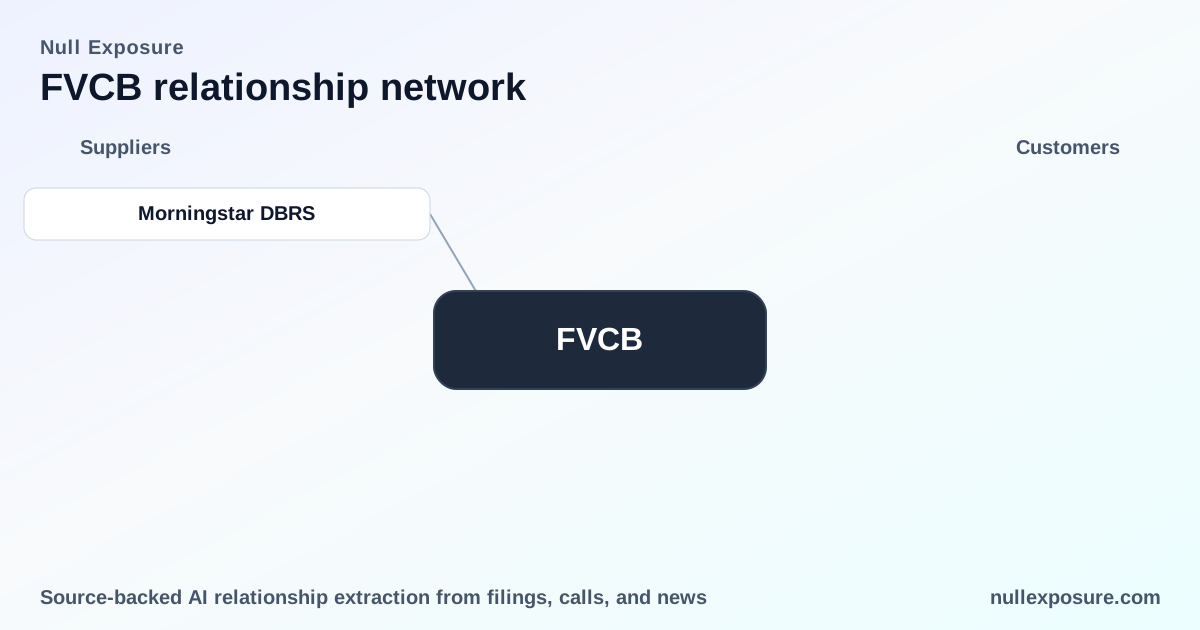
Morningstar DBRS — credit rating action reported on Intellectia (FY2026).
According to a March 2026 news report, Morningstar DBRS assigned a Long‑Term Issuer Rating of BBB (low) to FVCBankcorp and BBB to its subsidiary FVCbank, a reflection the agency tied to the company’s solid asset quality and capital levels (Intellectia report summarizing Morningstar DBRS, first seen 2026-03-09). This is a credit-market signal rather than a vendor contract, but it has direct implications for supplier terms and counterparty acceptance.
Operating constraints that shape supplier risk and negotiation posture
The documented constraints collectively frame how investors and counterparties should think about vendor risk for FVCB. These are company-level signals extracted from filings and public commentary:
-
Criticality: FVCB classifies certain third-party vendors as supporting “critical functions,” notably core processing. This means outages or contract disputes would directly affect deposit-taking, payments, and customer servicing—a single-vendor disruption would be high impact.
-
Role orientation: The company treats these vendors as service providers rather than simple contractors, which implies longer-term operational dependence and integrated delivery models that require mature governance (vendor oversight, SLAs, escalation paths).
-
Service segment breadth: Contracts span a wide range of services — core banking, communications, collaboration, and infrastructure — indicating bundle exposure rather than narrow single-function outsourcing, which increases switching complexity.
-
Scale and spend: Reported brokered deposit balances and the firm’s business model point to a >$100M annualized spend band on external funding sources and related service relationships, providing both bargaining power and a fixed-cost commitment that raises the economic costs of switching vendors.
Collectively, these constraints inform concentration risk, counterparty selection, and the priority investors should place on operational resilience in due diligence.
Practical implications for investors and operators
Operational risk and supplier concentration are now a central part of the investment thesis for FVCB. The following implications translate the signals into actionable items:
-
Valuation sensitivity: Because core processing outages would hit revenue collection and regulatory compliance, discount rates for the firm’s projected cash flows should reflect higher operational-risk premia than peers with in‑house core functionality.
-
Counterparty diligence: Underwrite supplier continuity: confirm SLAs, change-of-control clauses, data escrow arrangements, and dual‑sourcing options. Contracts should include measurable uptime, redundancy requirements, and exit cost caps.
-
Liquidity and funding risk: The presence of substantial brokered deposits implies a reliance on market-based funding that interacts with vendor continuity (for example, uptime on payment rails affects deposit stability). Stress tests should incorporate vendor outage scenarios.
-
Negotiation levers: Use the firm’s scale and brokered-deposit position as leverage in renegotiations; the company operates at a spend level that allows structured pricing and performance-based fee mechanisms.
Key takeaways
- FVCB’s vendor relationships are operationally critical; core processing and infrastructure are outsourced and embedded in everyday operations.
- Credit rating actions (Morningstar DBRS BBB low, March 2026) influence vendor acceptance and counterparty confidence.
- High spend and broad service scope create switching friction, making supplier continuity a strategic risk that impacts valuation and capital planning.
For a structured supplier-risk assessment tailored to FVCB and comparable franchises, visit our home page: https://nullexposure.com/.
Conclusion — what investors should do next
Treat vendor risk as a first‑order variable in FVCB diligence. Investors and counterparties should demand explicit evidence of redundancy, crisis playbooks, and contractual protections before assuming operational continuity. Operators should lock in performance guarantees and prioritize vendor governance upgrades to reduce the probability and impact of disruption.
Stay current on supplier intelligence and deepen your counterparty due diligence at https://nullexposure.com/ — the site consolidates contract-level signals, rating actions, and operational constraints that materially affect investment decisions.