FrontView REIT (FVR): Banks, Balance Sheet and the ATM Playbook
FrontView is an internally-managed net-lease REIT that acquires, owns and manages outparcel properties leased to a diversified tenant base and monetizes through steady net rental income plus periodic capital markets activity—most recently a $75 million at-the-market (ATM) equity program with major banks and associated forward-sale arrangements. The company's operating cashflow is rent-driven; the capital structure and liquidity profile are actively managed through equity issuance and banking relationships. For deeper relationships analytics and supplier mapping, see https://nullexposure.com/.
The business model in one paragraph
FrontView focuses on acquiring single-tenant outparcel properties and signing long-term net leases that transfer most operating expenses to tenants, creating predictable cashflow that supports dividend capacity and asset-level growth. Capital markets transactions (ATM offerings and forward sales) are a core monetization lever—they dilute equity but provide capital to fund acquisitions and de-lever or refinance balance sheet items. The REIT is internally managed, which concentrates operational control and centralizes property and corporate functions.
Take a closer look at the firm's profile and supplier footprint at https://nullexposure.com/.
What the corporate signals say about risk and posture
The public disclosures and parsed filing excerpts convey several firm-level constraints that shape supplier and investor risk:
- U.S.-centric portfolio. The company disclosed the aggregate cost of real estate for U.S. tax purposes, signaling a domestic concentration across its portfolio. This drives underwriting homogeneity and single-market exposure.
- Active acquirer posture. During the year ended December 31, 2024 FrontView completed 29 property acquisitions for an aggregate purchase price of $104.2 million, confirming that the company is a net buyer and that its supplier relationships include brokers, title, construction and acquisition financing partners.
- In-sourced management with transition costs. Management internalization produced a total consideration of $17.7 million, of which $16.5 million was recognized as a termination cost under ASC 420—this is a one-time expense tied to shifting from external manager arrangements to internal operations and influences near-term SG&A dynamics.
- Service-provider relationships are limited but specific. The company disclosed property accounting and human resources services with nominal fees ($0.1 million and $0.6 million for the three months and year ended December 31, 2024, respectively), indicating limited outsourced spend in those functions.
- Material leverage footprint. Filings list “Gross Debt 268,500,” a debt inventory that underpins refinancing risk, interest-cost exposure and the need for capital solutions such as ATM programs.
These signals indicate a REIT that is operationally consolidated, growth-oriented through acquisitions, and reliant on capital markets partnerships to execute its strategy.
The ATM counterparties you need to know
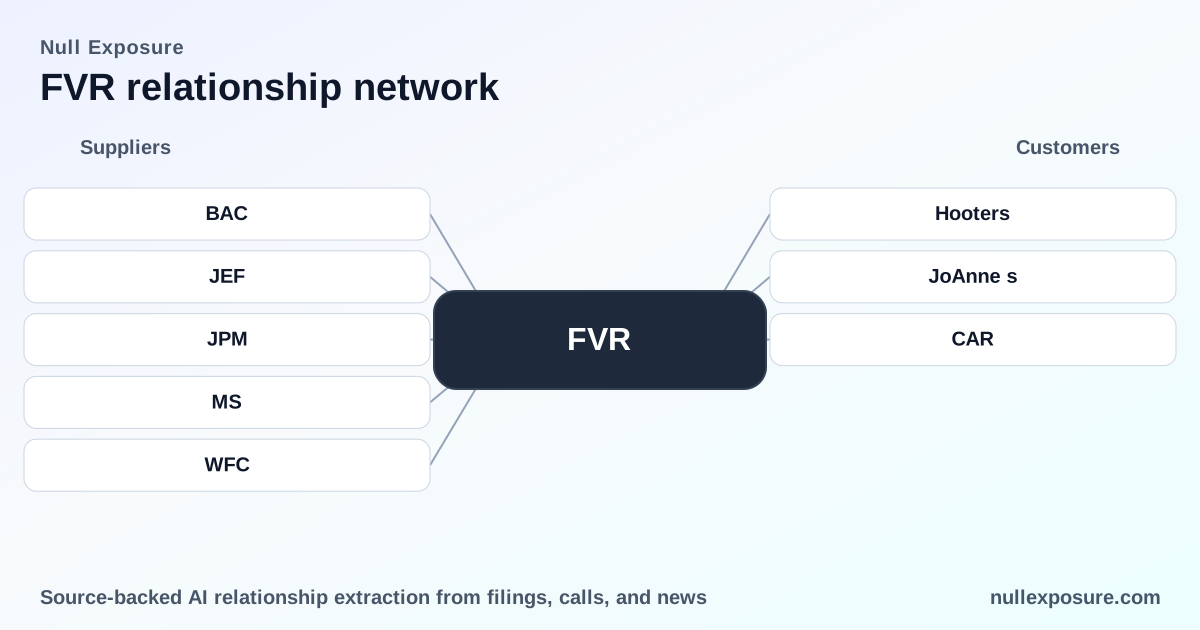
FrontView announced a $75 million ATM equity program accompanied by forward-sale arrangements with several major investment banks. Each of the banks below is named in that transaction package.
J.P. Morgan
J.P. Morgan is listed as a counterparty in FrontView’s $75 million ATM equity program and associated forward-sales agreements, providing placement and execution capacity for equity issuance. TradingView reported the transaction on March 9, 2026 (TradingView, Mar 9, 2026).
BofA (Bank of America)
Bank of America is named among the syndicate of banks supporting the ATM and forward sales, supplying distribution channels and institutional placement for incremental equity supply. TradingView reported the transaction on March 9, 2026 (TradingView, Mar 9, 2026).
Morgan Stanley
Morgan Stanley is included as a counterparty to the ATM facility, providing sales, trading and counterparty coverage that facilitates both at-the-market executions and structured forward-sale commitments. TradingView reported the transaction on March 9, 2026 (TradingView, Mar 9, 2026).
Wells Fargo
Wells Fargo is a named participant in the ATM and forward-sale program, indicating the bank's role in the equity distribution and execution network for FrontView’s capital raises. TradingView reported the transaction on March 9, 2026 (TradingView, Mar 9, 2026).
Jefferies
Jefferies is listed as a participant in the ATM and forward-sales consortium, offering capital markets execution and mid-market institutional access for the REIT’s equity issuance. TradingView reported the transaction on March 9, 2026 (TradingView, Mar 9, 2026).
Each of these counterparties was cited in the same market report covering the ATM and forward-sale program (TradingView, Mar 9, 2026).
For a full supplier map and to benchmark counterparties, visit https://nullexposure.com/.
What these bank relationships mean for investors and operators
- Concentration and execution capacity. By tapping multiple large banks for the ATM and forward sales, FrontView diversifies placement risk and leverages institutional distribution, improving the firm's ability to execute programmatic equity raises quickly.
- Contracting posture: transactional and capital-markets focused. These are financial counterparties—not strategic property services—so the contracting posture is short-duration, execution- and fee-based rather than long-term operational reliance.
- Criticality: high for liquidity, low for daily operations. Capital-markets counterparties are critical when FrontView needs balance-sheet flexibility; they are not critical vendors for property-level management.
- Maturity and signal of institutional access. The presence of top-tier banks demonstrates institutional credibility and access to capital, which is essential for an acquisitive REIT post-internalization.
Bottom line and investor actions
FrontView operates as an internally-managed, acquisitive net-lease REIT that funds growth through a combination of rental cashflow and capital markets activity; the $75 million ATM and forward-sale program with major banks formalizes that capital pathway. Key operational signals—29 property purchases in 2024, internalization costs recorded at $16.5 million, U.S.-centric assets and a material gross debt figure—frame the trade-off between growth and balance-sheet risk.
If you evaluate supplier and counterparty risk for REIT portfolios, map both the banking counterparties (for liquidity) and the outsourced operational vendors (even if currently small) to stress-test scenarios around issuance windows and refinancing cycles. Explore how these counterparties fit into your scenario models at https://nullexposure.com/.
For tailored supplier relationship analysis and a consolidated counterparty view for investment due diligence, visit https://nullexposure.com/ and connect with our research team.