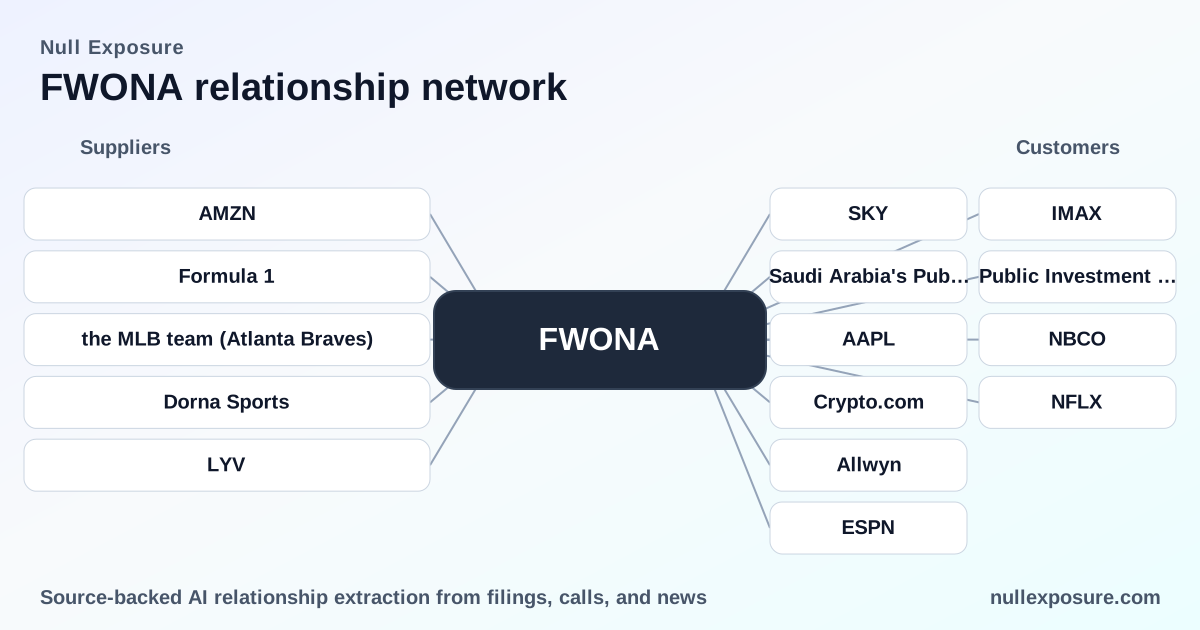
FWONA (Liberty Media — Formula One Group): Supplier relationships, commercial drivers, and operational constraints
Thesis: Liberty Media’s Formula One Group monetizes a tightly packaged sports-rights and live-experience business: long-term race hosting and media-rights sales, sponsorship and hospitality, licensing of intellectual property and race data, and strategic partnerships that scale live-event promotion and technology. Revenue is driven by global media contracts and event economics; supplier relationships therefore concentrate risk around data/technology partners, live-event promoters, and rights owners. Explore supplier exposures and implications at https://nullexposure.com/.
Financial posture that shapes supplier leverage
Liberty’s Formula One business sits on meaningful scale — TTM revenue of $4.48 billion and adjusted EBITDA of ~$997 million, with market capitalization near $19.8 billion and an EV/EBITDA around 18.7. Those economics support aggressive commercial growth but also create high dependency on recurring media rights, race-hosting agreements, and third-party service delivery that directly affect marginal profit. Institutional investors dominate the register (over 91% institutional ownership), which reinforces an expectation of predictable cashflow delivery and disciplined supplier management.
The supplier map — what each relationship delivers and why it matters
Below I cover every relationship in the source set. Each entry is a concise, plain-English take on what the relationship is and the public evidence that documents it.
Amazon Web Services (AWS)
Formula One partners with Amazon Web Services to aggregate and analyze enormous volumes of telemetry and race performance data, enabling richer broadcast analytics and enhanced fan experiences. According to GPBlog reporting in FY2022, F1’s data strategy involved a decisive move to partner with AWS to accumulate driver and performance statistics (https://www.gpblog.com/en/general/liberty-media-revitalises-formula-1.html).
Takeaway: AWS is a technology enabler for F1’s data monetization and broadcast enhancements — a high-value service-provider relationship for media products and UX.
Formula 1 (internal asset / core operating unit)
Liberty Media owns and operates Formula 1 as its core branded asset; the company acquired F1 in a large strategic transaction and has retained control of the event, media and commercial rights. Front Office Sports documented Liberty’s $4.4 billion acquisition in 2017 and noted management’s intent not to divest (reported in FY2023) (https://frontofficesports.com/newsletter/fos-pm-saudis-want-formula-1-next/).
Takeaway: Formula 1 is both the product and the principal counterparty — internal ownership concentrates strategic decisions, rights negotiations, and supplier obligations within Liberty’s commercial structure.
The MLB team (Atlanta Braves) and related development assets
Liberty’s ownership history extends beyond motorsport; the company previously acquired the Atlanta Braves and associated real-estate projects, demonstrating its capacity to own and operate live-sports franchises and property development initiatives. Front Office Sports noted Liberty’s acquisition of the Braves for approximately $1.5 billion and its related assets (reported in FY2023) (https://frontofficesports.com/newsletter/fos-pm-saudis-want-formula-1-next/).
Takeaway: Ownership of large live-sports assets demonstrates Liberty’s operational competency in venue and hospitality businesses — a useful comparandum for evaluating supplier contracts and in-house capabilities.
Dorna Sports (MotoGP counterparty/strategic asset target)
Liberty has been reported as preparing to acquire a controlling stake in MotoGP from Dorna Sports, indicating strategic consolidation in global motorsport rights and event ownership. PlanetF1 reported in FY2024 that Liberty planned to acquire an 86% stake in MotoGP from Dorna Sports (https://www.planetf1.com/news/liberty-media-f1-stake-sale-fund-motogp-takeover).
Takeaway: Expanding ownership into adjacent motorsport rights increases supplier scale and bargaining power but also elevates integration and execution risk across promotion, media rights, and technology suppliers.
Live Nation (event promotion and local partnership for Las Vegas)
Live Nation has been a promotional and local partner for the Las Vegas Grand Prix, supporting long-term event promotion and entertainment packages around the race. Sportico reported in FY2022 that F1 planned to promote the Vegas race in conjunction with Live Nation and local partners (https://www.sportico.com/business/real-estate/2022/liberty-media-expands-f1-las-vegas-footprint-with-240m-land-purchase-1234674643/).
Takeaway: Live Nation’s role highlights how F1 outsources large parts of event promotion and audience engagement — these contracts materially affect event economics and local execution risk.
Operating constraints and what they signal about supplier risk
Two company-level constraints from public materials shape how suppliers are contracted and evaluated:
-
Critical long-term licensing posture. Liberty’s business relies on multi-decade licensing arrangements (referenced as “100-Year Agreements” in company materials), which are critical to ongoing operations. This implies a contracting posture that prioritizes stability and long-duration rights, increasing the importance of counterparty performance and continuity across regulatory cycles and geopolitical shifts.
-
Service-provider model with active vendor risk management. Liberty treats many third parties as service providers and implements a third-party risk management program that evaluates cybersecurity for higher-risk vendors and vendors with system/data access. This indicates formalized vendor governance, security requirements, and selective outsourcing for sensitive functions (e.g., telemetry, broadcast systems).
From those constraints we derive practical signals: contracting favors long-term, lock-in rights where possible; supplier selection emphasizes operational maturity and cybersecurity posture; and supplier failure is material given license-critical operations.
Investment implications and an operator’s risk checklist
- Critical dependency on rights and long-term contracts. Disruption to licensing or race-hosting agreements would have outsized revenue impact because of the long-tenor nature of core contracts.
- Concentration in platform and media partners. Technology partners such as AWS are strategic and operationally critical for data monetization and broadcast functionality; loss or degradation of those services would meaningfully impair product delivery.
- Event execution risk via promoters and local partners. Partnerships with firms like Live Nation concentrate operational risk at the local execution layer; indemnities and performance SLAs matter.
- M&A and integration risk. Acquisitions like Dorna/MotoGP expand commercial reach but raise integration burden across suppliers, commercial rights, and operational teams.
For detailed supplier due diligence and to map contractual exposure across all counterparties, review the full supplier profiling tools at https://nullexposure.com/.
Final view and recommended next steps
Liberty’s Formula One business is a rights-driven, event-and-content company that leverages a small set of high-value suppliers (technology platforms, promoters, and rights sellers) to convert global audiences into media revenue and experiential income. Investors and operators should prioritize counterparty continuity, cybersecurity standards in vendor contracts, and the legal robustness of multi-decade licensing arrangements when assessing downside risk.
If you are evaluating supplier relationships or preparing diligence on FWONA, start with a focused review of rights agreements, top-tier technology contracts (data/broadcast), and event promotion SLAs — then validate vendor governance against the company’s third-party risk program. Learn more and access supplier intelligence at https://nullexposure.com/.