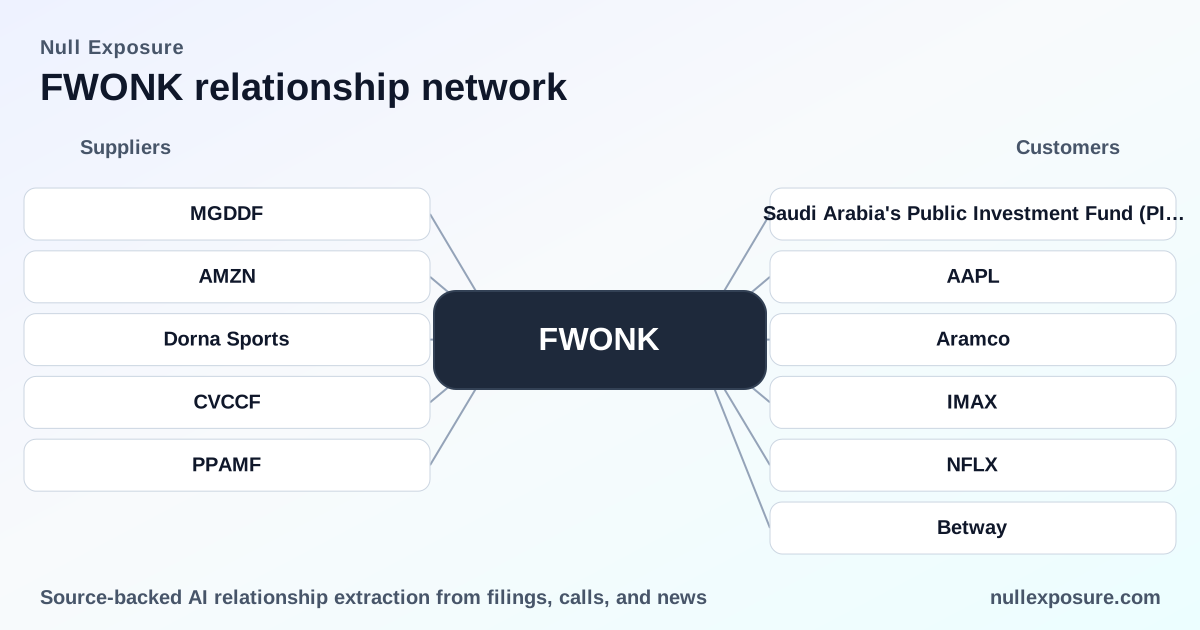
FWONK: Liberty Media’s Formula One Group — supplier relationships that move the needle
Thesis: Liberty Media’s Formula One Group (FWONK) runs a high-margin, rights-driven motorsports business that monetizes premium live content, global sponsorships, race promotion and hospitality, and licensing; strategic supplier agreements—particularly in technology, tire supply and rights ownership—directly affect revenue mix, margin resilience and the path to digital monetization. For investors evaluating supplier risk, the next 12–24 months hinge on how Liberty integrates new rights (MotoGP/Dorna) and commercial partnerships (cloud/AI), and how supplier concentration influences bargaining leverage and event execution. Learn more at https://nullexposure.com/.
How FWONK extracts value from racing and where suppliers matter
FWONK’s economics are straightforward: exclusive commercial rights to live motorsport events convert scarcity into recurring cash flows through media rights, global sponsorship sales, and on-site revenues. That operating model creates predictable supplier touchpoints: broadcast/technology partners deliver the product viewers consume; tire and equipment suppliers influence product quality and safety; and rights acquisitions (Dorna, historically CVC) change competitive scope and regulatory exposure.
- Contracting posture: FWONK operates as a principal counterparty—it sells consolidated rights packages to broadcasters and sponsors and signs supplier agreements that are often event- or season-level in scope, giving Liberty negotiating leverage but also concentration risk around a small number of critical suppliers.
- Concentration and criticality: A handful of partners (platform/cloud partners, technical suppliers, exclusive tire suppliers) are highly critical because failures directly impair live product and sponsor value.
- Maturity and upgrade path: The core live-rights business is mature and cash-generative; growth is driven by digital products and bespoke tech integrations (e.g., AI-driven enhancements), which shift supplier mix toward cloud and data partners.
If you want a consolidated view of supplier risk and rights exposure, start here: https://nullexposure.com/.
Key supplier relationships investors should track
Michelin — legacy racing supplier displaced in MotoGP
Cyclenews reported (April 2024) that Liberty Media confirmed Michelin will be demoted in MotoGP, with Pirelli becoming the sole tire supplier for the championship; Michelin’s role is reduced to supplying non-competitive vehicles in the paddock. This is a material commercial shift that removes Michelin from a high-visibility supply role in motorcycle racing and reallocates track-level exposure to Pirelli. (Source: Cyclenews, Apr 2024)
Pirelli — now the sole tire supplier for MotoGP under Liberty’s restructure
Cyclenews (April 2024) also reported that Pirelli will take over as sole control tire supplier for MotoGP, mirroring its control role in F1 and WorldSBK and consolidating tire supply across major Liberty-controlled series. This increases Pirelli’s strategic importance to Liberty’s live product quality and reduces supplier fragmentation across motorsports. (Source: Cyclenews, Apr 2024)
Amazon Web Services (AWS) — cloud and AI partner for personalized viewing
A NewsBytes report noted that Liberty plans to use Amazon Web Services (AWS) to power the Statbot, leveraging AWS cloud compute to analyze archival and live race data for personalized viewing experiences. This partnership signals a deliberate pivot to cloud-native, AI-driven fan engagement that directly affects FWONK’s digital monetization and product differentiation. (Source: NewsBytes, reported FY2024/Mar 2026)
Dorna Sports — MotoGP commercial rights acquisition changes the competitive footprint
PlanetF1 reported that Liberty acquired 86% of Dorna Sports, the exclusive MotoGP commercial rights holder, placing top-tier motorcycle racing under the same commercial umbrella as Formula 1. That ownership shift is transformative: Liberty now controls adjacent premium live-sport inventory, changing bargaining dynamics with global broadcasters and sponsors. (Source: PlanetF1, Mar 2026)
CVC Capital Partners — the prior owner whose sale set precedent for Liberty’s playbook
PlanetF1’s retrospective coverage notes Liberty’s 2016 purchase of Formula 1 assets from CVC Capital Partners for roughly $4.4 billion, a transaction that established Liberty as the consolidator of motorsports rights and set the template for later acquisitions such as Dorna. The CVC sale is the historical anchor for FWONK’s rights-driven strategy and dealer-of-record positioning. (Source: PlanetF1, FY2023 retrospective)
Operational and commercial implications for investors
- Supplier concentration is a structural risk: Pirelli becoming sole supplier across major series increases operational dependency on a single tire vendor for on-track performance, safety perception and sponsor alignment—factors that affect broadcast quality and rights valuations.
- Technology partnerships are the lever for future revenue per viewer: the AWS Statbot initiative is not ancillary; it is a core productivity and monetization play that scales personalized viewing, up-sells, and data licensing potential.
- Rights ownership increases strategic optionality but raises integration risk: acquiring Dorna expands FWONK’s inventory but requires harmonization of commercial contracts, promoter relationships and regulatory review—each of which can be a source of short-term execution risk.
If you’re modeling FWONK, incorporate supplier concentration scenarios and stress-test digital revenue take-up rates; for an investor-focused supplier risk briefing, visit https://nullexposure.com/.
What this means for valuation and deal risk
- Revenue mix: greater share of recurring, rights-driven revenue remains the base case; successful tech partnerships (AWS) accelerate digital ARPU, while the Dorna acquisition increases total addressable sponsorship inventory.
- Margin sensitivity: operational disruptions from a critical supplier (e.g., a tire recall or cloud outage during flagship events) would hit both on-site revenues and sponsor renewal prospects, compressing forward EBITDA multiples.
- Regulatory and integration risk: ownership consolidation across motorsports invites regulatory scrutiny and integration costs that investors must discount in near-term cash flow models.
Actionable takeaways for investors and operators
- Track Pirelli contract terms, transition timelines from Michelin, and contingency plans for tire supply to assess operational continuity risk. (Source: Cyclenews, Apr 2024)
- Monitor deployment and commercial rollout of the Statbot/AWS initiative to estimate digital monetization upside and potential uplift to sponsorship rates. (Source: NewsBytes, FY2024/Mar 2026)
- Evaluate Liberty’s integration playbook for Dorna as a proxy for execution on large rights acquisitions, looking for early signs of broadcaster and promoter alignment. (Source: PlanetF1, Mar 2026)
For a deeper supplier-risk due diligence and a consolidated supplier map for FWONK, see the research tools at https://nullexposure.com/.
Conclusion — balance concentration with upside
FWONK’s model is highly cash generative and rights-centric, with supplier relationships that are simultaneously strategic levers and concentrations of execution risk. Pirelli and AWS are singularly consequential for on-track product quality and digital growth respectively, while Dorna and historical ties to CVC frame Liberty’s continuing consolidation thesis. Investors should price in concentration risk and integration execution when valuing forward cash flows, and monitor supplier contract developments as catalysts for re-rating.
Final call to action: if your investment or operating thesis depends on supplier stability or digital monetization at FWONK, start your focused supplier diligence at https://nullexposure.com/.